I almost missed a $2,400 payment last spring. The client's "invoice approved" email sat in my inbox for six days, buried under forty-some messages from project tools I'd trialed once, a webinar platform, and three job boards I hadn't opened in months. I found it by accident while searching for something else entirely. That was the week I stopped giving my real email address to anything that wasn't a client.
If you freelance, you know this pattern. Every new project drags a tail of signups behind it: the client's preferred PM tool, a time tracker, an invoicing add-on, a design handoff app, a stock photo site for "just one asset." Each one wants an email before it shows you anything useful. Say yes forty times and your inbox stops being a workplace. It becomes a junk drawer with a few important letters hidden inside.
A week in my inbox, before I changed anything
Monday: kickoff call with a new client. They run on Notion, I don't, so I sign up. Tuesday: the designer sends Figma files and I create an account to leave comments. Wednesday: I download a "free freelancer rate calculator" that requires an email first. Thursday: I trial a time-tracking app the client asked about. Friday: I register on two job boards, just to look.
By the following Monday, five new senders have my address. By month's end, those five have become thirty, because every one of them shares data with "partners," gets acquired, or quietly sells its list. The client's emails still arrive, but now they're outnumbered twenty to one. Missing one stops being a freak accident. It becomes a matter of time.
Two addresses for two jobs
The fix turned out to be embarrassingly simple, and it has nothing to do with filters or folders.
My real address is now for humans who pay me. Clients, collaborators, my accountant. Maybe fifteen senders total, all people I have actually spoken to. If your name isn't on an invoice or a contract, you don't get this address.
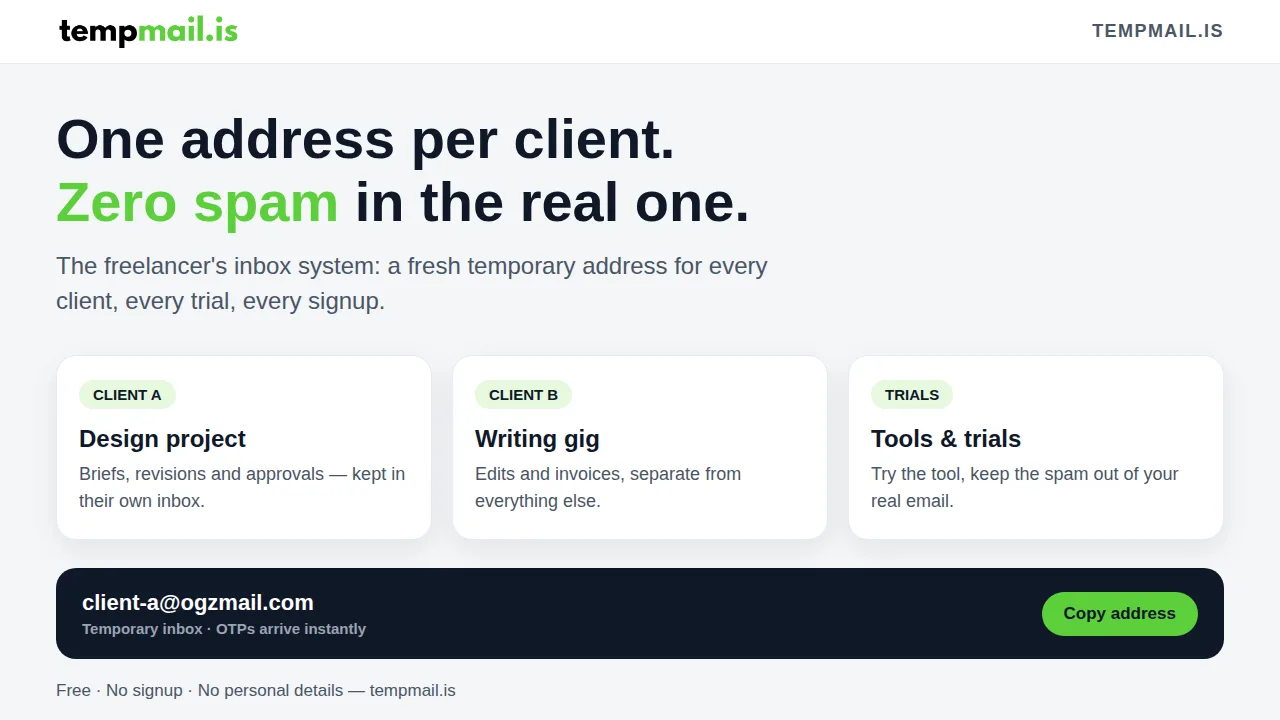
Everything else gets a disposable address from tempmail.is. Tool trials, job boards, template downloads, webinar registrations, anything with the word "free" next to an email field. The contrast is the whole point: one inbox holds a dozen threads of real work, and the disposable addresses absorb the noise. When a trial ends, the address goes with it. There is nothing to unsubscribe from, because I never subscribed with anything that matters.
I want to be clear about what changed, because it wasn't my tools or my discipline. It was the decision, made once, to stop handing the quiet address to noisy services.
How a trial signup actually goes now
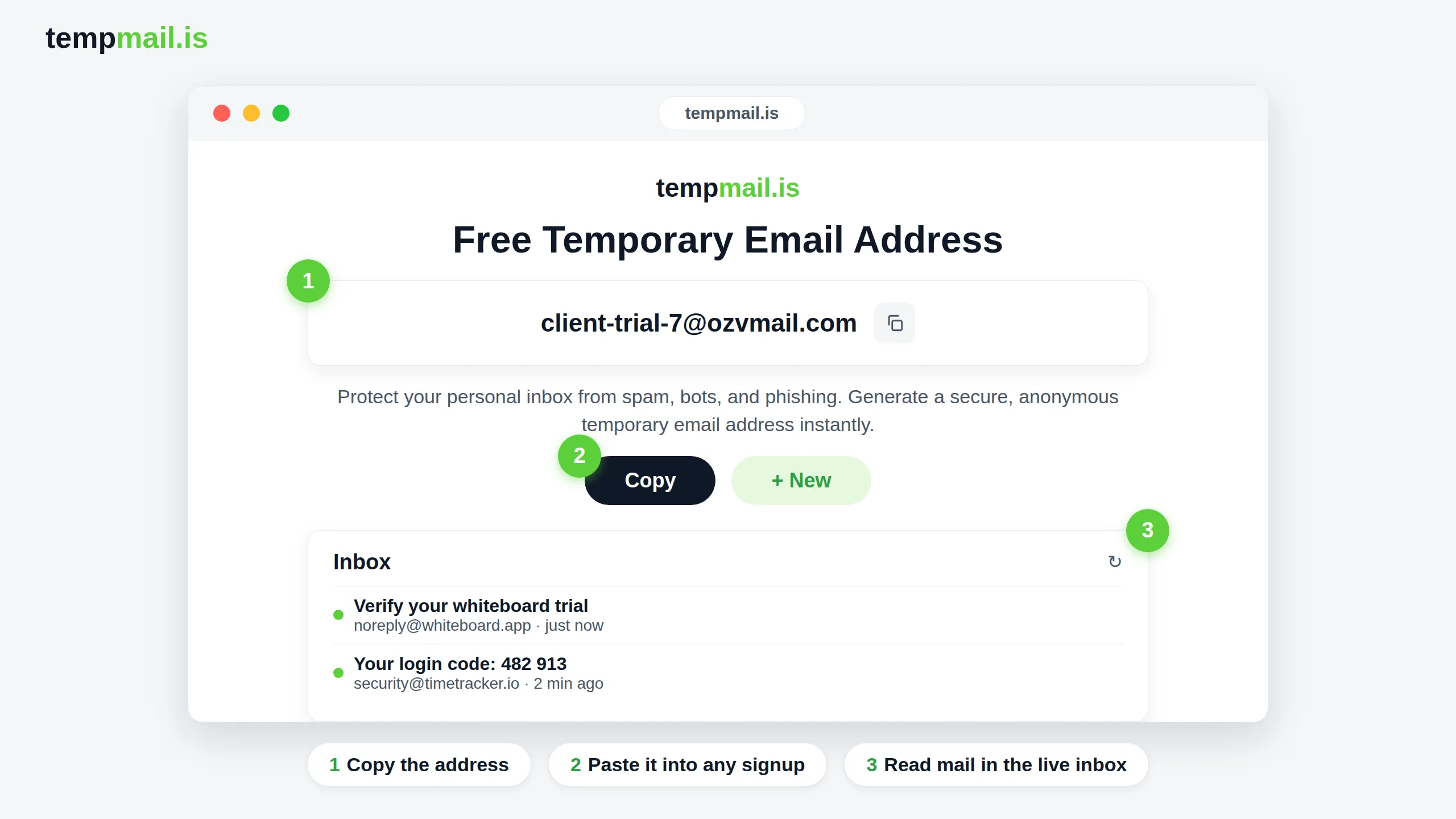
A client asks me to try their team's whiteboard tool for a two-week sprint. I open tempmail.is in a tab. There is a working address waiting, no signup, no password, nothing to install. Sometimes I take the random one; sometimes I type a custom username like "whiteboard-sprint" and pick a domain. I paste it into the tool's signup form.
The confirmation email lands in the inbox on the same tempmail.is page. The inbox refreshes on its own, so I just watch for it, click the magic link or copy the code, and I'm in. I do the work. Two weeks later the sprint ends and I close the tab. The marketing emails that tool will send for the next three years go to an address I no longer open. My real inbox never knew any of it happened.
This works because these aren't ten-minute addresses. The inbox persists, so when the trial stretches to a month, or I need a password reset in week three, the address still works. I keep one disposable address per trial, which has a side benefit I didn't expect: when stray mail arrives, the custom username tells me exactly which tool leaked my address.
Cleaning up the mess you already have
If your real address is already out there, don't despair, but be honest with yourself: you will never unsubscribe your way out. I tried. It took three evenings and the mail kept coming, because half of those senders had shared my address with companies I'd never heard of.
What actually worked was triage. I moved every client and every money-related service into a folder I check first thing in the morning, and I updated the email on file wherever it truly mattered. For everything else, I stopped engaging. I didn't unsubscribe from forty lists; I just stopped opening them, and for all new signups the disposable rule took over. Within two months, the old address quieted down on its own, because the only new mail it received came from humans. The historical spam still exists, but it stopped growing, and that turned out to be enough.
Pro tips from two years of doing this
Give every trial its own address. A custom username like "acme-whiteboard" tells you at a glance who leaked your address when the promotions start.
Keep the browser tab open for the life of the trial. Addresses live in your browser's local storage, which is convenient until you clear it. Then they're gone. For a two-week project, just leave the tab alone.
Quarantine job boards on a single address. Boards are the worst offenders for sharing with "partners." One disposable address for all job alerts keeps the damage in one place you can abandon.
Never put money or contracts on a disposable address. Invoices, payment platforms, signed agreements go to your real address, always. If losing access would cost you money or legal standing, it doesn't belong on a throwaway.
Glance at the disposable inbox once before you walk away. Trial tools love to send the export link or the "your files" email at the exact moment you cancel. Thirty seconds of checking saves a real headache.
The honest limitations
tempmail.is is receive-only. Mail comes in; nothing goes out. You can't reply, which makes it useless for anything conversational. That's fine, because conversations belong on your real address anyway.
Don't use it for banking, government services, healthcare, or anything tied to your legal identity. Those need a permanent, verifiable address, and several of them explicitly forbid disposable ones.
Some picky sites block disposable domains outright. When that happens, I take it as information and move on. It's usually a sign I didn't need that tool badly enough to hand over my real address.
And the browser-data point, once more, because it bites: clear your cookies and site data and your addresses go with them. I learned that the annoying way, mid-trial, on a project I actually cared about.
Questions I get asked
Is it really free? Yes. No trial period, no card, no "free for 14 days." The site is ad-supported.
Will I miss important emails? Only if you put important things on a disposable address, which is exactly what this system prevents. Clients go to the real inbox. Everything else is, by definition, missable.
Can I reply to anything? No. Receive-only, no exceptions. If a trial genuinely needs a reply, that's your signal to either use your real address or skip the tool.
What if a site rejects the address? A few do. I treat it as a filter, not a failure, and find another tool. On the rare occasion something is truly essential, the real address is still there.
Does this work on my phone? The site runs in any mobile browser. I keep it in a pinned tab when I'm traveling for client work.
Try the split for one week
You don't need to reorganize your life to test this. For the next seven days, route every non-client signup to a fresh address from https://tempmail.is and keep your real address strictly for the people who pay you. On Friday, open both inboxes side by side. I'm fairly confident about what you'll see, because it's what I saw: one quiet room where the work happens, and one noisy hallway you can simply stop visiting.