You’ve read the prompt three times, opened a fresh document, and now the cursor is just blinking at you. Sound familiar? That opening line carries more weight than any other in your paper, because it decides whether a reader leans in or starts skimming. Its job is simple: spark interest and point directly at the question you’re about to answer. The best ones are specific, stay close to the prompt, and lead smoothly into your thesis. It’s also the exact spot where most students freeze, which is why so many end up typing “write my essay” into a search bar late at night.
In this post, we’ll walk through how to start essay writing when the page is completely empty, what makes a hook grab attention instead of losing it, and which opening styles fit different types of assignments. You’ll see original example openers for each approach, and we’ll finish with a quick test you can use to check your own before you move on to the rest of the draft.
How do I start my essay writing?
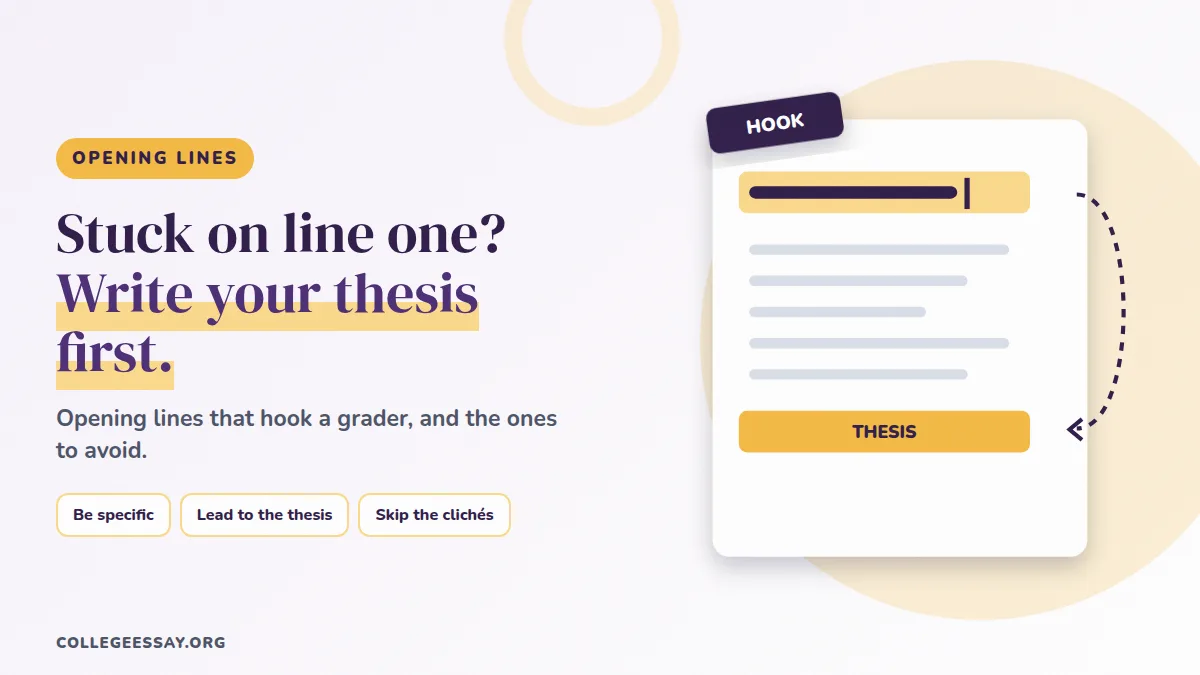
Start with the thesis, not the first sentence, and write the opening line last once you know what it needs to lead into.
The most common reason students cannot start is that they are trying to write the first line before they know what the essay argues. An opening has to point somewhere, and without a thesis there is nowhere for it to point. The result is a sentence that circles the topic in general terms, which is the opening graders find weakest.
Reversing the order solves this. Read the prompt, decide your answer in one sentence and write that down as a working thesis. Then outline the body points that support it. Only once the shape of the argument is clear do you go back and write the line that introduces it. An academic writing service for students works in the same order for the same reason: the opening depends on the argument, not the other way round.
Another way in is to write the question itself at the top of the page and answer it in plain words, as if explaining it to a friend. That rough answer is often a usable working thesis once the casual phrasing is tightened. It also stops the essay drifting toward the general topic, because the question stays visible as you write.
If even the thesis will not come, begin with the body paragraph you understand best. Writing about the point you are most sure of builds momentum and often clarifies the overall argument. Many strong essays are drafted from the middle outward, with the introduction written last.
What is a good opening line for an essay?
One that is specific to the topic, raises the question the essay answers and leads directly toward the thesis within two or three sentences.
A good opening line earns its place by doing work. It might present a surprising fact, describe a concrete case, name the tension at the heart of the debate or state a claim the essay will complicate. What it cannot do is say something true of every essay on the subject, because then it tells the reader nothing about this one.
The list below shows common opening types, an example of each written for a sample prompt about remote work and productivity, and the kind of essay each suits best.
- Specific fact: “Within two years of 2020, the share of US employees working from home at least part of the week had risen from a minority to a sizable portion of the workforce.” Best suited to argumentative and analytical essays.
- Concrete case: “A software team in Ohio shipped more updates in its first fully remote quarter than in any office quarter before it.” Best suited to persuasive and case-based essays.
- Stated tension: “Employers say remote work lowers productivity, while their own output data often says the opposite.” Best suited to compare and contrast and critical essays.
- Direct claim: “Remote work does not reduce productivity; it changes which kinds of work are productive.” Best suited to short argumentative essays.
- Framing question: “If productivity rose when offices closed, why are so many companies asking staff to return?” Best suited to exploratory and reflective essays.
Each of these narrows the topic immediately. The reader knows within one sentence what the essay is about and has a reason to want the answer. That is the whole job of a first line, and it is achievable without any rhetorical flourish.
Which opening lines should you avoid?
Dictionary definitions, sweeping statements about all of history or society, and rhetorical questions with obvious answers.
These openings are common because they feel safe. They are also the ones graders mention most often in feedback, because they delay the essay without adding anything. Recognizing them in a draft is the first step to replacing them.
- The dictionary opening: starting with what a word means, which the reader already knows
- The sweeping opening: claims about all of human history, every society or the beginning of time
- The empty question: a rhetorical question the reader can answer with "yes" and move on
- The announcement: "This essay will discuss", which tells the reader the topic but not the argument
- The borrowed quotation: a famous line with no clear link to the specific question
Each of these can be fixed by asking what the essay actually argues and starting closer to it. A definition becomes a point about how a term is contested in the field. A sweeping claim becomes a specific case. An announcement becomes a direct statement of the thesis.
Students who rewrite an opening many times and still find it flat sometimes decide to get my essay written for me as a model, because seeing an introduction built on their own prompt shows how the first line, the context and the thesis connect in a way generic advice does not.
How should the first sentence lead into the rest of the introduction?
The first sentence opens the topic, the next one or two narrow it to the question, and the last sentence of the paragraph states the thesis.
A strong introduction moves from general to specific in a short space. The opening line catches attention and sets the subject. The middle sentences give just enough context for the question to matter, such as a key term, a brief background or the debate the essay enters. The final sentence states the position the essay will defend.
The discipline matters too. A history essay often opens with a specific event or date, a literature essay with a moment in the text, and a science or social science paper with a finding or a problem the research addresses. Matching the opening to the conventions of the subject signals that the writer understands the field.
That structure keeps the introduction short. For an undergraduate essay of 1,500 to 2,000 words, three to five sentences is usually enough. A longer introduction tends to drift into material that belongs in the body, which weakens both.
The site's guide on writing an essay introduction walks through this structure sentence by sentence, with attention to how the context sentences should be chosen so they lead to the thesis rather than away from it.
A model paper shows the same pattern working on a real prompt. CollegeEssay.org delivers papers written to the student's brief by a writer assigned according to the assignment type, so the opening that arrives is built for the exact question the student was set, and the student can see how the first line leads into the thesis and then into the first body paragraph.
How can you test your own opening line?
Ask whether it could open any essay on the topic; if it could, it is not specific enough.
This single test catches most weak openings. A line about the importance of education could start a thousand essays. A line about a specific policy change and its measured effect could start only a few. The narrower the line, the more it tells the reader about your essay in particular.
Read the opening aloud as well. A first sentence that is hard to say in one breath is usually trying to do too much, and splitting it into two shorter sentences makes both clearer. Readers form an impression of the writing in the first few seconds, and a clean, direct line sets a better tone than an elaborate one.
Two further checks help. Read the first sentence followed immediately by your thesis. If the jump feels abrupt, the middle sentences need to do more bridging. If the first sentence already contains the thesis, consider whether a hook before it would draw the reader in, or whether a direct opening suits the essay better.
Frequently asked questions
How do you write a hook for an essay?
Choose something specific that raises the question your essay answers, such as a concrete fact, a short case or a clear tension. Keep it to one sentence and make sure it leads toward the thesis. A hook that entertains but does not connect to the argument costs more than it gains.
Should an essay start with a question?
Sometimes, if the question is genuine and the essay answers it. Rhetorical questions with obvious answers weaken an opening. A framing question that sets up a real tension can work well, especially in exploratory or reflective essays.
Is it acceptable to start an essay with a quote?
Only if the quotation is directly relevant to the specific question and you explain its significance immediately. A famous line chosen for its sound rather than its relevance is one of the most commonly criticized openings.
How long should the first paragraph of an essay be?
For most undergraduate essays, three to five sentences, ending with the thesis. Longer introductions often include material that belongs in the body. Graduate essays and longer papers may need more context, but the principle of moving quickly to the thesis still applies.
When should I write the introduction?
Many writers draft it last, after the body is complete and the argument is settled. Writing it first is fine, but expect to revise it once you know exactly what the essay argues, because the opening has to fit what follows.
TL;DR
The first sentence of an essay works when it is specific, tied to the question and leads to the thesis within a few lines, while dictionary definitions, sweeping claims and empty questions waste the reader's attention. Settle the thesis first and write the opening last. A model paper from CollegeEssay.org, written to the student's own brief, shows an opening built for the exact prompt and how it leads into the argument.