The Digital Kitchen Revolution: Mastering Ghost Kitchens and Virtual Brand Strategy
The restaurant industry has entered a new era where a physical dining room is no longer essential for building a successful food business. Ghost kitchens, also known as cloud kitchens, virtual kitchens, or dark kitchens, have transformed how restaurants prepare, market, and deliver food.
Instead of investing heavily in dining areas, décor, front-of-house staff, and prime retail locations, ghost kitchens focus on what matters most in the delivery model: efficient food preparation, consistent quality, technology, and fast fulfillment.
The rise of virtual brands has taken this concept even further. A single commercial kitchen can operate multiple food concepts under different brand names, allowing operators to reach different customer segments while sharing equipment, ingredients, staff, and infrastructure.
However, operating multiple brands from one kitchen requires careful planning. From menu engineering and kitchen workflow to packaging, delivery, technology, and expansion, every part of the operation needs to work together.
What Is a Ghost Kitchen?
A ghost kitchen is a professional food preparation facility designed primarily for takeaway and delivery orders rather than dine-in customers.
A traditional restaurant typically requires a dining area, tables, service staff, reception space, décor, and a customer-facing location. A ghost kitchen eliminates many of these requirements and concentrates investment on the back-of-house operation.
This makes the model particularly attractive for:
- Food entrepreneurs testing new concepts
- Established restaurants launching additional brands
- Delivery-focused businesses
- Cloud kitchen operators
- Catering and food-service companies
- Restaurants looking to enter new locations with lower capital requirements
The real advantage is not simply having a smaller restaurant. It is the ability to create a highly optimized food production environment designed around delivery demand.
Multi-Brand Management: Maximizing One Kitchen
One of the biggest advantages of a ghost kitchen is the ability to operate multiple virtual restaurant brands from the same facility.
For example, one kitchen could operate a gourmet burger concept during lunch and dinner, a chicken wings brand in the evening, and a dessert concept for late-night orders. The brands appear separately on delivery platforms while sharing much of the same infrastructure.
Engineer Menus Around Shared Ingredients
Menu engineering is essential when multiple brands operate from one kitchen.
Complementary brands can share ingredients without appearing identical to customers. Chicken, sauces, vegetables, buns, cheese, potatoes, and other ingredients can potentially be incorporated into different menus.
This approach can reduce unnecessary inventory, simplify purchasing, improve ingredient utilization, and help reduce food waste.
Target Different Customer Segments
Virtual brands also allow operators to address different customer needs.
One concept might focus on healthy bowls, while another specializes in comfort food. A third could target desserts or late-night snacks.
Rather than relying on one menu to appeal to everyone, operators can develop focused concepts for specific occasions, preferences, and customer segments.
Optimize Labor Across Brands
Staff can also be cross-trained to prepare products for multiple brands.
Instead of maintaining completely separate teams, kitchen employees can be trained in common preparation, cooking, assembly, and packaging procedures. Demand forecasting can then help managers schedule employees according to busy and quiet periods.
The objective is to keep the kitchen productive without unnecessarily increasing labor costs.
Creating an Efficient Shared Kitchen Workflow
Running several menus from the same kitchen can create operational challenges. Without a clear workflow, multiple orders can quickly lead to preparation delays, incorrect items, and packaging mistakes.
The solution is to design the kitchen around the actual movement of food and orders.
Create Dedicated Preparation and Assembly Zones
Shared cooking equipment can be highly efficient, but final assembly and packaging should be organized carefully.
Dedicated or clearly identified preparation areas for individual brands can reduce confusion. Color-coded containers, labels, storage systems, and packaging stations can help employees quickly identify which ingredients and packaging belong to each concept.
Food safety should remain a priority throughout the process, particularly when different ingredients and menus are being handled simultaneously.
Invest in Commercial Kitchen Equipment
The right commercial kitchen equipment forms the operational foundation of a ghost kitchen.
Depending on the menu, operators may require commercial fryers, ovens, grills, refrigeration, freezers, food preparation equipment, stainless-steel worktables, food storage systems, and other specialized equipment.
Equipment selection should be based on menu requirements, expected order volume, available kitchen space, energy consumption, and maintenance requirements.
The goal is not simply to buy more equipment. It is to build a kitchen where each piece of equipment contributes to efficient production.
Technology Is the Backbone of a Modern Ghost Kitchen
Technology connects the different parts of a delivery-focused kitchen.
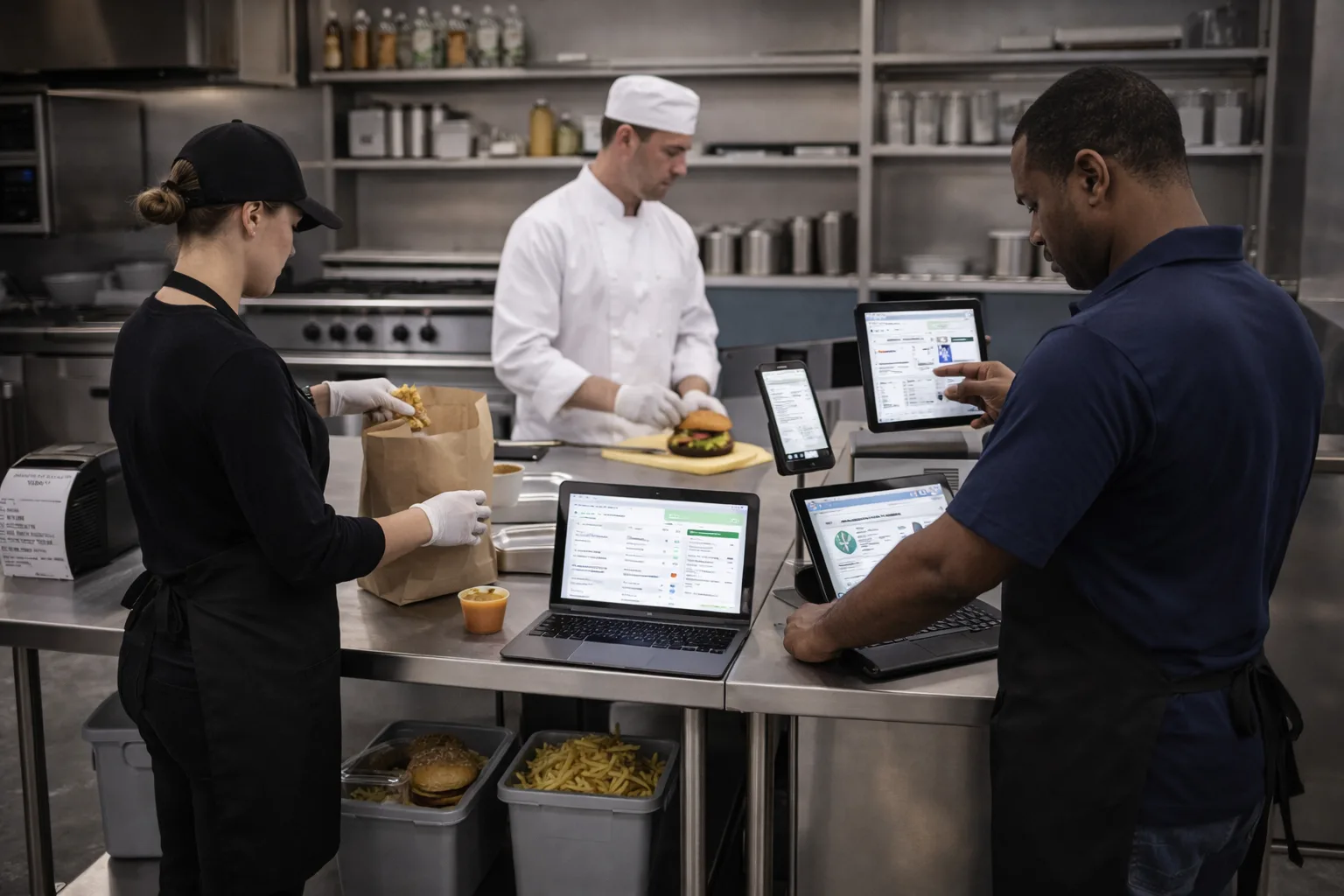
An order management system can consolidate orders from multiple delivery platforms into a centralized workflow. Instead of employees constantly monitoring different tablets, orders can be routed into one system.
A Kitchen Display System (KDS) can then organize orders according to preparation requirements, priority, and pickup timing.
Integration between the POS system and inventory management platform can provide better visibility into ingredient consumption and food costs. Managers can identify which ingredients are being used most frequently and monitor inventory levels more accurately.
For multi-brand operators, technology also makes it easier to compare the performance of individual virtual brands and determine which menu items generate the most demand.
Delivery Is Part of the Customer Experience
For a ghost kitchen, the customer may never visit the physical facility. The delivery order is therefore the primary interaction between the customer and the brand.
That makes speed, accuracy, presentation, and packaging extremely important.
Design Menus for Delivery
Not every dish performs well after spending 20 or 30 minutes in a delivery container.
Ghost kitchen operators should prioritize dishes that maintain their temperature, texture, appearance, and flavor during transportation.
Menus should also be easy to understand on delivery platforms. High-quality food photography and concise descriptions can help customers make purchasing decisions quickly.
Use Appropriate Packaging
Packaging should protect food while reinforcing the identity of the brand.
Containers need to be appropriate for the food being transported. Fried products, sauces, beverages, desserts, and hot meals may require different packaging solutions.
Tamper-evident seals can provide additional security, while branded labels and packaging can help create a recognizable customer experience.
For delivery businesses, packaging is effectively part of the storefront.
Build a Direct Ordering Channel
Third-party delivery platforms can provide valuable visibility and access to large customer bases, but depending entirely on external platforms can make it difficult for a business to control customer relationships and delivery economics.
Developing a first-party ordering channel through a website or app can give operators greater control over the customer experience.
Businesses can encourage direct ordering through loyalty programs, promotional offers, exclusive menu items, or other incentives.
A direct channel can also provide valuable first-party customer data that can support future marketing and retention strategies.
Scaling a Ghost Kitchen Business
One of the most attractive features of the ghost kitchen model is its potential for expansion without replicating the full structure of a traditional restaurant.
Start With an Asset-Light Model
Entrepreneurs can consider shared commercial kitchens, commissary kitchens, or host-kitchen arrangements rather than immediately investing in a large standalone facility.
This can reduce the initial investment associated with property, dining-room construction, furniture, and front-of-house operations.
Expand Based on Delivery Demand
Once a virtual brand demonstrates consistent demand, operators can evaluate new locations based on customer density, delivery times, order volumes, and market opportunities.
Opening additional kitchen locations can bring production closer to customers and potentially improve delivery efficiency.
Use Data to Test New Concepts
Data is one of the most valuable assets in a digital food business.
Operators can analyze order volumes, customer preferences, average order values, popular dishes, repeat purchases, and peak ordering periods.
If a virtual brand consistently underperforms, the concept can be modified, repositioned, or replaced without requiring the complete transformation of a traditional restaurant.
This flexibility allows ghost kitchen operators to experiment with new concepts while using existing infrastructure.
The Future of Ghost Kitchens
Ghost kitchens represent more than a change in restaurant format. They represent a shift toward data-driven, technology-enabled food production.
The combination of virtual brands, shared commercial kitchen infrastructure, specialized equipment, digital ordering, automated workflows, and delivery-focused menus allows businesses to operate with a different cost and efficiency structure than traditional restaurants.
However, technology alone does not guarantee success. A profitable ghost kitchen still depends on food quality, effective menu design, reliable equipment, food safety, trained employees, accurate order fulfillment, and a strong customer experience.
For operators planning to enter this market, the most important question is not simply how many brands a kitchen can support. It is how effectively the kitchen can produce consistent food across multiple concepts while maintaining quality and controlling operational costs.
Conclusion
Building a successful ghost kitchen starts with choosing the right equipment for efficient, flexible, and high-volume food production. If you are looking for a reliable Kitchen Equipment Supplier in Dubai, explore professional commercial kitchen solutions from KitchenHub, designed to support modern restaurants, cloud kitchens, and virtual brands.