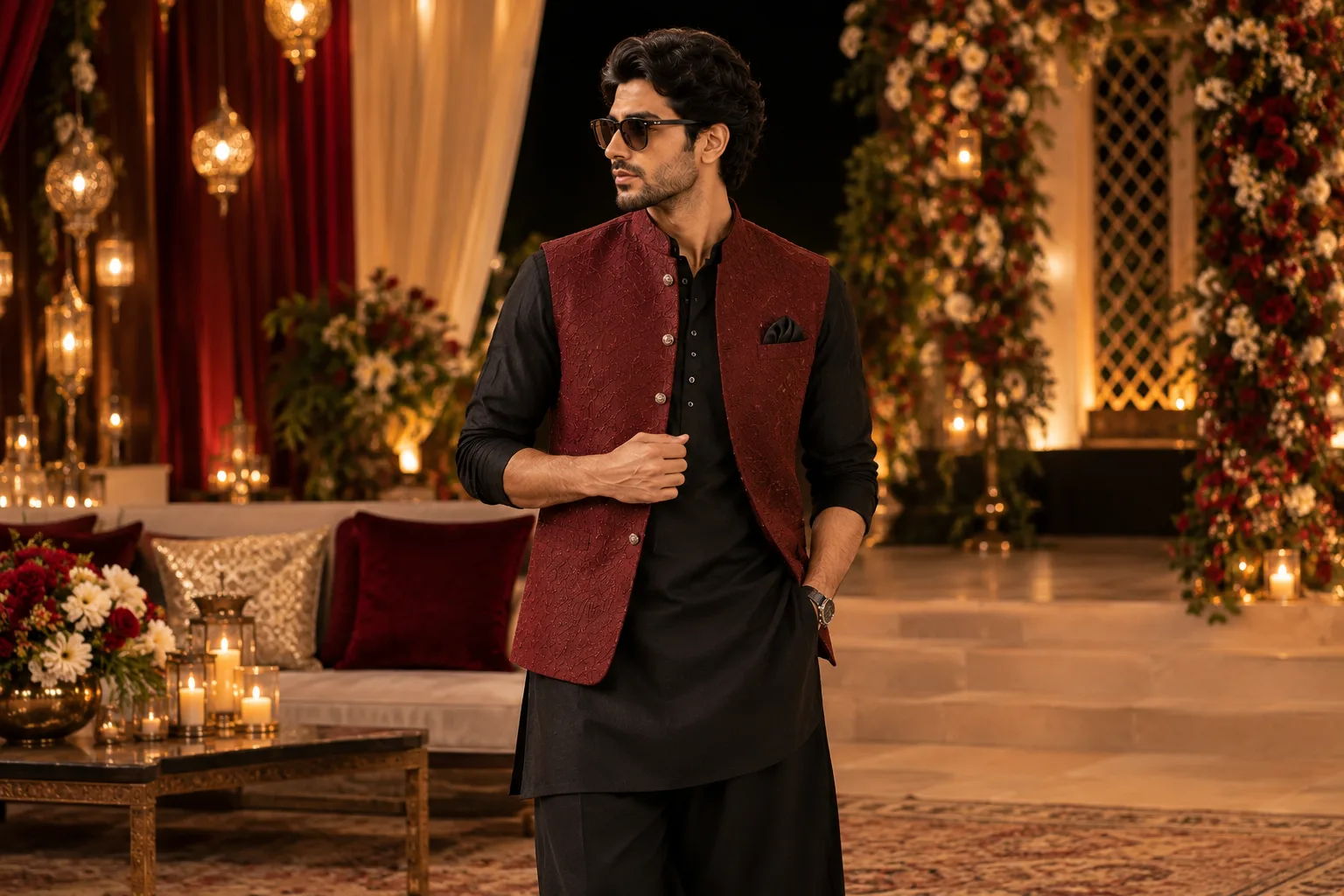
The dhol had already started in the courtyard by the time my cousin Aryan finally stepped out of his room, and for a moment, the entire hallway seemed to pause. Not because he was late - though he was, characteristically - but because of the way he looked walking down those stairs. Black kurta pyjama, sharp and understated, layered beneath a red embroidered Nehru jacket that seemed to carry its own quiet fire. He wasn't dressed for a party. He looked dressed for a memory in the making.
I remember thinking, watching him adjust his cuffs at the bottom of the stairs, that there's a reason sangeet nights ask something different of the men in the family than any other function does. It isn't the wedding day, with all its solemnity. It isn't the reception, with its polish and formality. The sangeet is joy, unfiltered - dance, laughter, old songs sung badly and loved fully - and the clothes worn that night need to move the same way the evening does.
Why Layering Tells a Story
There's a certain magic in textured layering that flat, single-piece outfits simply can't replicate. A well-layered ensemble doesn't just dress a man; it gives him depth, the way a good story has layers beneath its surface. The base - in Aryan's case, a black kurta pyjama - sets the tone: grounded, timeless, quietly confident. It's the kind of foundation that doesn't need embellishment to hold its own in a room.
Then comes the layer that changes everything.
A jacket isn't just an accessory on a sangeet night. It's punctuation. It's the moment in the story where the tone shifts, where restraint gives way to celebration. And when that jacket is a red embroidered Nehru jacket, structured but never stiff, the effect is almost cinematic - a splash of colour against black, catching the fairy lights strung across the courtyard, moving with him as he laughed, as he danced, as he pulled his little niece onto the floor for an impromptu twirl.
The Black Kurta Pyjama & Red Embroidered Nehru Jacket: Contrast as Craft
What made Aryan's outfit unforgettable wasn't loudness. It was contrast, handled with restraint. The black kurta pyjama did the quiet work - sleek lines, understated texture, the kind of piece that looks effortless precisely because so much care went into getting it right. Against that stillness, the red embroidered Nehru jacket became the heartbeat of the outfit, its embroidery catching light with every movement, its collar structured just enough to add a note of formality without losing the celebratory spirit of the night.
This is textured layering at its finest - not simply stacking fabrics, but building contrast that tells a story. Matte against detail. Stillness against movement. Tradition against a flash of contemporary boldness. It's the difference between an outfit that photographs well and one that people remember years later, describing it to others the way we still describe Aryan's that night: "You should have seen him - black kurta, red jacket, embroidery catching the light like something out of a film."
It's this exact philosophy - restraint paired with intention - that has become something of a signature for See Designs, a name that understands sangeet dressing isn't about excess, but about knowing precisely where to place the shimmer, the colour, the detail that makes an outfit sing.
More Than Fashion - A Family Watching
I think what moved me most that night wasn't the outfit itself, but watching my uncle - Aryan's father - see him for the first time dressed like that. He didn't say much. He rarely does. But he reached out, straightened the collar of the Nehru jacket that didn't need straightening, and said quietly, "You look like your grandfather did at my sangeet."
Aryan didn't know what to say to that. None of us did, really. But something shifted in the air - the kind of moment that happens maybe once or twice at a wedding, when clothing stops being fabric and becomes inheritance. The black kurta pyjama and red embroidered Nehru jacket weren't just well-chosen festive wear anymore. They were a thread connecting three generations of men who had stood in that same courtyard, dressed for love, dressed for family, dressed for nights exactly like this one.
Dancing in Layers
By midnight, the dhol was still going, and Aryan had long since abandoned any pretense of composure, dancing with his sisters, his college friends, his eighty-year-old grandmother who insisted on one more song. And through it all, the outfit held - the jacket swaying with him rather than against him, the embroidery glinting under string lights, the black base staying grounded no matter how wild the dancing got.
That's the quiet genius of textured layering done right. It doesn't restrict celebration. It participates in it.
As the night wound down and guests began drifting toward chai and warm jalebi, I caught Aryan for a moment, breathless and grinning, jacket slightly askew from hours of dancing. "Worth it?" I asked, nodding at his outfit.
He looked down at himself, at the red embroidery catching one last flicker of fairy light, and smiled the way people do when words feel unnecessary.
Some outfits are chosen for how they look in photographs. Others, like this one from See Designs, are chosen for how they make you feel when you're dancing in them, surrounded by everyone who's ever loved you - layered, textured, and quietly, unforgettably yours.