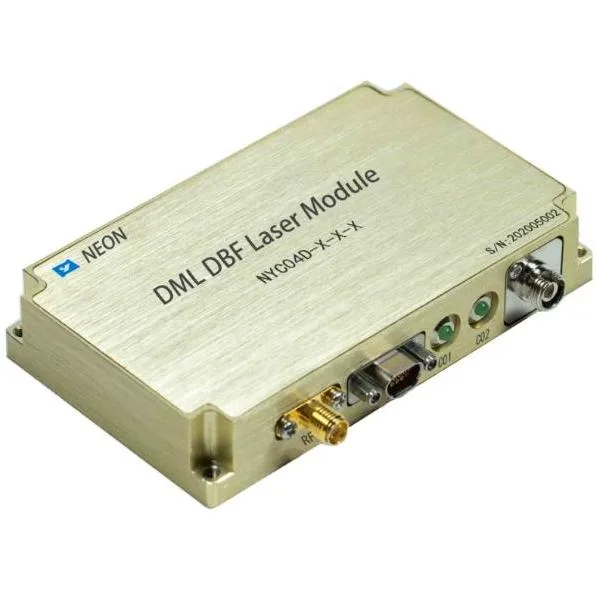
While much of the discussion around fiber optics focuses on long-distance telecommunications, some of the most exciting growth areas are in short-range, high-precision sensing and localization. Specifically, the application of UWB directly modulated transmitter technology has expanded beyond traditional communications into Real-Time Location Systems (RTLS) and industrial automation. In these domains, the goal is not just to send data, but to measure the physical world with centimeter-level accuracy. By leveraging the ultra-wideband nature of the signal, a UWB directly modulated transmitter can generate extremely short RF pulses—sometimes just nanoseconds in duration. When these pulses are distributed via fiber using a UWB directly modulated transmitter, the system can calculate the time-of-flight (ToF) of the signal with incredible precision, enabling accurate positioning even in complex, GPS-denied environments like warehouses, hospitals, and factories.
The application of UWB directly modulated transmitter in RTLS offers significant advantages over traditional technologies like Wi-Fi, Bluetooth, or passive RFID. Wi-Fi and Bluetooth typically provide accuracy in the range of 1 to 5 meters, which is insufficient for locating a specific tool on a shelf or tracking an automated guided vehicle (AGV) through a narrow aisle. UWB, in contrast, can achieve accuracy within 10 to 30 centimeters, and in some cases, even better. This high precision is possible because the UWB directly modulated transmitter produces signals with a very wide bandwidth (hence "ultra-wideband"). According to the Shannon-Hartley theorem, bandwidth is directly related to the maximum data rate, but for positioning, the wide bandwidth translates to a very narrow pulse in the time domain. A UWB directly modulated transmitter can generate pulses with rise times measured in picoseconds, allowing the receiver to measure the exact time the pulse arrived. Multiply that time-of-flight by the speed of light, and you get distance.
Furthermore, the application of UWB directly modulated transmitter in industrial environments is uniquely resilient to multipath interference. In a factory with metal shelves, machinery, and concrete walls, radio signals bounce around, creating multiple delayed copies of the same signal. Narrowband systems (like Wi-Fi) struggle to distinguish the direct signal from the reflected ones, leading to "ghost" readings. UWB signals, because they are so short in duration, arrive and are gone before most reflections even occur. The receiver can easily identify the first-arriving pulse (the direct path) and ignore the later reflections. This makes a system built around a UWB directly modulated transmitter far more reliable in cluttered industrial spaces. For example, an AGV navigating a warehouse can trust its UWB-based positioning system to know its location within centimeters, even as it passes through a canyon of tall metal racks.
Beyond positioning, the application of UWB directly modulated transmitter extends to high-speed, short-range data transfer. In industrial automation, there is a growing need to transmit sensor data from rotating machinery (like a wind turbine blade or a robotic arm) where wires cannot be used. A UWB directly modulated transmitter paired with a fiber-optic rotary joint can transmit data from the rotating platform to the stationary processing unit without wireless interference. Similarly, in wireless personal area networks (WPANs), a UWB directly modulated transmitter can support streaming of high-definition video from a laptop to a projector, or fast file transfers between smartphones, all while consuming very little power. As the Internet of Things (IoT) expands, the combination of precise location sensing and high-speed data transfer provided by the application of UWB directly modulated transmitter will enable new classes of smart devices, from surgical navigation tools in hospitals to inventory drones in logistics centers. By providing the hardware backbone for these systems, NEON’s UWB transmitter modules are quietly powering the next generation of connected, automated, and location-aware technology.