
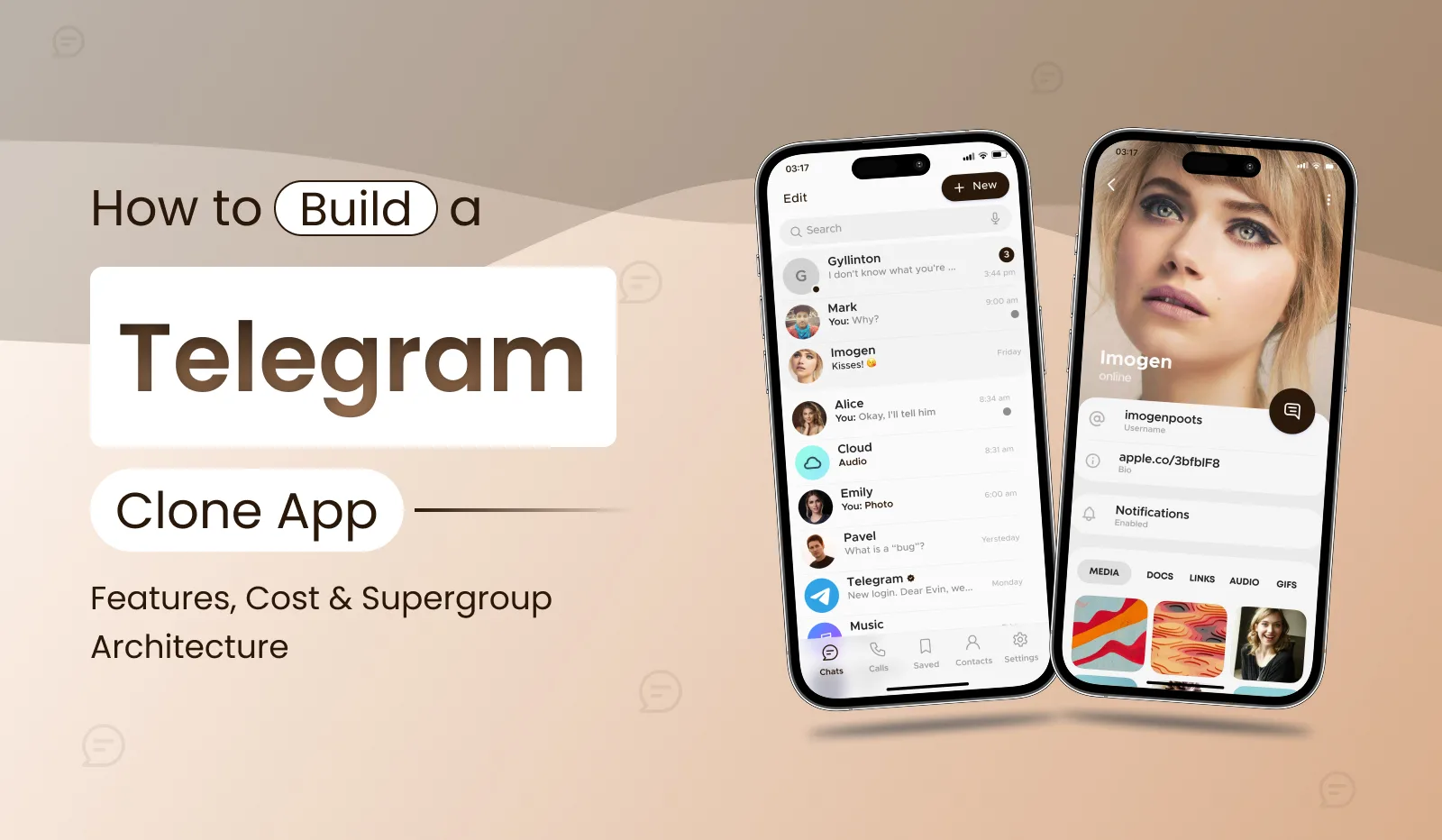
Telegram’s defining architecture decisions — server-side encrypted cloud storage, supergroups scaling to 200,000 members, broadcast channels with no algorithm, and a first-class bot API — are not coincidences. Each one was chosen deliberately to enable features WhatsApp’s E2E encryption model cannot support. Understanding why these decisions were made is how you build a platform that actually scales.
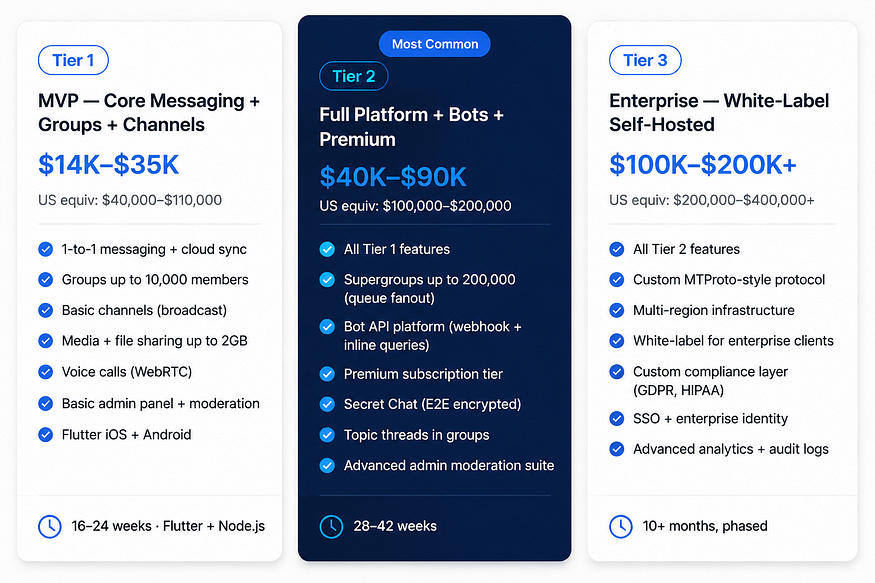
Telegram clone costs $14,000–$35,000 for an MVP (1-to-1 messaging, groups up to 10,000 members, media sharing up to 2GB, cloud message sync, basic channels, voice calls) at India development rates. A full-featured platform with supergroups up to 200,000 members, a bot API platform, premium subscription tier, and advanced admin moderation costs $40,000–$90,000. An enterprise platform with MTProto-style custom protocol, multi-region infrastructure, and white-label capability costs $100,000–$200,000+. US agencies quote $40,000–$150,000 for the same scope. The key architectural decision before any feature discussion: server-side encryption or end-to-end? This choice determines everything that follows. See our full WhatsApp vs Telegram vs Signal comparison →
Telegram has 700 million monthly active users and a product philosophy that deliberately chose tradeoffs most people misunderstand. Its server-side encryption is widely described as “less private than WhatsApp” — which is technically accurate but misses the point of why Telegram made that choice. Server-side encryption enables supergroups with 200,000 members, cloud sync across every device without re-sending message history, channels with unlimited subscribers, 4GB file transfers, and a programmable bot API that businesses and developers have built entire ecosystems on. Each of these features is structurally impossible with end-to-end encryption by default.
If you’re building a Telegram-style platform, the first question is not “which features should I include?” It’s “which encryption model does my product actually need?” — because the answer to that determines your entire backend architecture, your message storage strategy, your multi-device sync design, and your group scaling approach.
700M+
Telegram monthly active users
200K
Max members per supergroup
$150B+
Messaging app market by 2030
$14K
MVP starting cost (India rates)
4GB
Max file size — enabled by server-side arch
Server-Side vs End-to-End Encryption App
This is not a philosophical debate about privacy. It’s an architectural decision that determines what your platform can and cannot do. Choosing the wrong model for your product’s actual requirements is the most expensive mistake in messaging app development — because it requires rebuilding the storage and delivery layers to fix.
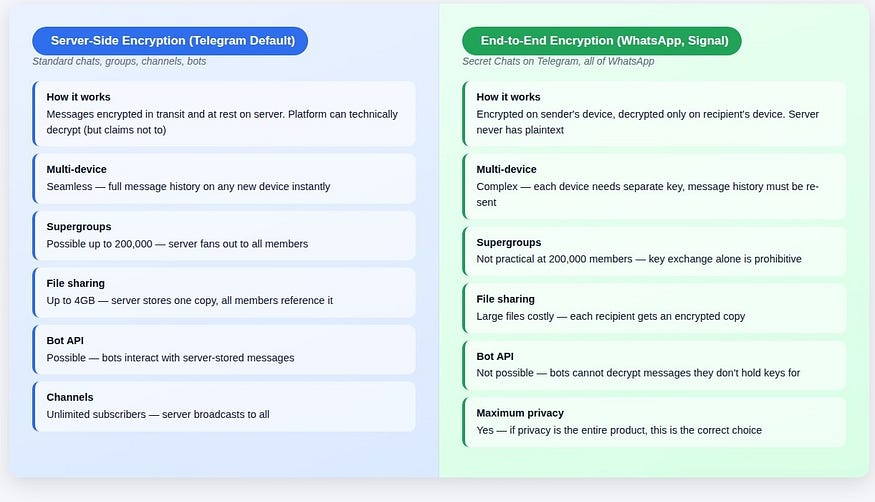
The nuanced truth about Telegram Secret Chats: Telegram offers both models simultaneously. Standard chats use server-side encryption — they sync across all your devices, persist in the cloud, and support all the features Telegram is known for. Secret Chats use device-to-device end-to-end encryption (using Diffie-Hellman key exchange) — they live only on the two specific devices involved in the conversation, don’t sync to the cloud, and can use self-destruct timers. If you’re building a Telegram-style platform, you can implement the same hybrid: server-side by default for feature richness, with optional E2E Secret Chat mode for users who need maximum privacy. See our E2E encryption implementation guide →
DMs, Groups & Channels: 3 Core Messaging Surfaces
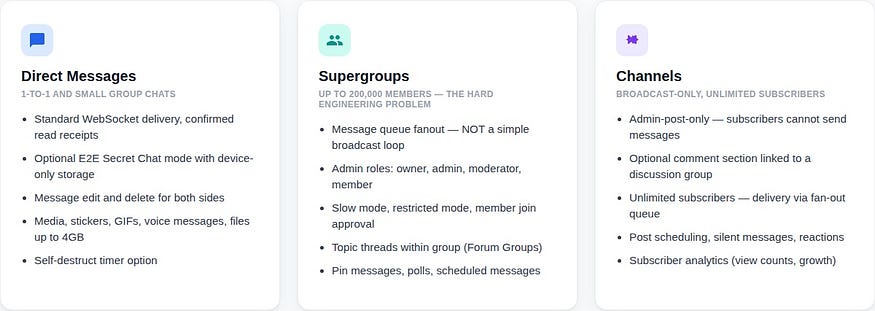
A Telegram-style platform isn’t one product — it’s three distinct communication surfaces with different data models, different permission systems, and different backend requirements. Building all three as variations of the same implementation is the fastest path to a platform that performs poorly at scale on all three.
Telegram Supergroup Architecture Explained
This is the section most Telegram clone guides skip entirely. Delivering a message to a WhatsApp-style group with 1,024 members using a loop iteration takes milliseconds. Delivering a message to a supergroup with 200,000 members using the same approach takes minutes — and that’s before accounting for the concurrent load of thousands of other groups sending messages simultaneously.
Why Naive Message Fanout Breaks at Scale
A naive implementation of group message delivery iterates through the member list, sends each member a push notification, and inserts a message receipt into each member’s inbox. At 1,024 members, this runs in milliseconds. At 200,000 members — and Telegram supergroups can reach exactly this — the sequential iteration alone would take minutes, and any server processing concurrent messages from other groups at the same time would be saturated. This is why Telegram’s architecture uses a different approach for supergroups than for small group chats.
Message Queue Fanout: The Correct Architecture

Worker processes subscribe to the group’s channel in Redis pub/sub. Each worker handles a batch of member notifications in parallel — not sequentially. At 200,000 members, delivery is eventually consistent rather than instantaneously simultaneous, which is acceptable. The key insight: separate the message ingestion (fast, synchronous) from the message fanout (parallel, async).
Channels vs Supergroups — different data models, same need for async fanout: Telegram channels have unlimited subscribers. A channel with 5 million subscribers receiving a post needs to deliver that post to 5 million people — a task that’s structurally identical to the supergroup problem at even larger scale. Channel delivery uses the same Redis pub/sub or message queue pattern, but with two important differences: channel messages are stored once on the server (all subscribers read from the same stored message, not individual copies in each inbox), and delivery to subscribers who are offline is handled by push notification services with no expectation of immediate simultaneous arrival. The data model for channels is also simpler — no per-member read receipt tracking at the channel level, just aggregate view counts. This makes channels technically easier to scale than supergroups despite having more potential subscribers.
Telegram Bot API Development Explained
Telegram’s Bot API is the reason businesses adopted Telegram at scale. Over 10 million bots run on Telegram , handling customer support, payment processing, content delivery, community moderation, appointment booking, and hundreds of other automated workflows. Building a bot platform on your custom messaging app is the single feature that most raises its attractiveness to business users and developers — and it’s the feature most Telegram clone guides describe in one sentence while calling it “bot integration.”
What a Bot Platform Actually Requires
A bot in a Telegram-style platform is an account that behaves like a user but is controlled by an external application via a webhook or polling mechanism. When a user sends a message that @mentions a bot or sends to a bot’s private chat, your server forwards that message to the bot’s registered webhook URL. The bot processes it and sends a response back through your server’s API. This requires a dedicated Bot API endpoint separate from your user-facing API, webhook registration and validation, rate limiting per bot to prevent abuse, inline query support (allowing bots to respond to queries typed in any chat), callback query handling for interactive button responses, and an admin dashboard where bot creators can manage their bot’s profile, token, and permissions.
Why a bot API turns your messaging platform into a distribution channel When Telegram released its Bot API in 2015, third-party developers built bots that attracted users to Telegram communities — not the other way around. A news bot that delivers curated content attracts readers who join the channel and stay for other content. A customer support bot for a business converts that business’s customers into platform users when they interact with the bot. A payment bot enables transactions entirely within the chat interface. Each bot built by a third-party developer is a distribution mechanism for your platform at zero marketing cost on your side. Building a bot API is a significant engineering investment — roughly 6–10 weeks of additional development — but the ecosystem it enables is one of the most durable competitive moats in messaging.
Get Your Telegram Clone App Cost Estimate
Share your target market and feature list — we’ll reply with a fixed-price quote covering supergroups, channels, and bot API within 24 hours.
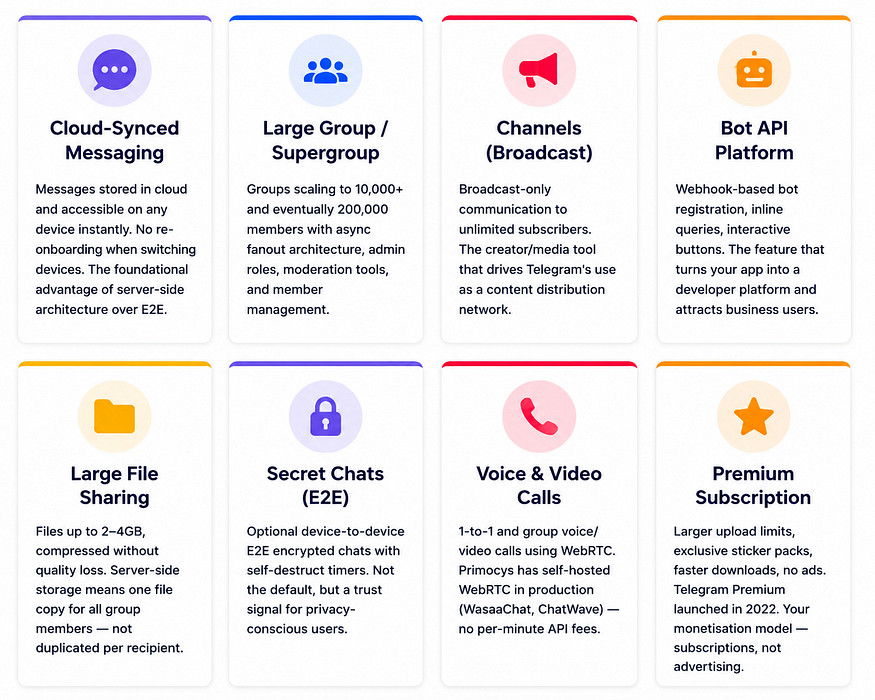
Telegram Clone App Features You Need
Here are the core Telegram clone app features to scope for your MVP, plus the Phase 2 additions worth planning for but not building first.
Niche Strategy to Compete With Telegram
Telegram has 700 million monthly active users, a free and open API, 10 years of architectural refinement, and a brand that specifically attracts privacy-conscious users. A new general-purpose messaging platform competing with Telegram for the same general audience has no realistic path to those numbers. The opportunities in 2026 are in specific markets where Telegram’s horizontal model serves users poorly or where regulatory, compliance, or data sovereignty requirements create a gap Telegram cannot fill.
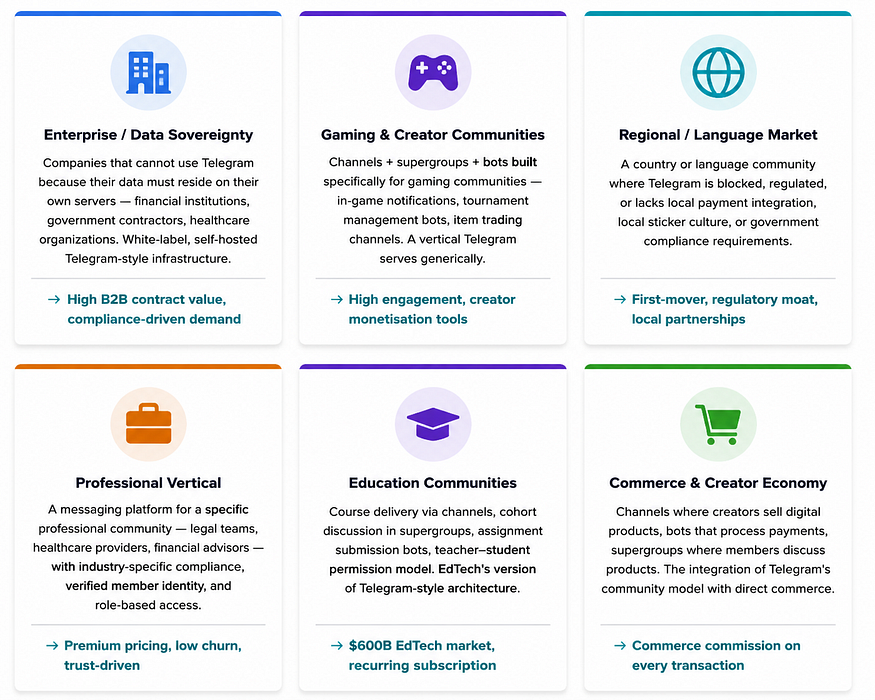
“Telegram’s open API is simultaneously its biggest gift and the clearest signal of what you shouldn’t build. If you can build it on Telegram’s existing infrastructure for free, there’s no business case for building a standalone clone. The business case is what Telegram can’t do — enterprise data sovereignty, regulated industry compliance, regional market localisation, or vertical-specific features that a horizontal platform will never prioritise.”
Telegram Clone App Development Cost by Tier
Messaging App Development Tech Stack
The tech stack choices below reflect what real-time messaging app development at Telegram’s scale actually needs at each layer — not a generic mobile app stack.
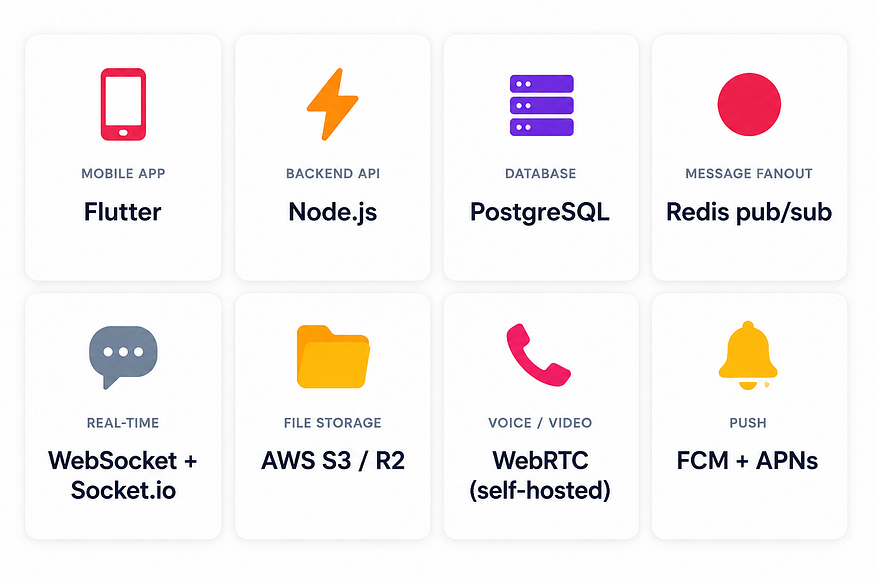
Why Redis pub/sub is the specific technology choice for supergroup fanout: Redis pub/sub allows publishers (your message ingestion server) and subscribers (your delivery worker pool) to communicate asynchronously without either needing to know about the other. When a message arrives in a 200,000-member supergroup, the ingestion server publishes it to the group’s Redis channel in a single operation. Multiple worker processes — as many as your server capacity supports — subscribe to that channel and each handles a batch of member notifications in parallel. If your platform grows and a single Redis pub/sub channel becomes a bottleneck at extremely high message volume, you can shard by group ID across multiple Redis instances. This scaling path is well-understood and doesn’t require rebuilding your core architecture. It’s why Redis pub/sub is the correct choice for supergroup fanout, not a simple in-process event emitter that would require single-process delivery. Primocys uses this architecture in WasaaChat and ChatWave’s group messaging infrastructure.
Primocys · Social Commerce & eCommerce App Development
We Build the Full Stack — Shoppable Video, Live Shopping, In-App Checkout
Primocys has built and shipped two real-time messaging apps — WasaaChat and ChatWave — both live on the App Store and Google Play, with self-hosted WebRTC and real production traffic. The supergroup fanout pattern, the Redis pub/sub architecture, the large file storage design — we’ve built it. Fixed price from $14,000, full source code.
Shoppable video architecture
HLS delivery, product tag system, recommendation engine instrumented from day one.
Live shopping infrastructure
RTMP ingest + real-time inventory reservation — concurrent oversell prevention designed in.
Stripe Connect correctly
Multi-seller split payments, commission deductions, seller payouts — no DIY marketplace payment logic.
Niche-first strategy advice
We’ll help you scope the vertical or creator community your platform serves, not a generic TikTok Shop clone.
Flutter + Next.js full stack
Mobile-first buyer app in Flutter, Next.js seller dashboard. One team coordinated delivery.
Fixed price from $20,000
Cost agreed before development starts. Milestone payments. Full source code ownership.
Conclusion: Building Your Telegram Clone App
A Telegram clone app is a realistic, fundable build in 2026 — an MVP starts at $14,000 at India development rates and can be live in 16–24 weeks. The decisions that matter most are getting the server-side vs end-to-end encryption choice right from day one, solving supergroup message queue fanout properly instead of a naive delivery loop, shipping a genuine bot API platform instead of “bot integration” in one sentence, and picking a niche instead of competing head-on with Telegram’s 700 million users. Get these four right, and the rest of the Telegram clone app features fall into place.
Primocys is a messaging app development company in India that has shipped WasaaChat and ChatWave — both live on the App Store and Google Play with self-hosted WebRTC and the same Redis pub/sub supergroup architecture covered in this guide. Talk to our team for a free, fixed-price cost estimate →
Build Your Telegram-Style Platform — Download Our Work First
Download WasaaChat or ChatWave, explore the live experience, then share your community app idea — we’ll provide an honest scope and fixed-cost estimate within 24 hours.