Planning to Register With the Tea Board? Get Your Documents Ready First
Tea exports can open valuable opportunities in international markets, but exporters need the right regulatory documentation before beginning commercial shipments. A missing business document, inconsistent company detail or incomplete application can create unnecessary delays.
The Tea Board Registration Documents required for an application can vary according to the applicant's business structure and activities. A tea manufacturer, merchant exporter, processor and trading company may not have an identical compliance profile. Therefore, exporters should first determine the applicable registration and then prepare the corresponding documents.
Getting the paperwork organized before applying makes the process easier and also helps identify inconsistencies between the IEC, GST, PAN, bank records and business registration documents.
Tea Board Registration Documents
What Is Tea Board Registration?
The Tea Board of India is responsible for the development, promotion and regulation of the Indian tea industry under the applicable legal framework.
Businesses involved in activities such as tea manufacturing, processing, trading and exporting may need to comply with requirements administered by the Tea Board, depending on their business activity.
Registration provides regulatory recognition and helps eligible businesses participate in tea-related commercial and export activities.
The exact registration, certificate or approval required should always be determined according to the applicant's activity and the current requirements of the authority.
Why Are the Right Documents Important?
Submitting complete documentation is one of the most important parts of a regulatory application.
Faster Verification
Clear and consistent records make it easier for the authority to verify the applicant.
Fewer Clarifications
Correct documents reduce the likelihood of repeated queries.
Better Regulatory Records
Maintaining organized documents helps with future renewals, amendments and compliance requirements.
Smooth Export Planning
Completing registration before an export order becomes urgent gives businesses more time to address any deficiencies.
Who May Need Tea Board Registration?
Depending on the nature of the business, relevant requirements may apply to:
- Tea Exporters
- Merchant Exporters
- Tea Manufacturers
- Tea Processors
- Tea Traders
- Tea Packers
- Tea Blenders
- Tea Companies
- Proprietorship Firms
- Partnership Firms
- LLPs
- Private Limited Companies
Businesses should determine their exact category before preparing the application.
Complete Tea Board Registration Documents Checklist
The following documents are commonly relevant when preparing a Tea Board registration or related application.
DocumentWhy It May Be RequiredImport Export Code (IEC)Exporter identificationPAN CardBusiness identificationGST RegistrationTax and business verificationBusiness Registration CertificateLegal entity verificationAddress ProofBusiness premises verificationBank Account DetailsFinancial informationCancelled ChequeBank account verificationAuthorized Signatory DetailsApplication authenticationIdentity ProofApplicant verificationProduct DetailsTea product identificationBusiness Activity DetailsRegistration classificationSupporting DeclarationsAuthority-specific complianceThe final checklist can vary depending on the applicant's constitution and the registration or certificate being requested.
Tea Board Registration Process
Before gathering documents randomly, exporters should understand where each document fits into the application process.
Identify Business Activity
↓
Determine Tea Board Requirement
↓
Check IEC & Business Records
↓
Prepare Required Documents
↓
Complete Application
↓
Upload / Submit Documents
↓
Authority Verification
↓
Clarification, If Required
↓
Registration / Certificate
↓
Maintain Compliance
Step 1: Identify the Business Category
The first step is determining whether the applicant is a manufacturer, processor, trader, merchant exporter or another type of tea business.
This classification helps determine which registration or certificate may be applicable.
Step 2: Verify Business Records
Before filing, compare the information appearing on:
- PAN
- GST certificate
- IEC
- Business registration certificate
- Bank documents
- Address proof
The legal name and other important information should be consistent wherever applicable.
Step 3: Collect Business Documents
Keep all statutory records in a clearly organized folder.
Scanned copies should be:
- Current
- Legible
- Complete
- Correctly named
- In the required format
Poor-quality scans can create avoidable delays.
Step 4: Prepare Product Information
The applicant may need to provide details about the tea products and business activities.
Depending on the application, this can include information relating to:
- Type of tea
- Business activity
- Processing or manufacturing activity
- Export activity
- Packaging
- Intended markets
Step 5: Complete the Application
Enter the information carefully and ensure that it matches the supporting records.
Applicants searching for Tea Board Registration Certificate services should verify the exact certificate or registration applicable to their business before submitting the application.
Step 6: Submit Supporting Documents
Upload or submit the prescribed records according to the applicable procedure.
After submission, keep:
- Application acknowledgement
- Payment receipt
- Application number
- Submitted documents
- Authority correspondence
These records can be useful if clarification is requested later.
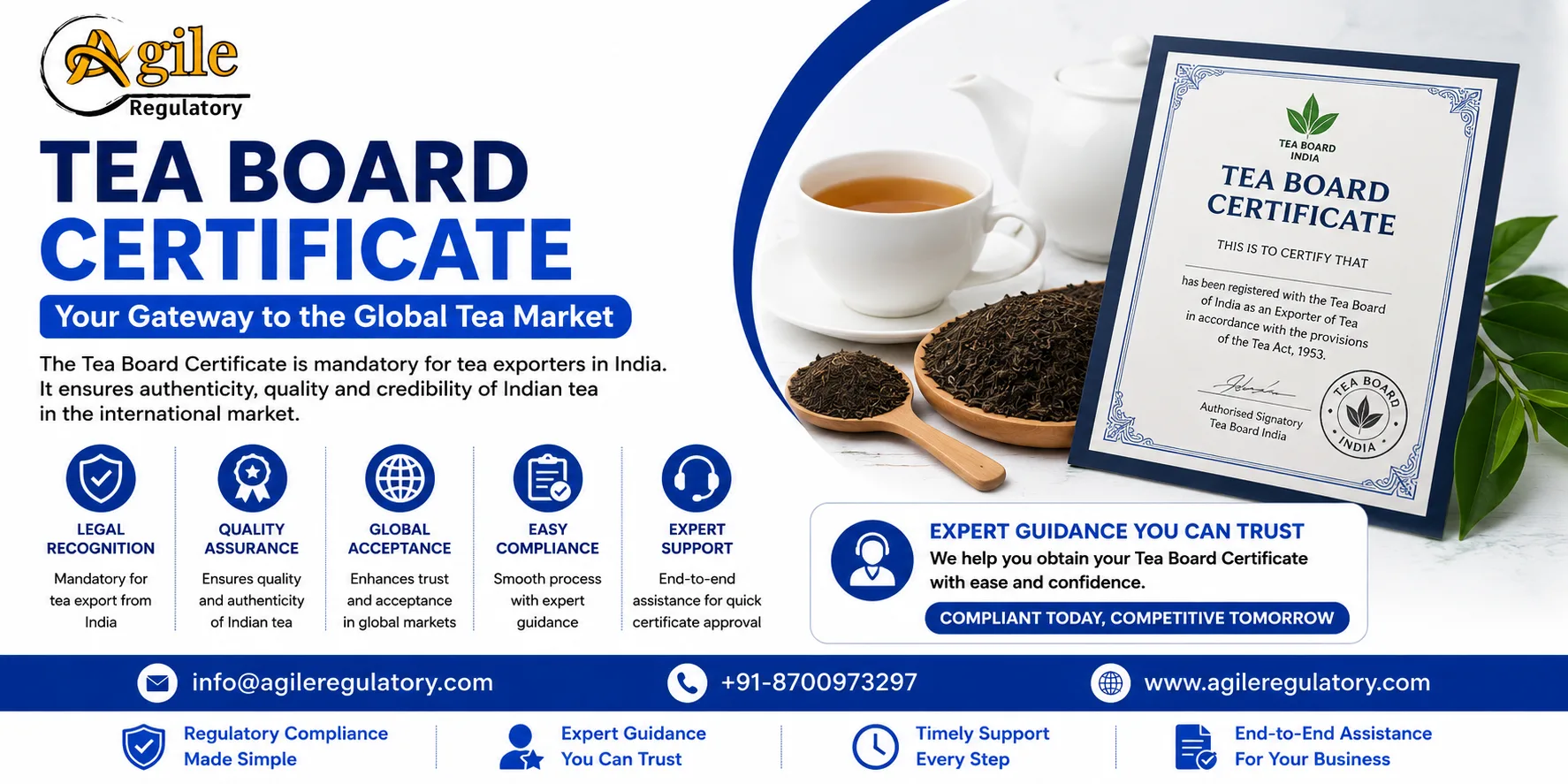
Tea Board Certificate
A Tea Board Certificate can refer to certification or registration documentation associated with an eligible tea business.
The exact document issued depends on the regulatory activity and application category.
Businesses should not assume that a certificate associated with one tea-related activity automatically authorizes every other activity.
For example, manufacturing, processing, domestic trading and exporting can involve different compliance considerations.
Tea Board License
The term Tea Board License is frequently used by businesses searching for regulatory approval.
However, the appropriate approval should be identified according to the actual business activity.
Before applying, exporters should clarify:
- What activity is being conducted?
- Is the business manufacturing, processing or trading?
- Is the business exporting tea?
- What Tea Board registration applies?
- Are additional export approvals required?
Using the wrong application category can result in unnecessary delays.
Tea Board Export License
Tea exporters often search for Tea Board Export License when preparing their first shipment.
Exporters should distinguish between Tea Board registration and other export requirements such as:
- IEC
- DGFT compliance
- Customs documentation
- RCMC, where applicable
- Product-specific certificates
- Destination-country requirements
The applicable requirements should be assessed before shipment rather than after the goods are ready for dispatch.
Tea Board RCMC
The term Tea Board RCMC may arise when exporters are completing export-related registrations.
RCMC means Registration-Cum-Membership Certificate and is associated with recognized export promotion bodies or commodity authorities, depending on the product and applicable framework.
Exporters should verify whether RCMC is required for their particular tea export activity and which authority is responsible for issuing it.
An RCMC should not be treated as a substitute for every other licence or registration.
Tea Business Registration in Delhi
Tea businesses operating from Delhi may need to manage multiple registrations depending on their activities.
For example, an exporter may need to assess:
- Business registration
- PAN
- GST
- IEC
- Tea Board requirements
- FSSAI requirements, where applicable
- Packaging and labelling requirements
- Export documentation
A business operating from Delhi but exporting tea internationally should therefore review its complete compliance structure rather than focusing on one certificate.
Documents for Different Business Types
Merchant Exporter
A merchant exporter may primarily need business, IEC, banking and product-related documentation.
Manufacturer Exporter
A manufacturer may need additional records concerning manufacturing premises and production activities, depending on the applicable requirements.
Tea Processor
Processing businesses should ensure that information concerning processing operations is accurately represented.
Tea Trader
A trader should maintain clear records showing its business constitution, banking details and commercial activities.
The final document checklist should always be based on the actual business model.
Common Document Errors to Avoid
Mismatch in Business Name
The company or proprietor name should be consistent across major statutory records.
Incorrect Address
Verify the registered business and operational address wherever required.
Outdated IEC Information
Exporters should ensure that their IEC details are current.
Missing Bank Documents
Bank information should be accurate and supported by the required records.
Unclear Scanned Copies
Blurry documents can make verification difficult.
Wrong Product Information
Tea product details should accurately represent the business activity.
Missing Supporting Declarations
Some applications may require additional declarations depending on the applicant and registration category.
How to Prepare Documents Before Applying
A simple document-control system can make the application process easier.
Business Documents
│
├── PAN
├── GST
└── Registration Certificate
↓
Export Documents
│
├── IEC
└── Export Details
↓
Bank Documents
│
├── Bank Details
└── Cancelled Cheque
↓
Product Information
│
├── Tea Category
└── Business Activity
↓
Final Document Review
↓
Application Submission
Tea Board Registration Fees
The applicable registration charges depend on the nature of the service and prevailing requirements.
Businesses should verify the current Tea Board Registration Fees before submitting an application.
When budgeting for compliance, exporters should distinguish between government charges and other expenses such as testing, documentation, packaging changes or professional consultancy.
Old fee information from third-party websites should not be relied upon without checking the latest official requirements.
Tea Board Online Registration
Where online facilities are available, applicants can submit registration-related information electronically.
Before starting an online application, businesses should:
- Check the correct portal.
- Verify eligibility.
- Prepare documents.
- Check file formats.
- Confirm applicable fees.
- Review product information.
- Keep contact details accessible.
After submission, applicants should regularly monitor the application for clarification requests.
Expert Tip for Tea Businesses
Do a document-matching check before submitting the application. Compare your IEC, PAN, GST, bank certificate and business registration records line by line. Correcting inconsistencies before submission is usually easier than responding to verification queries later.
Why Choose Agile Regulatory?
Agile Regulatory provides professional regulatory assistance for tea businesses and exporters across India.
Our team can assist with:
- Tea Board registration
- Documentation preparation
- Certificate application support
- RCMC-related assistance
- Export compliance
- Regulatory coordination
We help businesses identify documentation gaps before submission and organize their compliance requirements according to their business activity.
Conclusion
Preparing the correct Tea Board Registration Documents is an important step for tea businesses seeking registration, certification or export-related approvals. A complete application requires more than a basic identity document; businesses should organize their IEC, PAN, GST, business registration, banking, address and product-related records according to the applicable requirements.
Exporters should also understand that Tea Board registration may form only one part of their overall export compliance framework. IEC, customs, product-specific and destination-market requirements should be assessed separately where applicable.
By preparing accurate documents before filing, businesses can reduce avoidable queries and make the registration process more organized. Agile Regulatory provides professional assistance with documentation, application preparation and regulatory coordination for tea businesses across India.
Frequently Asked Questions
1. What documents are required for Tea Board registration?
Common documents may include IEC, PAN, GST registration, business registration certificate, address proof, bank details, cancelled cheque, identity proof, authorized signatory information and product details.
2. Is an IEC required for tea exporters?
Businesses exporting goods from India generally require a valid Import Export Code, subject to applicable exemptions.
3. What is a Tea Board Certificate?
It is a registration or certification document associated with an eligible tea-related activity, depending on the applicable regulatory requirement.
4. Is Tea Board registration the same as a Tea Board licence?
Not necessarily. The appropriate registration, certificate or licence depends on the nature of the business activity and applicable regulations.
5. What is Tea Board RCMC?
RCMC stands for Registration-Cum-Membership Certificate. Exporters should verify whether an RCMC is applicable to their particular tea export activity.
6. Can Tea Board registration be completed online?
Where online services are available, eligible applicants may submit registration information and supporting documents digitally through the applicable official system.
7. How can Agile Regulatory help?
Agile Regulatory assists tea businesses with document preparation, Tea Board registration, certificate applications, RCMC-related support and export compliance.