
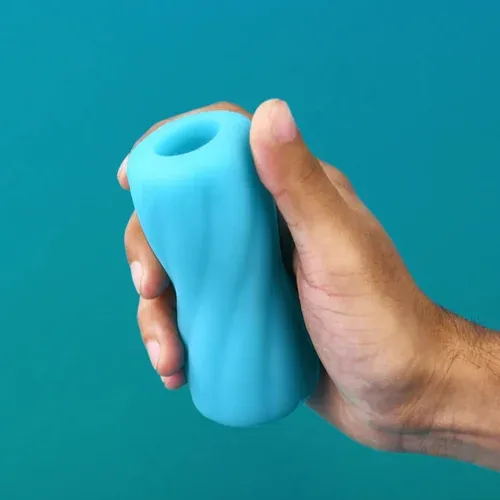
This question sounds simple.
But the answer isn’t.
Because it’s not just about what feels better — it’s about why it feels different.
Most men start with what’s familiar. Their hand. Their rhythm. Their pattern.
And over time, that familiarity becomes routine.
Predictable. Mechanical. Sometimes even less satisfying than before.
That’s where the comparison begins.
The Comfort of Familiarity
Your hand is something you’ve learned over time.
You already understand:
- The grip that works
- The speed that feels right
- The pressure your body responds to
There’s no learning curve.
But there’s also no variation.
And that’s where things start to flatten.
When your body gets used to the same type of stimulation repeatedly, it adapts.
That adaptation reduces sensitivity over time.
What once felt intense starts feeling average.
What a Stroker Changes
A stroker doesn’t just replace your hand.
It changes the type of experience.
Instead of controlled, predictable motion, it introduces:
- Internal textures
- Even pressure distribution
- Consistent contact across the entire length
This creates a more immersive sensation.
Not necessarily stronger — but deeper.
The Difference in Stimulation
With your hand:
- Pressure is uneven
- Movement depends on effort
- Sensation is surface-level
With a stroker:
- Pressure surrounds evenly
- Movement feels smoother
- Sensation feels layered
That layered feeling is what most people notice first.
Control vs Immersion
This is where the real difference shows up.
Hand:
- Full control
- Adjustable at every second
- Familiar rhythm
Stroker:
- Less control
- More surrender to the sensation
- More focus on feeling instead of doing
Some people prefer control.
Others prefer immersion.
Neither is better — they’re different experiences.
Breaking the Pattern
One of the biggest benefits of using a stroker is breaking repetition.
When your body is used to one pattern:
- It becomes harder to feel new intensity
- Your response becomes predictable
Introducing a different sensation resets that pattern.
It reactivates sensitivity.
The Sensitivity Factor
Over time, many men notice reduced sensitivity with repetitive stimulation.
This doesn’t mean something is wrong.
It means your body adapted.
Switching to a different form of stimulation:
- Re-engages nerve response
- Changes how sensation is processed
- Creates a stronger awareness of touch
Effort vs Experience
Using your hand requires effort.
You’re controlling everything:
- Speed
- Pressure
- Rhythm
With a stroker, that effort reduces.
You’re not managing every detail.
That allows more focus on the experience itself.
The Psychological Shift
There’s also a mental difference.
Hand use often becomes habitual.
Quick. Functional. Goal-oriented.
A stroker changes that dynamic.
It slows things down.
It makes the experience feel more intentional.
Does It Replace the Hand?
No.
And it’s not supposed to.
Both serve different purposes.
Hand:
- Quick
- Convenient
- Familiar
Stroker:
- Engaging
- Varied
- More immersive
Using both at different times creates balance.
What Most People Realize
After using both consistently, most people notice:
- Their sensitivity improves
- The experience feels less routine
- They become more aware of what actually feels good
The Reality
It’s not about choosing one over the other.
It’s about expanding your experience.
Because once your body experiences something different…
It stops settling for repetition.