
Introduction
The logistics industry depends on speed, accuracy, and smooth communication. Many companies still use emails, Excel sheets, and paper documents to manage orders, shipments, and invoices. This often causes delays, data errors, and extra costs.
EDI (Electronic Data Interchange) solves this problem.
EDI allows logistics companies to exchange business data automatically between systems without manual work. It helps reduce errors, save time, and improve supply chain performance.
In this complete guide, you will learn:
- What EDI is and how it works
- Step-by-step EDI implementation process
- Benefits, costs, and challenges
- Best practices to succeed
What is EDI in Logistics?
EDI in logistics is a system that allows companies to exchange documents like orders, invoices, and shipment details electronically in a standard format.
EDI in logistics is a digital system that automatically shares business documents between companies without manual work, improving speed and accuracy.
Common EDI Documents Used in Logistics
- Purchase Orders (EDI 850)
- Shipment Notices (EDI 856)
- Invoices (EDI 810)
- Delivery Updates
- Inventory Reports
Instead of sending emails or PDFs, EDI sends data system-to-system in real time or batches.
Why Logistics Companies Need EDI
Logistics companies use EDI to reduce manual work, improve speed, and avoid errors in supply chain operations.
Key Benefits
1. Faster OperationsOrders and shipments are processed automatically.
No manual typing means fewer mistakes.
Less paperwork and fewer employees needed for data entry.
Get updates on shipments instantly.
Customers receive accurate and timely information.
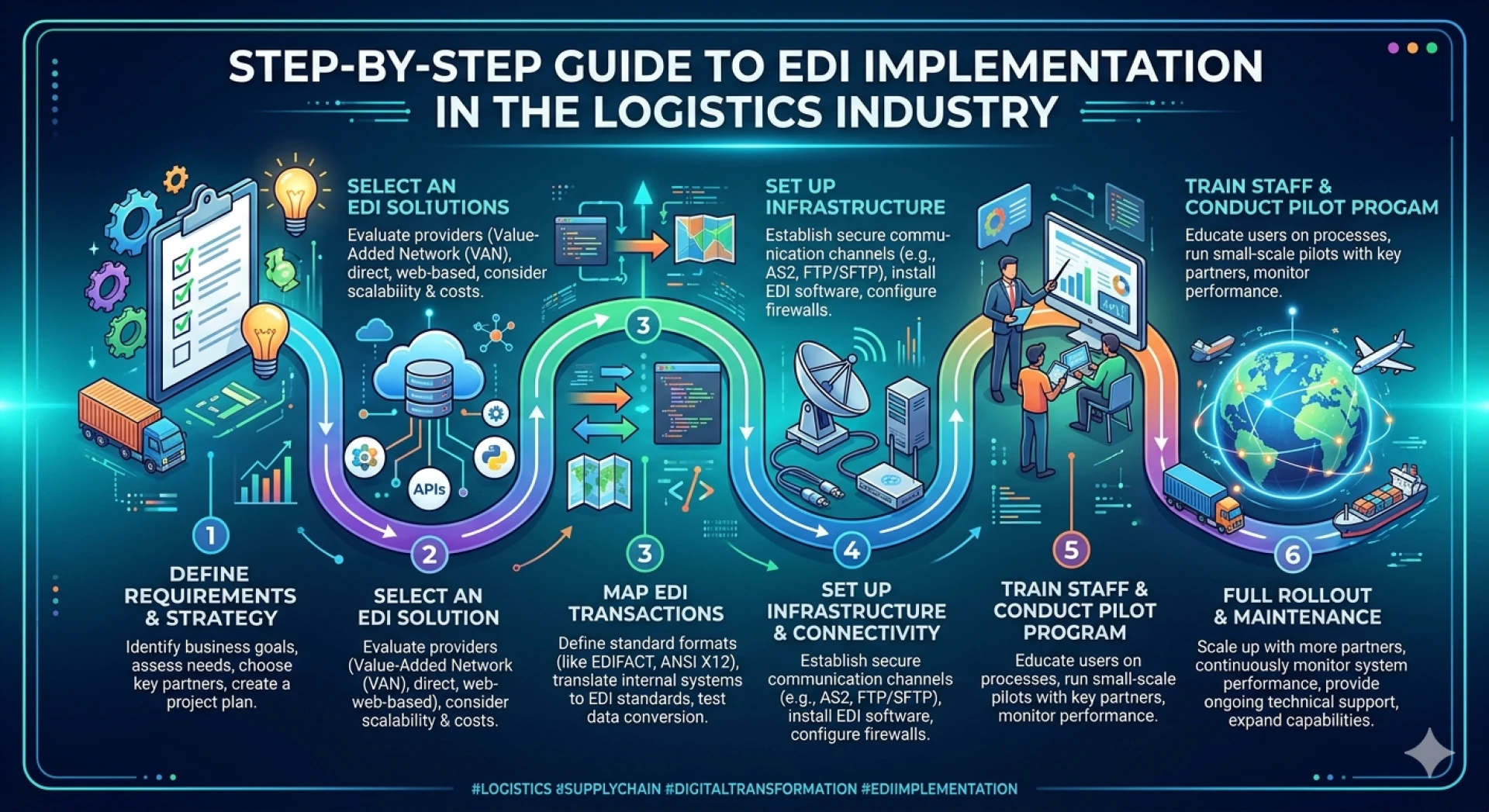
Step-by-Step EDI Implementation Guide
Step 1: Understand Your Business Needs
Before starting, identify where EDI is needed.
Ask:
- Which processes are slow?
- Where do errors happen often?
- Which partners require EDI?
Goal: Find the right starting point.
Step 2: Set Clear Goals
Set measurable goals.
Examples:
- Reduce processing time by 30%
- Improve shipment tracking
- Remove manual data entry
Tip: Clear goals help track success.
Step 3: Choose the Right EDI Solution
Types of EDI Solutions
1. Direct EDI- Direct connection between companies
- High setup cost
- Third-party manages communication
- Good for large networks
- Low cost
- Easy setup
- Scalable
SEO Tip: Most businesses search for cloud-based EDI for logistics.
Choose carefully.
Look for:
- Logistics industry experience
- Support for multiple standards
- Easy integration with ERP/WMS/TMS
- 24/7 support
- Data security
Data mapping connects your internal data with EDI format.
Example: Your invoice → EDI 810 format
Tasks:
- Match fields
- Convert format
- Validate data
Data mapping ensures your system data matches EDI standards correctly.
Connect EDI with your systems:
- ERP
- WMS
- TMS
This allows automatic data flow.
Common standards:
- ANSI X12
- EDIFACT
Why important? Different partners use different formats.
Before going live, test everything.
Check:
- Data accuracy
- File format
- System connection
- Error handling
Testing ensures your EDI system works correctly before launch.
Train employees on:
- Monitoring transactions
- Fixing errors
- Basic troubleshooting
After launch:
- Monitor transactions
- Fix issues quickly
- Track performance
Metrics to track:
- Processing time
- Error rate
- Success rate
EDI Implementation Timeline
EDI implementation usually takes 4 to 12 weeks depending on complexity.
Breakdown
- Planning: 1–2 weeks
- Setup & Mapping: 2–4 weeks
- Testing: 1–3 weeks
- Go Live: 1 week
Cost of EDI Implementation
EDI cost depends on solution type, but cloud EDI is the most affordable option.
- Software type
- Number of partners
- Integration complexity
- Support services
- Small business: Low monthly cost
- Enterprise: Higher setup cost
Common Challenges and Solutions
1. High Cost
Solution: Use cloud-based EDI
2. Complex Integration
Solution: Choose experienced providers
3. Partner Compatibility Issues
Solution: Support multiple standards
4. Data Errors
Solution: Proper testing and validation
Real Use Cases of EDI in Logistics
Shipment Tracking
Real-time updates between partners
Inventory Management
Automatic stock updates
Order Processing
Fast and error-free order handling
Billing and Invoicing
Automatic invoice generation
Best Practices for EDI Success
- Start small and scale
- Use cloud-based solutions
- Keep data accurate
- Communicate with partners
- Monitor performance regularly
Future Trends of EDI in Logistics
Cloud EDI
More flexible and scalable
AI Automation
Better data processing
Blockchain
Improved security
Real-Time Data Exchange
Faster communication
Conclusion
EDI is no longer optional for logistics companies. It is a must-have technology to stay competitive.
By following this step-by-step guide, you can implement EDI easily, reduce manual work, and improve your business performance.
Start with small steps, choose the right solution, and focus on long-term growth.