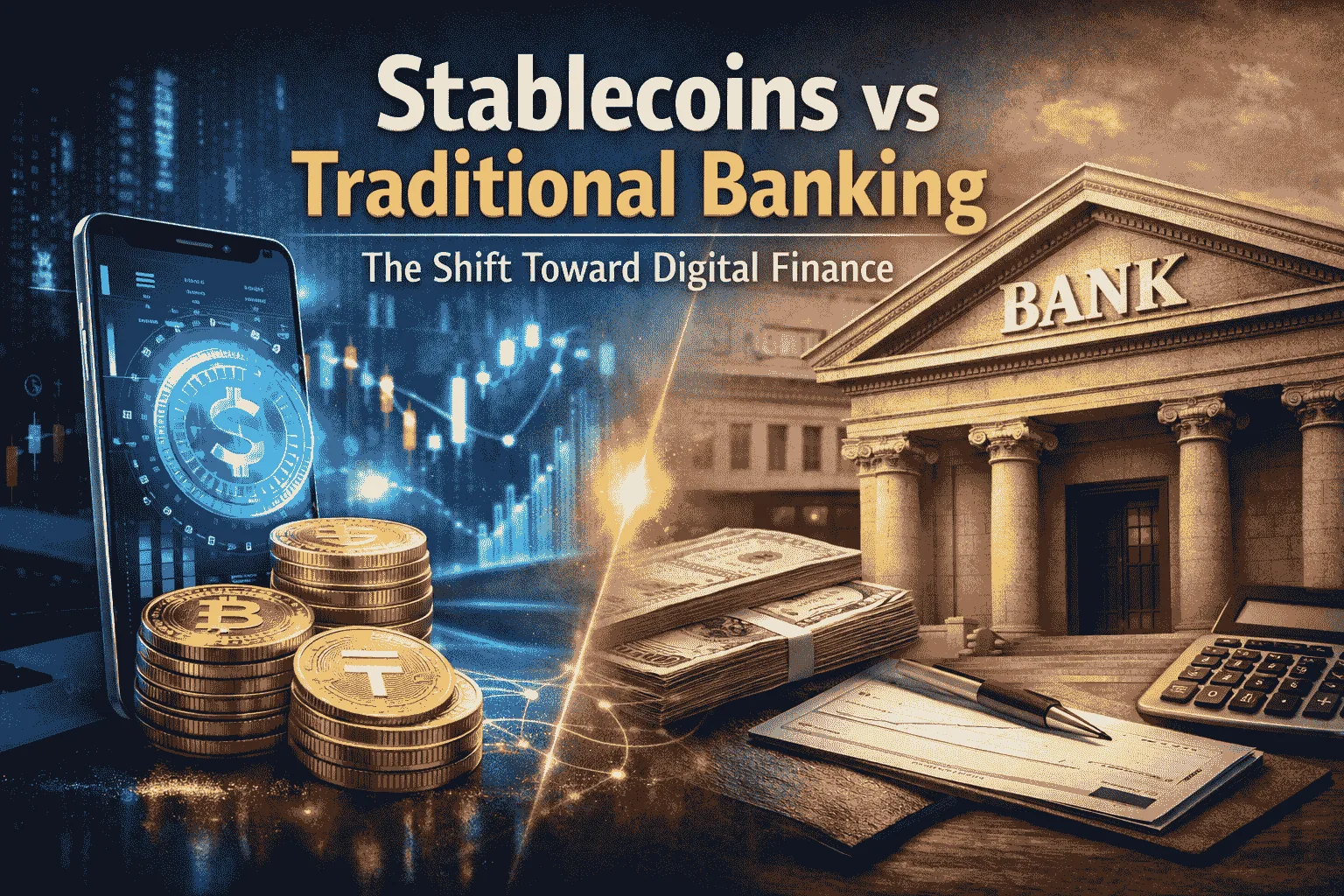
The global financial ecosystem is undergoing a structural transformation driven by digitization, decentralized networks, and programmable monetary systems. For decades, traditional banking institutions controlled the movement of capital through centralized infrastructures, intermediary networks, and regulatory frameworks that prioritized institutional trust over transactional speed. However, the emergence of blockchain-based financial instruments, particularly stablecoins, is redefining how value is transferred, stored, and utilized in the digital economy.
Stablecoins are digital assets engineered to maintain price stability by being pegged to fiat currencies, commodities, or reserve-backed mechanisms. Unlike volatile cryptocurrencies, stablecoins are designed to function as reliable mediums of exchange within decentralized finance ecosystems and enterprise-grade financial applications. Their growing adoption is challenging conventional banking models that often struggle with inefficiencies such as delayed settlements, cross-border transaction friction, and excessive intermediary costs.
As digital finance accelerates, stablecoins are no longer viewed as experimental blockchain products. They are becoming operational financial tools capable of supporting remittances, treasury management, tokenized assets, and institutional payment rails.
Why Traditional Banking Faces Structural Limitations
Traditional banking systems were built for a pre-digital financial environment where physical branches, centralized ledgers, and manual verification processes were considered standard operational requirements. Although modern banks have implemented digital channels, the underlying architecture remains dependent on legacy settlement systems and fragmented interbank networks.
Several operational limitations are pushing enterprises and consumers toward blockchain-powered alternatives:
- Cross-border transactions often involve multiple correspondent banks, increasing settlement time and transaction fees.
- Banking hours restrict access to financial services, especially for international transactions requiring real-time liquidity.
- High compliance overhead and intermediary participation reduce transactional efficiency.
- Legacy infrastructure creates integration challenges for fintech platforms and digital asset ecosystems.
- Financial inclusion remains inconsistent in emerging economies where access to banking services is limited.
These inefficiencies are becoming more visible in an era dominated by API-driven platforms, instant payment expectations, and digitally native business models. Enterprises operating across global markets increasingly require financial systems that support near-instant settlement, programmable payments, and interoperable digital assets.
Stablecoins address many of these challenges through blockchain-enabled settlement layers that operate continuously without relying on traditional clearing mechanisms.
Stablecoins as the Backbone of Digital Finance
Stablecoins are rapidly evolving into foundational components of digital financial infrastructure. Their utility extends far beyond cryptocurrency trading. Financial institutions, fintech firms, and Web3 platforms now utilize stablecoins for treasury operations, cross-border settlements, payroll distribution, decentralized lending, and tokenized commerce.
One of the most significant advantages of stablecoins is transactional finality. Blockchain networks can process transfers within minutes or seconds, depending on network architecture, eliminating delays associated with traditional settlement cycles. This capability becomes especially valuable for multinational enterprises managing liquidity across jurisdictions.
Another major innovation is programmability. Stablecoins can integrate with smart contracts, enabling automated financial workflows that reduce manual intervention. This allows businesses to execute conditional payments, automated escrow mechanisms, and real-time revenue-sharing models without depending on centralized intermediaries.
The expansion of tokenized finance has also increased demand for enterprise-grade blockchain infrastructure and Stablecoin Development services capable of supporting compliance frameworks, reserve transparency, interoperability, and secure smart contract deployment.
In addition, stablecoins contribute to greater financial accessibility. Individuals in underbanked regions can access digital wallets and blockchain-based payment systems without requiring conventional banking relationships. This creates opportunities for broader participation in digital commerce and decentralized financial ecosystems.
Institutional Adoption and Regulatory Momentum
The growing institutional acceptance of stablecoins indicates that digital finance is moving toward mainstream integration rather than remaining a niche technological movement. Large financial institutions, payment processors, and fintech enterprises are actively exploring blockchain settlement networks to improve operational efficiency and reduce transaction costs.
Several developments are accelerating institutional adoption:
- Central banks and regulators are developing frameworks for digital asset governance and reserve-backed stablecoin issuance.
- Enterprises are exploring tokenized payment infrastructure for faster supplier settlements and treasury optimization.
- Fintech companies are integrating stablecoin payment rails into cross-border remittance platforms.
- Asset tokenization initiatives are creating demand for stable settlement assets within digital securities ecosystems.
- Decentralized finance protocols are using stablecoins as liquidity anchors for lending, staking, and collateralization.
Regulatory scrutiny is also shaping the evolution of stablecoins. Transparency regarding reserves, anti-money laundering compliance, and consumer protection standards are becoming central priorities for policymakers. Although regulatory uncertainty still exists in some jurisdictions, the broader trajectory indicates that governments are moving toward structured oversight rather than outright resistance.
This regulatory maturation is critical because institutional adoption depends heavily on trust, auditability, and compliance alignment. Stablecoin issuers capable of demonstrating reserve integrity and operational transparency are likely to play a major role in the future financial ecosystem.
The Future Relationship Between Banks and Stablecoins
The rise of stablecoins does not necessarily imply the complete replacement of traditional banks. Instead, the financial sector is moving toward a hybridized environment where conventional institutions and blockchain-based systems coexist.
Banks still possess significant advantages in regulatory relationships, consumer trust, credit issuance, and large-scale capital management. However, they are increasingly being forced to modernize their infrastructure to remain competitive in a digitally accelerated economy.
Many financial institutions are already experimenting with blockchain integrations, tokenized deposits, and digital asset custody solutions. Some are partnering with fintech firms to incorporate stablecoin payment rails into existing financial services. Others are exploring central bank digital currencies as state-backed alternatives that incorporate elements of blockchain-based financial architecture.
The broader shift toward digital finance is ultimately about efficiency, transparency, and interoperability. Consumers and enterprises no longer want fragmented financial experiences characterized by delayed transfers, excessive fees, and operational bottlenecks. They expect financial systems to operate with the same speed and accessibility as modern internet platforms.
Stablecoins represent a major step toward that transition. Their ability to combine blockchain efficiency with price stability makes them one of the most practical innovations within the digital asset economy. As institutional infrastructure matures and regulatory clarity improves, stablecoins are positioned to become integral components of next-generation financial systems.
Traditional banking will continue to exist, but its operational framework is evolving under the pressure of decentralized technologies and digital-native financial expectations. The institutions that successfully adapt to this transformation will define the future of global finance.
Word Count: 920