
In today’s hyper‑connected world, customers expect every phone interaction to be fast, accurate, and personalized. For call centers, meeting those expectations isn’t just about hiring friendly agents—it’s about leveraging the right technology. Speech analytics call center solutions are quickly becoming the backbone of modern call center quality assurance software and call center analytics software, turning every conversation into a goldmine of actionable insight.
Why Speech Analytics Matters
Traditional quality assurance (QA) relied on manual call listening—a time‑consuming, subjective process that could only cover a fraction of the daily call volume. Speech analytics automates that work by:
- Transcribing in Real Time – Advanced AI converts voice to text with industry‑leading accuracy, even when agents and customers speak with accents or background noise.
- Detecting Keywords & Phrases – Pre‑defined or dynamically learned triggers flag compliance terms, product mentions, or negative sentiment.
- Measuring Sentiment & Emotion – Voice‑tone analysis pinpoints frustration, satisfaction, or confusion, allowing supervisors to intervene before a minor issue escalates.
The result? A 30‑50 % reduction in manual QA hours and a 20‑35 % boost in first‑call resolution rates, according to recent industry benchmarks.
Integrating Speech Analytics with QA Software
When you embed speech analytics call center capabilities directly into your call center quality assurance software, you gain a unified platform that:
- Prioritizes High‑Risk Calls – Instead of listening to calls at random, the system surfaces those with compliance breaches, escalations, or low sentiment scores first.
- Automates Scoring – Conversational metrics (e.g., script adherence, empathy, product knowledge) are scored automatically, delivering consistent, unbiased evaluations.
- Provides Agent Coaching in Context – Supervisors can attach a short video or tip to a transcript segment, enabling agents to see exactly where improvement is needed.
Because the analytics layer is built into the QA workflow, agents receive feedback faster, and managers can track performance trends over weeks or months without a spreadsheet nightmare.
Turning Insights into Actionable Business Intelligence
Beyond QA, speech analytics enriches call center analytics software by feeding structured data into dashboards that answer strategic questions:
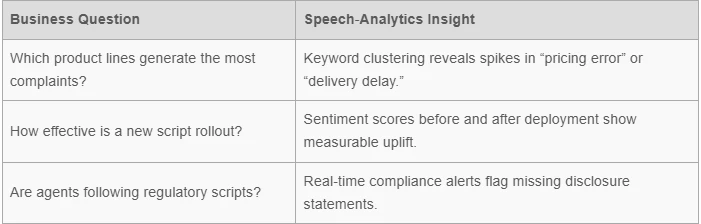
These insights empower leadership to fine‑tune training programs, redesign scripts, and even influence product development—all from the voice of the customer.
Best Practices for a Successful Deployment
- Start Small, Scale Fast – Pilot the speech analytics engine on a single queue or product line. Use the results to refine keyword libraries and sentiment models before a full rollout.
- Align with Business Goals – Define clear KPIs—e.g., reduction in average handling time, increase in net promoter score (NPS)—so the technology is measured against tangible outcomes.
- Maintain Data Privacy – Ensure all recordings are stored securely, and anonymize personally identifiable information (PII) when feeding data into analytics platforms.
- Combine AI with Human Oversight – Periodically review flagged calls to train the system and prevent false positives, keeping the AI both accurate and trustworthy.
The Bottom Line
Incorporating speech analytics call center capabilities into your call center quality assurance software and broader call center analytics software ecosystem is no longer a “nice‑to‑have”—it’s a competitive imperative. By automating transcription, keyword detection, and sentiment analysis, you free QA teams to focus on coaching, while leadership gains real‑time, data‑driven visibility into every customer interaction.
If you haven’t yet explored speech analytics, now is the moment to listen to what your customers are really saying—and turn those words into measurable, lasting improvements.