If a US enterprise buyer has asked for your SOC 2 report, the first question is usually "how soon can we have it?" The honest answer depends on the report type, your current controls, and how quickly you can fix gaps.
This guide breaks down the realistic timeline for SOC 2 compliance in Australia, phase by phase, so you can plan around real deadlines rather than marketing promises.
SOC 2 timeline at a glance
- Type 1: typically 6-8 weeks if you already have controls in place.
- Type 2: typically 9-12 months from a standing start.
- Observation window (Type 2 only): 3-12 months, with 6 months the minimum most enterprise buyers accept.
These ranges assume a focused team and a clear scope. Larger environments, extra criteria, or heavy remediation will push them out.
First, understand what you are getting
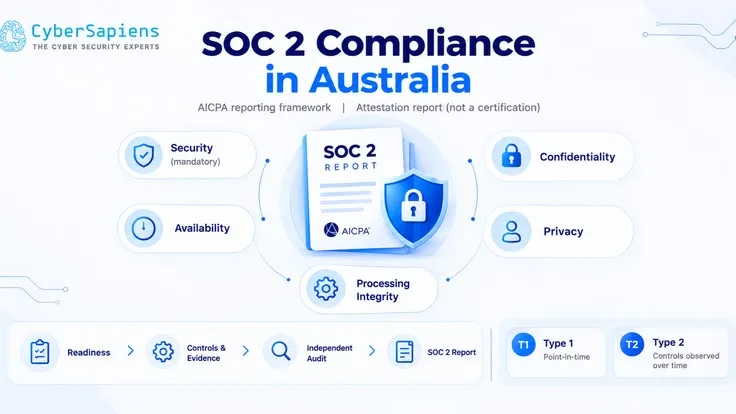
SOC 2 (System and Organization Controls 2) is a reporting framework from the American Institute of CPAs (AICPA). An independent audit firm tests your controls against the Trust Services Criteria: Security (mandatory), Availability, Processing Integrity, Confidentiality, and Privacy.
It is technically an attestation report, not a certificate. People say "SOC 2 certification" informally, but buyers ask for the report itself. SOC 2 is also not legally required in Australia. The demand is commercial, driven by procurement teams that treat a current report as a gate in vendor due diligence.
The four phases of a SOC 2 project
Phase 1: Readiness assessment and gap analysis (4-8 weeks)
You define the scope, decide which Trust Services Criteria apply, and map your current controls against them. The output is a clear list of gaps. A tight scope at this stage saves weeks later.
Phase 2: Gap remediation (1-4 months)
This is where most of the work happens. You write and approve policies, deploy tooling, and implement missing controls. Typical areas include access control, change management, incident response, vendor risk, and least-privilege access across cloud platforms.
Phase 3: Observation window (Type 2 only, 3-12 months)
Your controls run in real conditions while evidence is collected continuously. This window cannot be shortened or reconstructed afterwards. If a control was not operating, there is no way to prove it retroactively.
Phase 4: Audit fieldwork and report (4-8 weeks)
The auditor tests your evidence, raises questions, and issues the final report. Responsive evidence handling keeps this phase on the shorter end.
Type 1 vs Type 2: which timeline fits you?
SOC 2 Type 1
- What it tests: Control design at one point in time
- Typical timeline: 6-8 weeks with existing controls
- Observation period: None (a single date)
- Buyer confidence: Moderate; often an interim step
- Best for: First-time programmes and urgent deals
SOC 2 Type 2
- What it tests: Design and operating effectiveness over time
- Typical timeline: 9-12 months from a standing start
- Observation period: 3-12 months
- Buyer confidence: High; the report most procurement teams expect
- Best for: Sustained enterprise sales and renewals
You do not need Type 1 before Type 2. Many companies go straight to Type 2. If a deal is under time pressure, though, Type 1 works well as a short bridge while your Type 2 observation window runs.
Why "SOC 2 Type 2 in 45 days" is not realistic
Type 2 requires auditors to observe your controls operating over time. That is an AICPA requirement, and no provider can bypass it. A claim of a 45-day Type 2 is either describing a Type 1 or overpromising. Ask any provider exactly what report you will receive and what observation period it covers.
What affects how long SOC 2 takes
- Existing maturity. Companies with documented policies and clean access management move much faster.
- ISO 27001. The two frameworks share an estimated 60-70% of controls, so an existing ISMS shortens readiness considerably. See our ISO 27001 certification service.
- Scope and criteria. Each added Trust Services Criterion means more controls to implement and test.
- Environment complexity. Multiple cloud platforms, many vendors, and large teams increase evidence volume.
- Evidence method. Automated collection is faster and more consistent than manual screenshots. Read about automated vs manual compliance.
- Audit route. A Big 4 firm, an overseas specialist, and a local consultancy working with an audit partner differ in coordination effort and cost.
Six ways to keep your SOC 2 timeline on track
- Start with a narrow, well-defined scope and expand later if needed.
- Begin the readiness assessment before a deal forces the issue.
- Assign one internal owner with authority to make decisions.
- Fix access control and offboarding early, since auditors test them heavily.
- Collect evidence from day one of the observation window.
- Reuse existing ISO 27001 work wherever it maps.
Our SOC 2 compliance checklist is a practical starting point.
Frequently asked questions
How long does SOC 2 take in Australia? A Type 1 report typically takes 6-8 weeks with existing controls. A Type 2 report typically takes 9-12 months from a standing start, including the observation window.
What is the SOC 2 observation window? It is the period, usually 3-12 months, during which an auditor watches your controls operate. Six months is the minimum most enterprise buyers accept.
Can the observation window be shortened? No. The window is an AICPA requirement and evidence has to be collected as controls run.
Do I need Type 1 before Type 2? No. Type 1 is optional and useful mainly as an interim report under deal pressure.
Is SOC 2 required by law in Australia? No. Demand comes from enterprise customers, particularly US buyers, rather than regulation.
How much does SOC 2 cost in Australia? Cost depends on scope, company size, auditor tier, and existing maturity. See our SOC 2 cost guide for Australia for a breakdown.
Plan your SOC 2 timeline with confidence
The most reliable way to avoid delays is to start with a gap assessment and a clear plan. Book a free SOC 2 consultation with CyberSapiens to get a fixed-price quote and a realistic timeline for your organisation.