
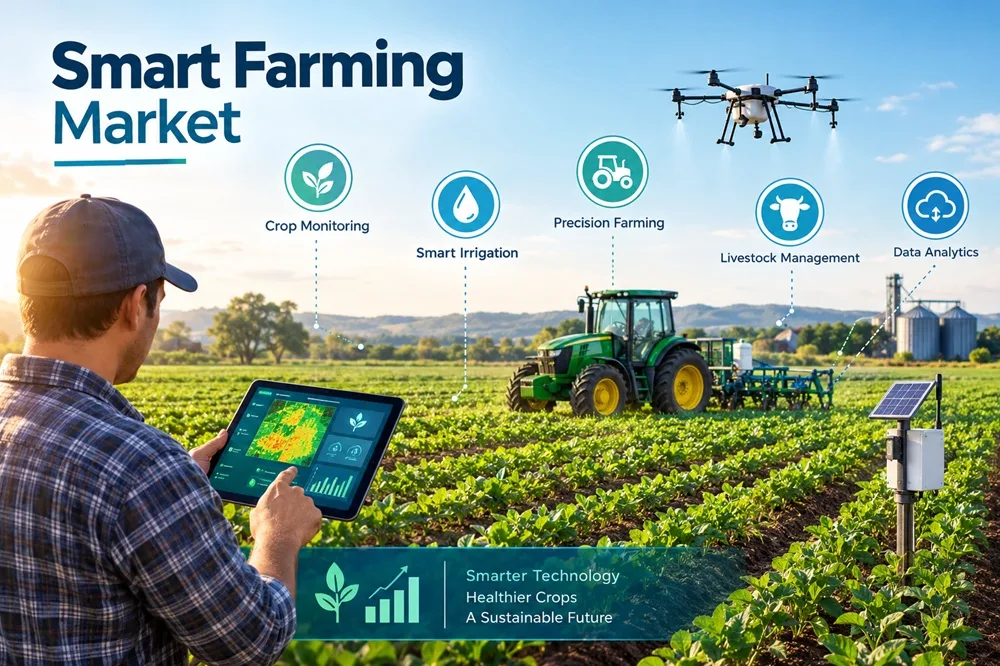
The smart farming market is transforming agriculture through technologies that improve productivity, resource efficiency, and operational decision-making. Solutions such as connected sensors, artificial intelligence (AI), robotics, and data analytics help farmers monitor crops, optimize irrigation, and manage livestock.
What are the Key Drivers of the Smart Farming Market?
- Rising food demand: Growing global food requirements are encouraging farmers to adopt technologies that improve agricultural productivity and support efficient food production.
- Demand for sustainable agriculture: Increasing pressure to conserve water, reduce chemical inputs, and minimize environmental impacts is accelerating the adoption of resource-efficient farming practices.
- Advancements in digital technologies: The integration of AI, the Internet of Things (IoT), GPS, and data analytics enables real-time monitoring and more informed agricultural decisions.
- Need to reduce operational costs: Automated machinery, targeted spraying, and precision irrigation help farmers manage labor requirements, optimize input usage, and improve operational efficiency.
How is Smart Farming Being Applied Across Agriculture?
Smart farming technologies support multiple agricultural activities, from crop production to livestock and aquaculture management. Precision agriculture enables targeted planting, fertilization, spraying, and irrigation based on field conditions. Livestock monitoring systems track animal health, feeding patterns, and movement, while aquaculture solutions help manage water quality and feed consumption. These applications improve visibility across operations and support data-driven decisions.
Get An Updated Sample for Smart Farming Market - Focus on Application, Hardware, Software, and Region Analysis and Forecast, 2024-2034
What are the Key Trends Shaping the Smart Farming Market?
- AI-driven farm analytics: Machine learning tools are helping farmers interpret field data, identify crop stress, predict yields, and make timely operational decisions.
- Connected sensors and advanced networks: IoT devices, 5G, and low-power wide-area networks are expanding real-time monitoring and connectivity across agricultural environments.
- Automation and agricultural robotics: Autonomous equipment, agricultural drones, and robotic systems are supporting planting, crop monitoring, targeted spraying, and harvesting activities.
- Digital traceability and integrated platforms: Farm management software and blockchain-based solutions are creating opportunities to improve recordkeeping, product traceability, and information sharing across agricultural supply chains.
Which Regions are Driving Growth in the Smart Farming Market?
North America is positioned as a leading regional market, supported by established agricultural technology providers, digital infrastructure, and adoption of precision farming solutions. Europe also benefits from investments in agricultural innovation and sustainable farming practices. Meanwhile, Asia-Pacific presents substantial growth potential as countries such as China and India explore digital agriculture to improve productivity and resource management. Regional adoption will depend on infrastructure, investment, and farmer access to technology.
What Challenges and Opportunities Exist in the Smart Farming Market?
High initial investment costs, limited digital skills, inconsistent rural connectivity, and concerns about data security can restrict adoption, particularly among small and medium-sized farms. Integrating new technologies with existing equipment can also create implementation challenges.
However, these barriers present opportunities for technology providers to develop affordable solutions, subscription-based platforms, and user-friendly tools. Investments in agricultural technology startups, AI-powered analytics, and connected equipment can expand market access. Partnerships among equipment manufacturers, software developers, agricultural institutions, and governments can further support adoption through training, technical assistance, and improved digital infrastructure.
Conclusion
The smart farming market is poised for substantial growth as agriculture increasingly adopts digital technologies to improve productivity, optimize resource utilization, and support sustainable practices. Advances in AI, IoT, automation, and precision agriculture are creating new opportunities for technology providers and farmers. Despite challenges related to costs, connectivity, and technical expertise, continued innovation and accessible solutions are expected to accelerate adoption and strengthen the role of smart farming in the future of global agriculture.