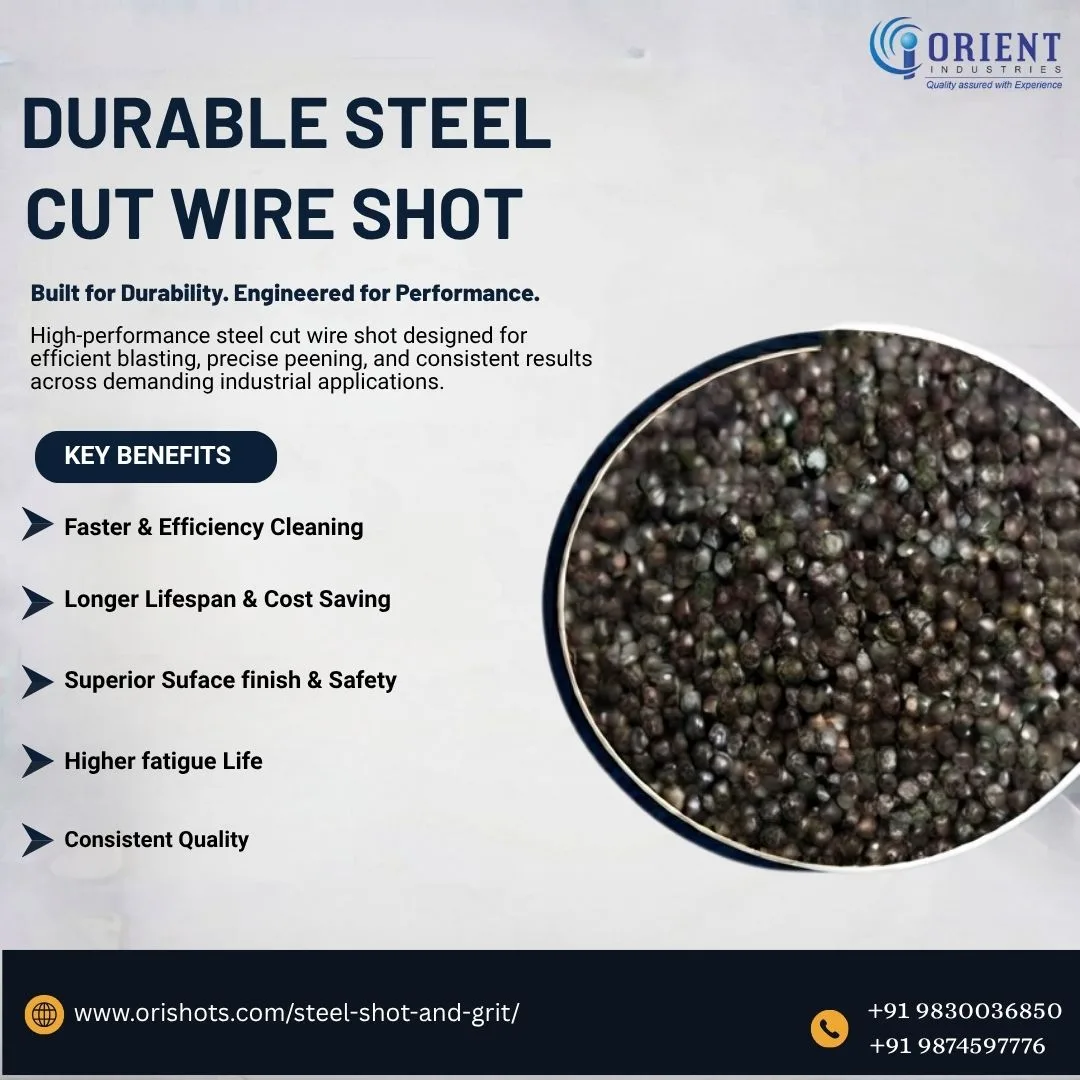
Walk through any fabrication unit or foundry, and somewhere near the blasting section you'll find small bins of tiny metal pellets that most visitors would walk right past without a second glance. Nobody stops to admire them. Yet the finish on many castings, weld seams, and shot-blasted panels coming out of that unit depends heavily on those little pellets doing their job right. That's Cut Wire Shot for you — small, unglamorous, and quietly responsible for a huge chunk of surface treatment work across industries.
Orient supplies this product for industrial surface treatment, and it's worth understanding why something this small carries so much weight in finishing. Most people outside the fabrication world never think about it, yet skip it or get it wrong, and the results show up almost immediately on the shop floor.
The right abrasive also helps keep the blasting process steady across different batches. When particle size and shape remain consistent, operators can work with more predictable machine settings and achieve a similar surface finish without constantly adjusting the process. That becomes especially useful when large volumes of metal components need to be treated.
What Cut Wire Shot Actually Does in Surface Treatment?
Surface treatment sounds technical, but the idea behind it is simple. Before paint, coating, or any finishing process goes onto a metal surface, that surface needs to be clean, roughened just enough, and free of scale or rust. Cut Wire Shot is one practical way to achieve that.
Fired at high speed onto a metal surface, Cut Wire Shot removes rust, mill scale, and old coatings while creating a uniform surface texture that paint or coating can actually grip onto. Skip proper surface preparation, or use the wrong abrasive, and the coating may struggle to adhere properly or hold up over time.
Orient manufactures Cut Wire Shot specifically with this consistency in mind, since uneven shot sizes lead to uneven blasting results — patches that are over-treated next to patches barely touched at all. Operators notice this the moment inspection lights hit an unevenly blasted panel, which is exactly the kind of rework nobody has time for on a production schedule.
Why Cut Wire Shot Works Well for Repeated Blasting?
Not every abrasive on the market does the same job equally well. Sand, grit, and cast shot all have their place, but Cut Wire Shot can be particularly effective in repeated-use blasting operations because of its durability and reusability. Here's why fabricators keep coming back to it:
● Longer working life — cut wire shot holds its shape through more blasting cycles before breaking down
● Consistent particle size, which helps produce a more uniform blasting result
● Lower dust generation, making it a cleaner option in enclosed blasting cabinets
● Recyclable through multiple passes, reducing overall abrasive consumption and cost
● Available in multiple hardness levels, so it can be matched to soft or hardened metal surfaces
This durability is one reason Cut Wire Shot is widely used in shipyards, foundries, and structural steel fabrication units that run blasting operations regularly.
Orient's Steel Cut Wire Shot and What Sets It Apart
Not all Steel Cut Wire Shot is manufactured to the same standard, even though it might look identical in a bag. Hardness inconsistency, poor roundness, or contamination during production can quietly ruin an entire blasting batch without anyone noticing until the finish comes out wrong.
Orient focuses on maintaining consistent size and hardness during manufacturing, producing Steel Cut Wire Shot suited to controlled and repeatable blasting operations. That consistency matters more than people assume — a blasting operator adjusting machine settings around inconsistent shot sizes ends up wasting both time and material.
For industries relying on steel shot for daily surface preparation — automotive parts, heavy machinery, shipbuilding — that consistency translates directly into fewer rejected batches and less rework down the line. A dependable source of steel shot can also make blasting easier to control, particularly when the same process is repeated across large production batches. For Orient, that consistency is an important part of delivering Cut Wire Shot that performs predictably from one blasting cycle to the next.
Choosing the Right Abrasives for Your Blasting Operation
Buying abrasives without understanding the surface you're treating is a common mistake, and it usually shows up later as wasted material or a poor finish. Picking between Cut Wire Shot, grit, or other abrasives depends on a few practical factors:
● Metal hardness — softer metals need gentler shot to avoid surface damage
● Desired surface profile — some coatings need a rougher texture to bond properly
● Equipment type — certain blasting machines work better with specific shot shapes
● Reusability needs — cut wire shot generally survives more cycles than brittle abrasives
● Budget over time — cheaper abrasives that break down fast often cost more in the long run
Orient helps customers work through exactly this kind of decision before committing to a bulk order, since the wrong abrasive choice tends to become an expensive mistake once blasting is already underway.
Conclusion
Cut Wire Shot might be small, but it plays an outsized role in how well a finished metal surface holds up over time. From removing rust and scale to preparing surfaces for lasting coatings, this abrasive does work that's easy to overlook until something goes wrong.
Orient Industries manufactures Cut Wire Shot with the kind of consistency that keeps blasting operations running smoothly, batch after batch, without the guesswork that comes with inconsistent suppliers. Whether it's steel shot for daily industrial use or selecting the right abrasives for a specific project, making the right choice can save both time and material costs later. In surface treatment, the smallest components often carry the biggest responsibility, and that's rarely appreciated until they're missing.