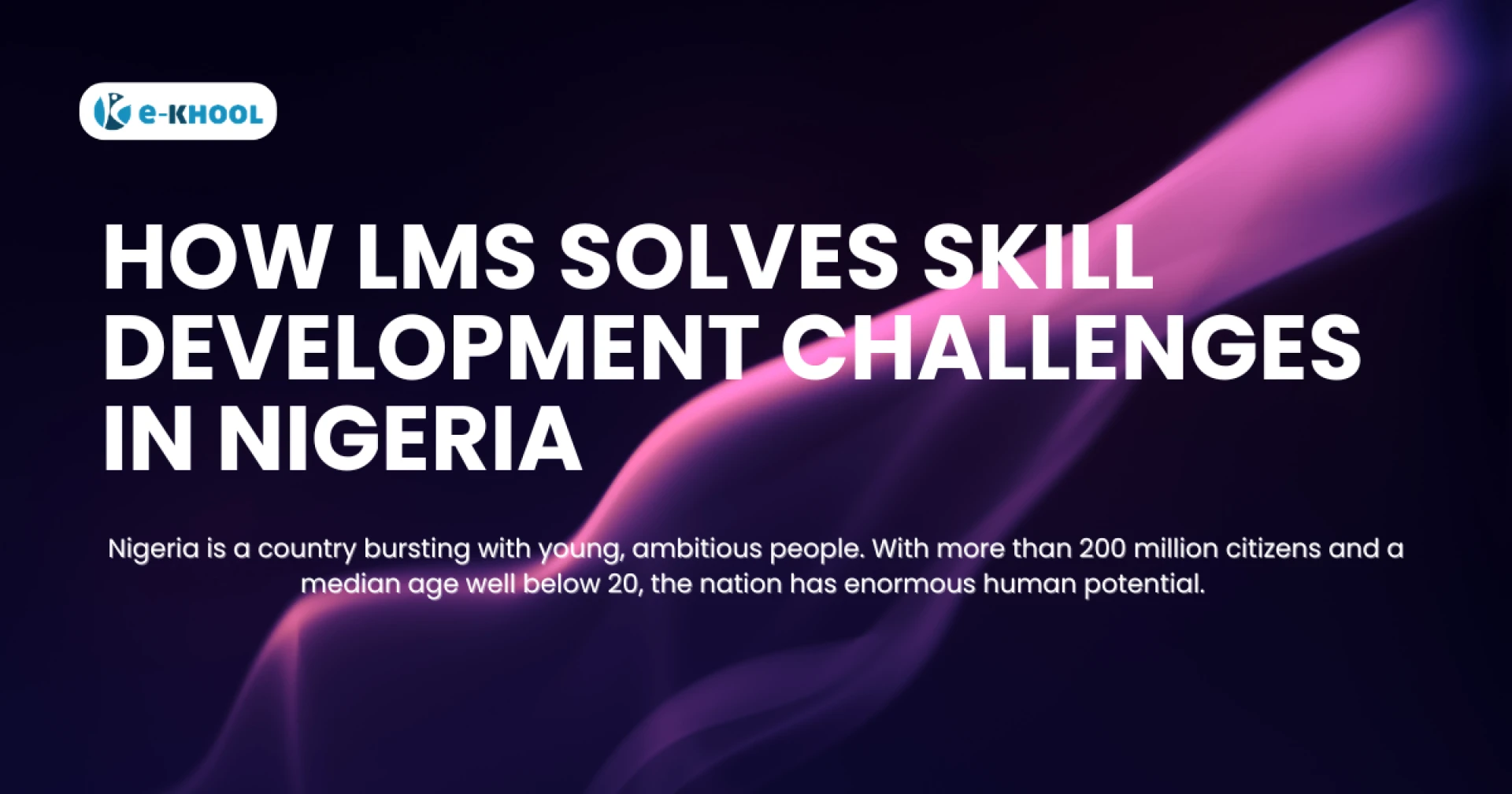
Nigeria is a country bursting with young, ambitious people. With more than 200 million citizens and a median age well below 20, the nation has enormous human potential. But for decades, that potential has run into the same wall: a skills gap that leaves millions of graduates underprepared for the jobs that exist, and millions of workers stuck without the tools to grow. The classroom, as it has traditionally worked in Nigeria, was simply not built to keep up.
That is changing slowly, but visibly. It is not a magic fix. But for a country that needs practical, fast, and affordable training for millions of people at once, learning management software is proving to be one of the most powerful answers available.
The Real Problems Nigeria Faces with Skill Development
Nigeria's education system produces millions of graduates every year. But employers both local and international consistently say these graduates are not fully ready to work. That gap between what schools teach and what workplaces need is not new. What is new is how fast that gap is growing, as industries change and digital skills become non-negotiable.
Nigeria is a vast country, and the quality of training available in Lagos is simply not the same as what is available in Borno or Kebbi. Someone in a rural town who wants to learn data analysis, project management, or customer service skills often has nowhere to go. Physical training centers are too expensive, and still out of reach for most of the working Nigerians who cannot leave their jobs to attend classes.
Professional development courses from private providers can cost more than a month's salary. Government training programs there but are often underfunded, inconsistent in quality, and difficult to access. Many Nigerians who want to grow their skills simply cannot afford the amount that institutes prefer.
Nigeria does not need to train a few thousand people. It needs to train millions of people continuously, and in ways that actually follows. Traditional training, even when it works well, we cannot scale fast enough to meet that need.
What Is an LMS and Why Does It Matter Here?
A learning management system is, at its core, a digital platform that lets organizations create, deliver, manage, and track training or educational content. It is where courses live, where learners log in, where progress is measured, and where results are recorded.
A good LMS is more like a complete ecosystem. It handles everything from enrollment and scheduling to assessments, certifications, and reporting. It works on a phone, a tablet, or a computer. It can serve five learners or five million. It remembers where each learner stopped, nudges them to continue, and tells administrators exactly who learned what and when.
For Nigeria, what makes learning management software so relevant is its ability to overcome distance, reduce cost, and deliver consistent quality at a scale that no traditional classroom can match. A company with offices in Lagos, Abuja, and Kano can push the same updated compliance training to every employee on the same day. A government agency can certify thousands of field workers without sending them all to a central location. A university can extend its best courses to students in states that do not have strong local institutions.
Core Capabilities of Modern LMS Platforms :
- Centralized storage and delivery of all training content
- Automated enrollment, progress tracking, and completion reports
- Built in quizzes, assignments, and competency assessments
- Mobile access, allowing learning from anywhere with internet
- Certification management with expiry reminders and re-enrollment
- Multi-language and multi-department support for large organizations
- Real time data dashboards for training managers and HR teams
How Learning Management Solutions Are Solving Nigeria's Biggest Training Problems
Breaking the geographic barrier :
One of the most important benefits of an LMS is that it removes location as a requirement for learning. Some platforms go further, offering offline access that syncs when connectivity returns a critical feature for areas in Nigeria with inconsistent internet service. This alone is a major shift. For the first time, geography does not have to determine the quality of someone's professional development
Reducing the cost of training at scale :
The costs to train 500 employees in the traditional way, venue hiring, printed materials, facilitator fees, travel allowances, and days out of the office is very costly. Now consider doing the same thing through an LMS portal. The course is built once, updated when needed, and available to everyone immediately. For Nigerian businesses operating on tight margins, and for government institutions managing limited budgets, this is not a minor convenience, it is a financial argument that is very hard to ignore.
Bringing consistency to training quality :
In a traditional training environment, quality depends heavily on the individual trainer. A brilliant facilitator in one department produces better outcomes than a less experienced one in another. An LMS changes that dynamic. The experience does not degrade because one trainer was unavailable or because a session was rushed. This kind of consistency is particularly valuable for organizations that need to meet regulatory standards or demonstrate uniform competency across a large workforce.
Managing content the right way :
A learning content management system which is the content focused layer within or alongside a full LMS allows organizations to build, organize, and update training materials in a structured way. In Nigeria, where industries are evolving rapidly the regulatory requirements have changed often, having a learning content management system means that when a new policy comes into effect, trainers do not have to scramble to reprint or rebook facilitators. They update the content in the system, and the new version is live immediately for every learner who needs it.
Tracking who actually learned what :
In many Nigerian organizations, training has historically been a checkbox exercise. People attend, sign a form, and that is the record. There is little accountability for whether the training actually transferred any knowledge. An LMS changes this completely. Every quiz, every completion, every assessment score is recorded. Managers can see in real time which team members are on track, which are falling behind, and which have achieved certification. This data makes training accountable in a way that classroom attendance sheets never could.
Who Is Using LMS Portals in Nigeria Right Now?
In the corporate sector, Nigerian banks, telecoms companies, manufacturing firms, and fast moving consumer goods companies have been among the earliest adopters. These are organizations with large, distributed workforces that need regular compliance training, product knowledge updates, and leadership development. The return on investment for these companies has been clear enough that many have expanded their LMS use well beyond initial compliance needs, using it now for onboarding, performance management, and succession planning.
The public sector, federal ministries and state government agencies are beginning to recognize that training thousands of civil servants cannot realistically happen in person. Programs backed by international development organizations have introduced LMS portals into some government training programs, with mixed but increasingly promising results.
The Bigger Picture for Nigeria's Workforce
Nigeria cannot afford to wait for its skill development challenges to solve themselves. With more than 13 million young people entering the workforce every year, the pace of training required is simply too great for traditional methods to handle alone. The infrastructure for physical training classrooms, facilitators, printed materials will always have a role. But it will never be enough on its own.
Learning management solutions do not solve every problem. They do not replace good teachers, motivated learners, or organizations that genuinely care about developing their people. But they do something important. It means the technology is no longer speculative. It is here, it is being used, and for the millions of Nigerians who need better access to skill development, it represents one of the most practical and scalable paths forward available today.