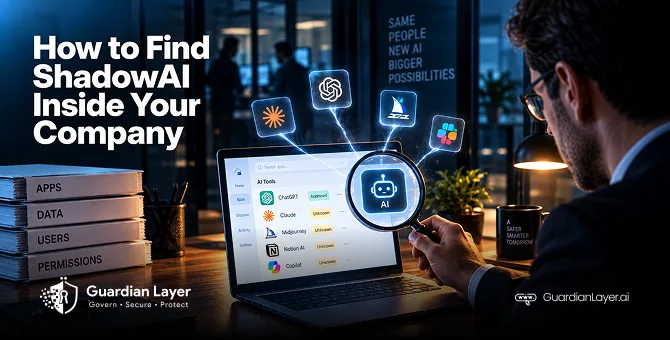
Somewhere in your organization right now, someone is pasting a client contract into ChatGPT to summarize it. Someone else is running your Q3 sales numbers through a free AI tool they found on Reddit last week. Nobody asked permission. Nobody filed a ticket. And your CISO has no idea any of it happened.
That's shadow AI, and it's not a hypothetical. It's already running through your Slack channels, your email drafts, and your customer data, whether your IT department approved it or not.
Most leadership teams still treat this like a policy problem. Write a memo, ban ChatGPT on the corporate network, move on. That approach fails almost every time, and here's the uncomfortable truth: it fails because it was never really a policy problem to begin with. It's a visibility problem. You can't govern what you can't see, and right now, most companies can't see much of anything.
Why Do Employees Turn to Shadow AI in the First Place?
Ask ten employees why they use an unapproved AI tool, and you'll get the same answer nine times: the approved option didn't exist, or it was slower, clunkier, or locked behind three approval layers. A marketer needs a first draft of ad copy in twenty minutes, not two weeks. A developer wants a code review buddy at 11 p.m. when nobody from IT is on call. A support rep wants to summarize a forty-message ticket thread instead of reading it line by line.
Unauthorized AI use isn't usually rebellion. It's convenient to win against bureaucracy. Workplace surveys over the past two years have consistently found that employees are adopting generative AI tools faster than almost any prior category of workplace software, faster than spreadsheets, faster than smartphones, faster than Slack itself. IT departments are used to controlling the pace of adoption. This time, the pace controlled them.
There's a second, quieter driver too: fear of falling behind. Employees see peers cutting their workload in half with AI, and they don't want to be the one person still doing things the slow way. So they download the app, sign up with a personal email, and start feeding it work data often without a second thought about where that data goes afterward.
What Does Unauthorized AI Use Actually Look Like Inside a Company?
It rarely looks dramatic. Nobody is smuggling in a rogue server. It looks like a browser extension installed on a laptop that summarizes emails and quietly logs every one of them to a third-party server. It looks like a free transcription tool used in a board meeting that stores the audio indefinitely. It looks like a finance analyst uploading a spreadsheet full of unreleased earnings data just to get a chart made faster.
Three patterns show up again and again once a company finally goes looking:
Browser Extensions with Broad Permissions
Employees install AI-powered writing assistants and "productivity boosters" that request access to everything on the page, including internal dashboards, CRMs, and HR portals.
Personal Accounts on Approved Tools
Even when a company has a sanctioned AI platform, employees sometimes bypass the enterprise login and use a personal, unmonitored account because it's one click faster or doesn't require a VPN.
API keys issued outside procurement
Engineering teams are the biggest offenders here. A developer grabs a personal API key from an AI provider, wires it into an internal script, and now company data is flowing to a third party with zero contractual protection and zero audit trail.
None of this shows up in a typical security review, because most security tooling was built to catch malware and phishing, not a sanctioned SaaS-style app an employee logged into with their own credentials. That's the core problem with AI visibility today: the tools built to protect your company weren't built with this threat model in mind.
It also rarely stays confined to one department for long. A pattern that starts in marketing, pasting draft copy into a free rewriting tool has a way of spreading to legal, then finance, then HR, simply because coworkers share what's working for them. Shadow AI grows the same way any convenient shortcut grows inside an organization: quietly, department by department, until it's touching nearly every kind of data the company holds.
How Do You Actually Get AI Visibility Across an Organization?
Visibility starts with traffic, not trust. Network and endpoint monitoring tools that already sit inside most mid-size and large companies secure web gateways, cloud access security brokers, and endpoint detection platforms can be reconfigured to flag connections to known AI domains. That single step, done properly, surfaces the majority of shadow AI use within the first week, because most employees aren't hiding their tracks. They just never thought to ask.
The next layer is a lightweight inventory. Not a forty-page audit. Nobody reads a running list of every AI tool touching company data, who owns it, what data it can access, and whether it retains that data for training. Treat AI tools the way modern software supply chains treat open-source dependencies: know what's in your stack before you can secure it.
Finally, talk to your people. A ten-minute anonymous survey asking "what AI tools do you currently use for work, approved or not" will produce more accurate results than any network scan. Employees aren't trying to be sneaky. Most will tell you exactly what they're using if you make it clear they won't get in trouble for answering honestly.
Run these three checks together, not in sequence, and compare notes. The network scan will catch tools employees forgot they even installed. The survey will catch tools that never touch the corporate network at all, like a personal phone app used to draft an email before it's copied over. Neither one alone gives you the full picture, but together they usually get you to 90% AI visibility within a month.
What Does Real Shadow AI Governance Look Like Once You Find It?
Here's where most companies get it backwards. They find shadow AI, panic, and lock everything down overnight. That approach buys two weeks of quiet before employees find a new, less visible way around the ban, usually a tool your monitoring hasn't been tuned to catch yet. You've traded visible risk for invisible risk, and that's a worse trade every time.
Real governance replaces prohibition with a fast lane. Set up an approval process that takes days, not months. Publish a short, plain-English list of AI tools that are pre-cleared for specific use cases: one for drafting, one for coding assistance, one for data analysis, each with clear boundaries on what data can and can't touch them. Give employees a tool that's almost as fast as the shadow option, and most will happily switch, because convenience is what drove them to shadow AI in the first place.
Pair that fast lane with a data classification rule that's genuinely simple to follow: public and low-sensitivity information can go to a wider range of approved tools, while regulated, financial, or customer data stays on a shorter, more tightly vetted list. Most employees don't need a security lecture. They need one clear rule they can apply in three seconds before they hit paste.
What Happens When a Company Finally Gets This Right?
A mid-size insurance firm spent six months believing it had "no AI usage" because its approved tool list had exactly one entry. A network audit told a different story: 43 distinct AI domains had been contacted from company devices in the prior ninety days, including three tools that had ingested policyholder claim data. Nobody had acted maliciously. Every single case traced back to an employee trying to finish a task faster.
Within sixty days of building a fast-lane approval process and publishing a plain-language data rule, unauthorized AI domain traffic dropped by more than 70%, not because access got harder, but because the approved path finally got easier than the workaround. That's the pattern that shows up again and again: governance that competes on speed wins. Governance that only restricts losses, slowly and then all at once.
The Bottom Line
Shadow AI isn't a future risk you need to prepare for. It's a present-tense reality sitting on the laptops your employees are using right now, at this exact moment. The companies that get burned by it aren't the ones with the most AI use; they're the ones with the least visibility into it.
You don't need a bigger security budget to fix this. You need to know what's actually happening inside your walls, build a governance path that's genuinely faster than the shadow alternative, and trust that most of your employees will take the easier, sanctioned route once you give them one. Start with visibility. Everything else follows from there.