When a patient comes home after surgery, an accident, a serious illness, or a long hospital stay, the family often thinks the difficult part is over.
In reality, the first few days at home can bring a completely different set of challenges.
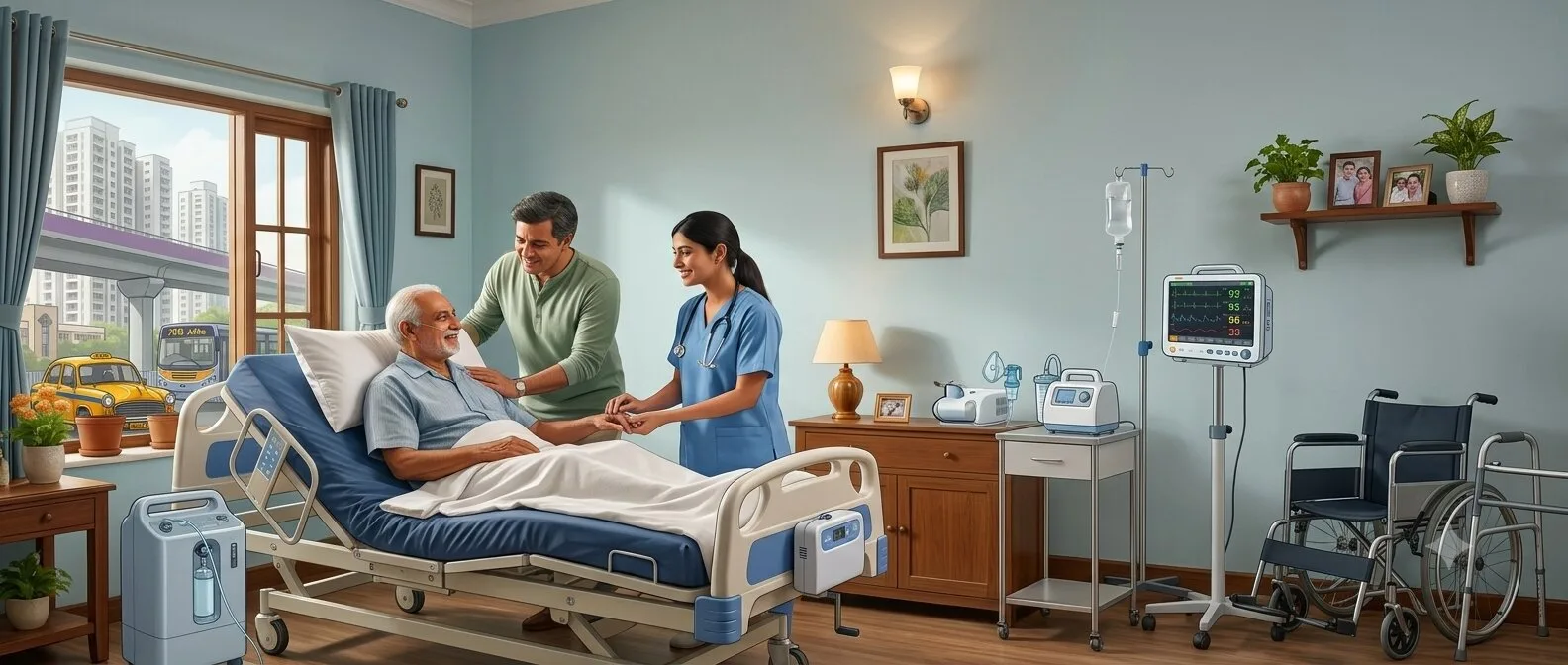
The patient may not be able to walk without assistance. Getting in and out of bed may be difficult. A wheelchair may suddenly become necessary. Some patients may require oxygen support, while others need equipment that makes routine care safer and more comfortable.
For families in Joka, Behala, Thakurpukur and nearby areas of South Kolkata, arranging these things quickly can be difficult, especially when they have never cared for a patient at home before.
The good news is that families do not always have to purchase every piece of equipment.
For short-term recovery, renting medical equipment can often be a more practical option, while buying may make more sense when the equipment will be needed for a long period.
Why Home Recovery Often Requires More Than a Bed
A patient's needs can change considerably after coming home.
Someone recovering from a minor procedure may only need a walking aid for a few weeks. Another patient recovering from major surgery may require a hospital bed, wheelchair and other supportive equipment.
The right equipment depends on the patient's condition and the advice of their healthcare team.
Some commonly needed equipment includes:
- Hospital beds
- Wheelchairs
- Oxygen concentrators and cylinders
- Nebulizer machines
- Air mattresses
- Commode chairs
- Walking aids
- Suction machines
- IV stands
- Over-bed tables
- Patient monitoring equipment
- ICU equipment for appropriate home-care situations
The purpose is not to turn every home into a hospital.
It is to make necessary care safer, more manageable and more comfortable for the patient and caregiver.
When Does Renting Medical Equipment Make More Sense?
This is one of the first questions families usually ask.
If the patient needs equipment only for a few weeks or months, purchasing an expensive device may not make financial sense.
For example, a patient recovering from surgery may need a hospital bed temporarily but may return to normal mobility after rehabilitation.
In that situation, renting can be practical.
Rental can be particularly useful for:
- Post-surgery recovery
- Short-term mobility problems
- Fracture recovery
- Temporary respiratory support
- Rehabilitation after hospital discharge
- Short-term patient care
- Temporary home ICU arrangements
Once the patient no longer needs the equipment, the family does not have to find storage space for it or worry about what to do with it.
When Should a Family Consider Buying Instead?
Rental isn't always the best answer.
If a patient has a long-term condition and is expected to use the equipment regularly for years, purchasing may be more practical.
For example, families may consider buying equipment when:
- The patient has a long-term mobility limitation
- A medical device will be used every day
- The equipment is required for ongoing home care
- The family expects to need it for an extended period
The decision should ideally be based on the expected duration of use, the equipment required and the patient's care plan—not simply on the initial price.
Hospital Beds Can Make Home Care Much Easier
A normal bed isn't always suitable for a patient who has difficulty moving.
A hospital bed can make it easier to change the patient's position, assist with getting in and out of bed and provide a more suitable setup for caregivers.
This can be particularly helpful for:
- Patients recovering from surgery
- Patients with restricted mobility
- Elderly patients
- Patients requiring prolonged bed rest
- People receiving home nursing care
Depending on the patient's requirements, families may need a manual or motorized hospital bed.
The important thing is to choose the equipment according to the patient's actual needs rather than simply selecting the most expensive option.
Wheelchairs and Mobility Equipment Are About Independence
A wheelchair is not necessarily a permanent solution.
For some patients, it is simply a temporary tool that allows them to move around while recovering.
A wheelchair can help a patient:
- Move around the house
- Attend medical appointments
- Travel short distances
- Participate in family activities
- Reduce unnecessary physical strain
Depending on the patient, families may consider manual, reclining, commode or motorized wheelchair options.
Walking aids can also be useful when a patient is gradually regaining mobility.
Oxygen Equipment Requires More Careful Consideration
Oxygen equipment should not be treated like an ordinary household appliance.
If a doctor has recommended oxygen therapy, the family needs to understand what equipment is appropriate and how it should be used.
Depending on the requirement, home-care providers may arrange equipment such as:
- Oxygen concentrators
- Portable oxygen cylinders
- Other oxygen-support equipment
Families should follow the prescribing clinician's instructions regarding oxygen use. The equipment provider can help with the practical setup and operation, but the patient's oxygen requirement should be medically determined.
Nebulizers Can Be Useful for Certain Respiratory Conditions
A nebulizer converts liquid medication into a mist that can be inhaled.
It is commonly used when prescribed for respiratory conditions such as asthma or certain respiratory infections.
For families managing respiratory care at home, having access to the appropriate nebulizer can make the treatment routine more convenient.
But again, the device itself is only part of the process.
The medication, dosage and frequency should come from the patient's doctor.
What About Home ICU Equipment?
Some patients require a much more intensive level of care after leaving the hospital.
In selected cases, families may arrange equipment such as:
- Ventilators
- Suction machines
- Infusion pumps
- Multiparameter monitors
- Emergency power backup equipment
A home ICU setup is considerably different from simply renting a hospital bed.
The equipment, clinical supervision, nursing support and emergency planning all need to be considered together.
Families should therefore discuss the home-care plan with the treating medical team before arranging critical-care equipment.
Don't Forget the Smaller Equipment
Families sometimes focus on the large items and overlook the smaller things that make everyday care easier.
Depending on the patient's needs, these may include:
- Air mattresses
- Commode chairs
- IV stands
- Over-bed tables
- Walking aids
- Suction units
For a bedridden patient, for example, an air mattress may help with pressure management, while a commode chair can make basic personal care easier.
These aren't glamorous purchases, but they can make a noticeable difference to day-to-day caregiving.
How Do Families in Joka Usually Arrange Medical Equipment?
The process doesn't have to be complicated.
A practical approach is:
First, understand what the patient actually needs.
Ask the doctor, nurse or physiotherapist which equipment is required.
Second, decide whether the requirement is temporary or long-term.
This helps determine whether renting or buying is more sensible.
Third, check the condition and maintenance of the equipment.
Medical equipment should be clean, functional and properly maintained before being used.
Finally, understand how to operate it.
A family caregiver should not be expected to figure out complicated equipment without proper instructions.
This is particularly important for oxygen equipment, suction machines, monitors and other devices where incorrect use can create unnecessary risk.
Medical Equipment Is Only One Part of Home Recovery
There is another part of home recovery that families sometimes overlook: follow-up care.
A patient may need regular monitoring or laboratory tests after returning home.
For elderly patients, people recovering from surgery or anyone with limited mobility, repeatedly travelling to a diagnostic centre can be tiring.
That is why services such as home lab tests in Joka can complement home-based medical care. A trained professional can collect the required sample at home and the sample can then be processed by a laboratory. Medilink Healthcare Services provides home sample collection for a range of routine tests in Joka and nearby areas.
The idea is simple: if the patient is already recovering at home, some routine healthcare requirements can also be arranged without unnecessary travel.
What Should Families Check Before Renting or Buying?
Before taking any medical equipment, ask a few basic questions:
- Is this equipment appropriate for the patient's condition?
- Has the doctor recommended it?
- How long is it likely to be needed?
- Would renting or buying be more practical?
- Has the equipment been cleaned and serviced?
- Will someone explain how to use it?
- What happens if the equipment develops a problem?
- Is delivery available to your area?
- Are replacement or maintenance services available?
These questions can prevent a family from making a rushed decision based only on price.
Why Local Availability Matters in Joka
When a patient needs equipment urgently, distance becomes important.
A family may not have the time or ability to travel across Kolkata looking for a hospital bed or wheelchair.
Having a local provider can make the process easier, particularly when delivery, installation or guidance is required.
Medilink Healthcare Services, based in Joka, provides medical equipment for both rental and purchase, including hospital beds, wheelchairs, oxygen equipment, nebulizers, ICU equipment and other patient-care equipment.
The company also connects equipment support with its broader home healthcare services, which can be useful for families managing recovery at home.
The Right Equipment Can Make Home Care Less Difficult
Home recovery is never exactly the same for two patients.
One person may need a wheelchair for three weeks.
Another may need a hospital bed for several months.
Someone else may require respiratory support or a more complete home-care setup.
That is why the goal shouldn't be to rent or buy as much equipment as possible.
The goal should be to arrange the right equipment for the patient's actual needs, for the appropriate period, with proper guidance.
For families in Joka and surrounding areas, having access to medical equipment locally can remove one more problem from an already stressful period.
And sometimes, making recovery easier isn't about doing something complicated.
It is simply about having the right support available when the patient comes home.