Every business owner trying to grow online eventually hits this frustrating moment: the website looks good, traffic is coming in, but the right customers still aren't calling. Rankings slowly climb, yet leads from actual nearby areas never quite materialize.
Before blaming the algorithm or throwing more money at ads, it's worth looking at something most people overlook entirely: whether the right types of pages even exist on the site.
This is exactly where most SEO services fall short; they optimize what's already there without questioning whether the page structure itself is the problem.
The conversation around service pages vs location pages SEO gets surprisingly little attention outside marketing circles, but it shapes everything about how search engines decide who surfaces and who disappears.
Getting this distinction right isn't a minor tweak. It's a structural decision that determines which searches a website can realistically win.
Two Pages, Two Completely Different Jobs
Here's the simplest way to think about it.
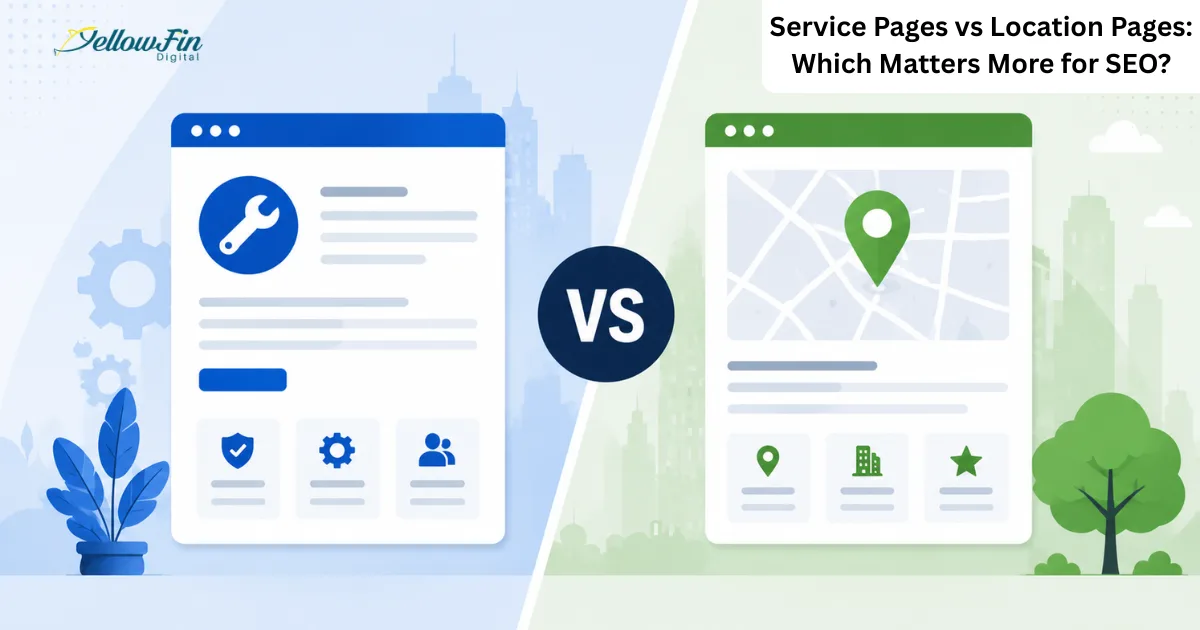
A service page answers "what do you actually do?" It's where someone lands when they want to understand an offering, how it works, what's included, why it's worth paying for. These pages attract people still evaluating their options.
Location page SEO plays a totally different role. It answers "do you serve where I am?" These pages exist for the person who already knows what they need and just wants someone local.
They're typing "fence installation near Westside" or "same-day AC repair [city name]", and they're ready to book.
Both serve real, distinct needs. Neither replaces the other.
It All Comes Down to How People Actually Search
Search intent is something most businesses never think about, but Google thinks about it constantly.
Someone typing "how much does roof replacement cost" is curious, maybe planning ahead. Someone typing "roof replacement [city name] this week" is standing in their living room staring at water damage.
Those two people need completely different pages, and sending both to the same generic service page is how businesses silently lose customers every single day.
Service pages work best for:
- People in research mode who want details before committing
- Comparisons between service types or approaches
- Long-tail informational searches that build awareness
Location pages work best for:
- High-intent searchers ready to hire someone locally
- Geographic searches including a city, neighborhood, or "near me"
- Situations where proximity and availability matter most
Miss this distinction, and even a beautifully designed website ends up invisible to the people most likely to convert.
What Strong Location Page SEO Actually Looks Like
This is where many businesses quietly go wrong. They build location pages, but build them lazily, the same block of text repeated across twenty city pages with only the name swapped out. It feels like a shortcut. In reality, it's a penalty waiting to happen.
Search engines have become extremely good at detecting templated content. And beyond the algorithm, real users can smell a copy-paste job immediately. If nothing on the page feels specific to where they live, they leave.
Genuinely effective local SEO landing pages look and feel different:
- They reference real neighborhoods, local landmarks, or area-specific details
- They include testimonials or job examples from customers in that specific location
- They define service coverage clearly, zip codes, driving radius, response times
- They use schema markup so search engines can properly read the location data
- Title tags and meta descriptions name the city alongside the service naturally
The underlying goal is simple: make someone from that area feel like the page was written for their neighborhood, not just indexed there.
Building Service Pages That Actually Do Their Job
A weak service page is a lost opportunity dressed up in decent design. Listing services without context, skipping the process explanation, and burying the call to action — these are the hallmarks of a page that ranks occasionally but rarely closes.
Strong on-page SEO for service pages means going deeper:
- Lead with a headline naming the actual benefit, not just the service category
- Walk through the process step by step — people want to know what happens after they call
- Answer real objections in a FAQ section — this naturally pulls in long-tail traffic too
- Show proof — photos, case studies, or customer stories make claims believable
- Place calls to action throughout, not just at the very bottom
Businesses investing in search engine optimization services that focus only on keyword placement while ignoring content depth consistently underperform.
Relevance isn't just about matching a search term — it's about genuinely answering what the person came to find out.
Why Local Search Optimization Needs Both
Here's the trap many businesses fall into: treating this like a choice. Either focus on service pages or build out location pages. Pick one, get good at it, move on.
That logic sounds reasonable. It's completely wrong.
Local search optimization depends on both page types working together. Service pages establish what a business is authoritative about. Location pages establish where that authority applies geographically. Pull one out and the whole structure weakens.
Internal linking is the thread that connects them. Every service page should point toward the cities where that service is available. Every location page should link back to relevant services offered in that area.
This network tells search engines the business isn't just vaguely present somewhere, it's a legitimate, active provider of specific things in specific places.
Scaling Smart Without Sacrificing Quality
Growing businesses serving multiple cities face a real dilemma. Build a location page for every possible area and content quality collapses. Build too few and entire markets go uncovered.
A disciplined multi-location SEO strategy solves this by prioritizing depth over breadth. Before creating any new location page, ask honestly:
- Is there real search volume in this city worth targeting?
- Can genuinely useful, unique content be written for this area?
- Does the business actually serve here regularly, or just occasionally?
Local SEO services for small businesses operate under tighter constraints, limited time, limited budgets, limited resources. That makes quality control even more critical.
A handful of excellent location pages in core service areas will consistently outperform a sprawling collection of thin, barely-differentiated pages chasing every possible zip code.
Where the Competitive Gap Actually Shows Up
Picture two businesses offering identical services in the same region. One has a solid service page ranking for broad terms. The other has built geo-targeted landing pages for every major city — each with specific content, local reviews, and proper schema markup.
When someone searches "[service] + [city name]," the second business wins. Not occasionally. Consistently.
Generic service pages can't carry local searches on their own. They lack the geographic signals those searches demand. Meanwhile, location pages without strong service content leave visitors with no reason to trust or reach out.
Local market reach that generates real revenue comes from combining both, one reinforcing the other at every stage of the customer journey.
Mistakes That Quietly Undo Good Work
- Swapping city names in identical page templates — search engines catch this fast
- Service pages that exist in a geographic vacuum with zero local context
- Skipping schema markup and leaving structured data signals completely unused
- No internal linking between service and location pages — breaks the connective tissue of the strategy
- Creating location pages for areas the business barely serves — misleads users and wastes crawl budget
Mastering Service Pages vs Location Pages SEO for Better Local Visibility
Neither wins alone, and framing it as a competition is the wrong approach entirely.
Location-based SEO content works precisely because these two page types operate in different lanes. Service pages build topical depth and credibility.
Location pages build geographic relevance and local trust. Together they cover how real people search, from early research all the way through to ready-to-hire.
Businesses that get this right, whether independently or by working with a skilled local SEO agency, consistently show up where it counts, not just for broad terms, but in the specific cities and neighborhoods where their actual customers are searching.
That's what separates a website that looks good from one that genuinely grows a business.