Ranking first on search engines used to feel like winning. Today, it often feels like a hollow victory. Many teams are driving more traffic than ever before—yet struggling with low engagement, weak conversions, and rising bounce rates. The problem isn’t visibility. It’s what happens after the click.
For years, digital strategy has revolved around search engine optimization (SEO): find the right keywords, optimize your pages, build backlinks, and watch traffic grow. And to be clear—SEO still matters. But somewhere along the way, it became the end goal rather than the starting point.
What’s increasingly clear is this: SEO alone is not enough. If your website doesn’t deliver a meaningful, usable, and trustworthy experience, even the best rankings won’t translate into real results.
It’s time to shift from search optimization to holistic web experience optimization.
The Rise—and Limits—of SEO
SEO earned its place as a cornerstone of digital strategy for a reason. It democratized visibility. It allowed small teams to compete with larger players. It brought structure to the chaotic world of online content.
But success in SEO also created a narrow definition of success itself.
Traffic became the primary metric. Rankings became the benchmark. Entire strategies were built around capturing attention—often with little regard for what happened next.
This led to predictable patterns:
- Content designed for algorithms rather than humans
- Pages are overloaded with keywords but lack clarity
- Aggressive tactics aimed at clicks, not comprehension
In many cases, teams succeeded in doing exactly what they set out to do: attract users. But attraction without retention is a fragile win.
Because once a user lands on your site, SEO stops doing the heavy lifting.
Where SEO Falls Short
The gap between visibility and value is where most digital strategies break down. And it usually happens in three key areas.
1. Mismatched Intent
Ranking for a keyword doesn’t guarantee you’re meeting the user’s actual need.
A page might attract thousands of visitors searching for a solution—but if the content doesn’t align with their intent, they leave. Quickly.
This is the hidden cost of traffic-first thinking: you optimize for queries, not for people.
2. Poor On-Site Experience
Even when intent is aligned, experience often isn’t.
Users land on pages that are:
- Slow to load
- Difficult to navigate
- Overwhelming in layout
- Distracting with pop-ups or ads
In these moments, users aren’t evaluating your SEO strategy. They’re asking a much simpler question: “Is this worth my time?”
If the answer isn’t immediately clear, they’re gone.
3. Content Without Clarity
SEO-driven content often prioritizes volume and keywords over meaning.
The result?
- Long articles that say very little
- Repetitive phrasing designed for ranking
- Lack of structure or narrative
Content like this might satisfy search engines—but it rarely satisfies readers.
And increasingly, search engines themselves are catching up to that reality.
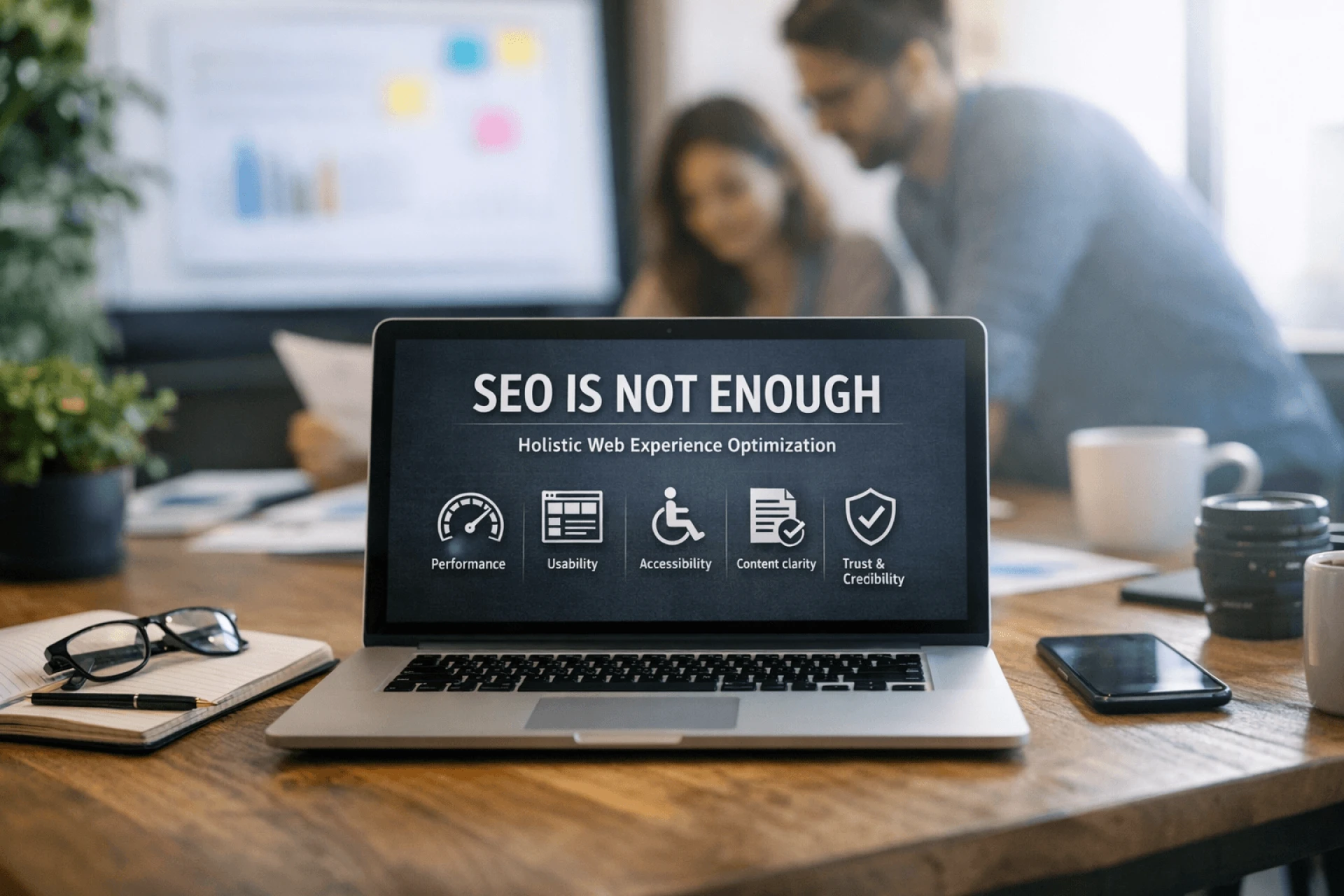
What Is Holistic Web Experience Optimization?
If SEO is about getting users to your site, web experience optimization is about what happens once they arrive.
It’s a broader, more integrated approach that focuses on delivering value across the entire user journey—not just the first click.
At its core, it includes five key pillars:
1. Performance
Speed is no longer a technical detail—it’s a user expectation. Slow websites erode trust before content even has a chance to speak.
2. Usability (UX Design)
Clear navigation, intuitive layouts, and thoughtful interaction design help users achieve their goals without friction.
3. Accessibility
A truly optimized experience works for everyone—including users with disabilities. Accessibility isn’t just ethical; it improves usability for all.
4. Content Clarity
Content should communicate ideas clearly, not just rank well. That means structure, readability, and purpose matter as much as keywords.
5. Trust and Credibility
Design, tone, and transparency all influence whether users believe what they’re seeing—and whether they’re willing to act on it.
These elements don’t replace SEO—they complete it.
The Business Impact of Better Experiences
Shifting to a holistic approach isn’t just about user satisfaction—it’s about measurable outcomes.
When experience improves, so does performance:
- Higher conversions: Clear, usable pages guide users toward action
- Lower bounce rates: Engaging experiences keep users exploring
- Stronger brand perception: Trust builds through consistency and clarity
- Long-term growth: Retained users are more valuable than fleeting visitors
In other words, traffic becomes more meaningful.
Instead of asking, “How do we get more users?” the question becomes, “How do we serve the users we already have better?”
From Silos to Systems
One of the biggest barriers to holistic optimization is organizational structure.
SEO, design, development, and content are often treated as separate functions:
- Marketers drive traffic
- Designers focus on visuals
- Developers handle performance
- Content teams produce material
But users don’t experience your website in silos. They experience it as a whole.
And when teams work in isolation, gaps appear.
- Great content hidden behind poor navigation
- Beautiful designs slowed down by inefficient code
- High-ranking pages that fail to convert
Holistic optimization requires a shift—from isolated efforts to collaborative systems.
A Practical Framework for Moving Forward
Making this shift doesn’t require a complete overhaul. It starts with small but meaningful changes.
1. Align Search Intent with Page Purpose
Before optimizing for a keyword, ask: What is the user actually trying to do?
Then design the page around that goal.
2. Design for Clarity, Not Just Attention
A visually impressive page isn’t enough. Users need to understand:
- Where they are
- What they can do
- Why it matters
Clarity reduces friction—and friction kills conversions.
3. Measure What Matters
Move beyond rankings and traffic. Track:
- Engagement time
- Conversion rates
- User flows
- Retention
These metrics reflect real value, not just visibility.
4. Prioritize Performance Early
Don’t treat speed as an afterthought. Build it into the design and development process from the beginning.
5. Encourage Cross-Team Collaboration
Bring marketers, designers, and developers into the same conversations. Better alignment leads to better outcomes.
From Traffic to Value
The future of digital strategy isn’t about abandoning SEO—it’s about putting it in its proper place.
SEO gets users to your door. Experience invites them in.
And in a digital landscape where users have endless options, the difference between success and failure often comes down to what happens in those first few seconds after a click.
Websites that win aren’t just optimized for search engines. They’re optimized for people.
They respect users’ time. They communicate clearly. They remove friction. They build trust.
In doing so, they turn attention into engagement—and engagement into lasting value.
Because in the end, traffic is only as valuable as the experience it leads to.