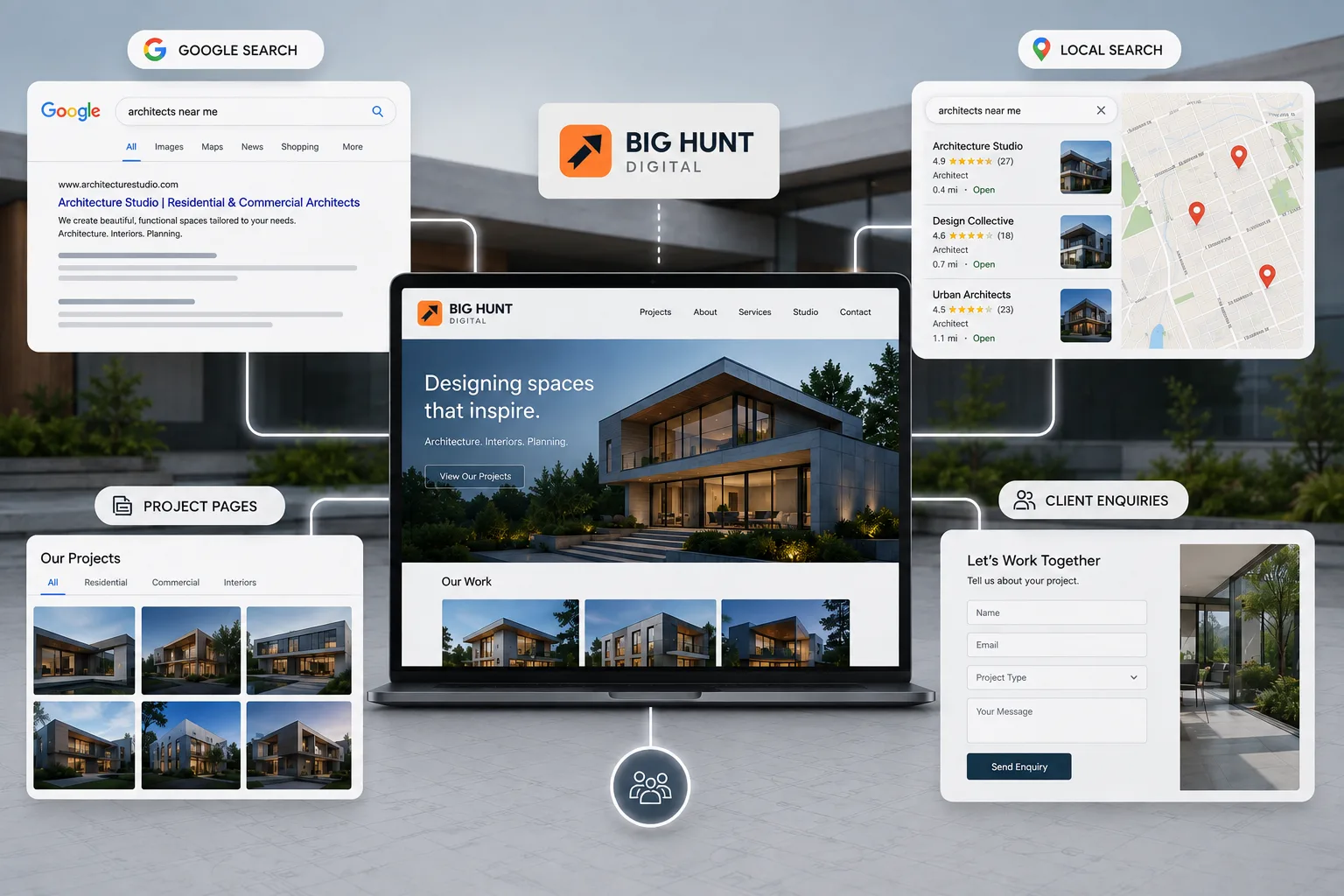
Open a project page from a typical architecture website on your phone. Now read it the way Google does, which mostly means ignoring the photos.
That little exercise is the fastest way we know to understand seo for architect firms. So let's do it properly, from the top of the page to the bottom.
The title
Most of the time it's a name. "Ealing House." "Project 14." "The Oak Residence." Lovely for a portfolio, useless for a search.
Nobody types "Ealing House" into Google. They type something like "rear extension Victorian terrace" and a borough. If the page never says what it is in plain words, there's nothing for that search to match. The fix is dull: call it what it is, "Rear extension to a Victorian terrace in Ealing", and keep the nice name underneath as a subtitle.
The first paragraph
Usually there isn't one. Or there's a line like "a light-filled family home, thoughtfully reimagined", which reads well and tells a stranger nothing.
What a homeowner wants to know is much more practical. How big was the house? What did the client ask for? Did it go through permitted development or a full application? Was anything awkward? That last one is the paragraph people actually remember. The neighbour who objected, the party wall negotiation, the conservation officer who wanted the brickwork changed. Practices tend to leave these out because they feel unflattering. They're the most convincing thing on the page, because they show you've been through it before.
The photos
Big, beautiful, and heavy. Four megabytes each, in a gallery that loads everything at once. On a phone on mobile data, that's a page that sits blank for a few seconds, and plenty of people don't wait.
Compress the images. Name the files after what's in them instead of a camera number. Write alt text that describes the picture the way you'd describe it to someone on the phone. And check how your gallery loads, because some load images in ways a crawler can't follow, which means the page looks full to a person and nearly empty to a search engine.
What the page doesn't say about itself
Look at the bottom. Is there a link to the service page for this kind of work? A related project? Anything telling the visitor what to do next?
Often it's a dead end. A page about a loft conversion should lead to your loft conversion page, and to another loft project, so both a visitor and a search engine can follow the thread. Behind the scenes there's also structured data, a bit of markup that says this is a project by an architecture firm and what kind. Visitors never see it. Search engines and AI tools lean on it more than you'd expect.
The page one level up
Zoom out for a second. Where does this project page sit? On a lot of sites the answer is "in a gallery", with a grid of thumbnails and no words around it. That grid page is a missed chance. It could introduce the type of work, say which boroughs you cover, and give a sentence or two on each project so the whole section reads as a map of what you do. Search engines treat a page like that very differently from a wall of thumbnails, and so do people. It also gives you somewhere natural to link from your homepage.
Who should fix it
If you have the time, you can do all of this yourself, one page at a time. Start with your three best projects. Most practices find it takes longer than they thought, mostly because writing about your own work is harder than doing it.
This is where a lot of people look at SEO services, and we'll be upfront: we sell them, so apply the right discount to what we say. What we'd suggest regardless of who you hire is a simple test. Ask them to open three of your project pages during the first call and tell you what's wrong with each. A provider who does that is paying attention. One who talks about "keyword strategy" without looking at your pages is working from a template.
Does any of it work
Two clients, at very different stages.
Extension Architecture, a London practice doing house extensions, conversions and new builds, has been with us since early 2016. Their problem wasn't a weak portfolio. It was structure and visibility: flat impressions, barely any presence in AI answers. Today their authority score is 31 and 148 pages are cited across Google AI Overview, AI Mode, Gemini and ChatGPT.
London Design & Build is much newer, a client since 2025. Their organic traffic is up 12% to 281 visits a month, with early citations on ChatGPT and AI Mode.
That second number isn't big, and we'd rather say so than dress it up. For a firm whose projects are large, 281 of the right people can matter more than 5,000 of the wrong ones. But it's early, and traffic isn't enquiries. If someone quotes you a traffic figure with no mention of what happened to the phone, ask about the phone.
The part we can't fix from a page
Everything above assumes the work itself is strong. If the photography is mediocre or the projects look like everyone else's, no amount of structure will make a stranger pick you. We can rebuild pages. We can't make the building better.
That's usually less of a problem than practices fear. Most have far better work than their websites show.