
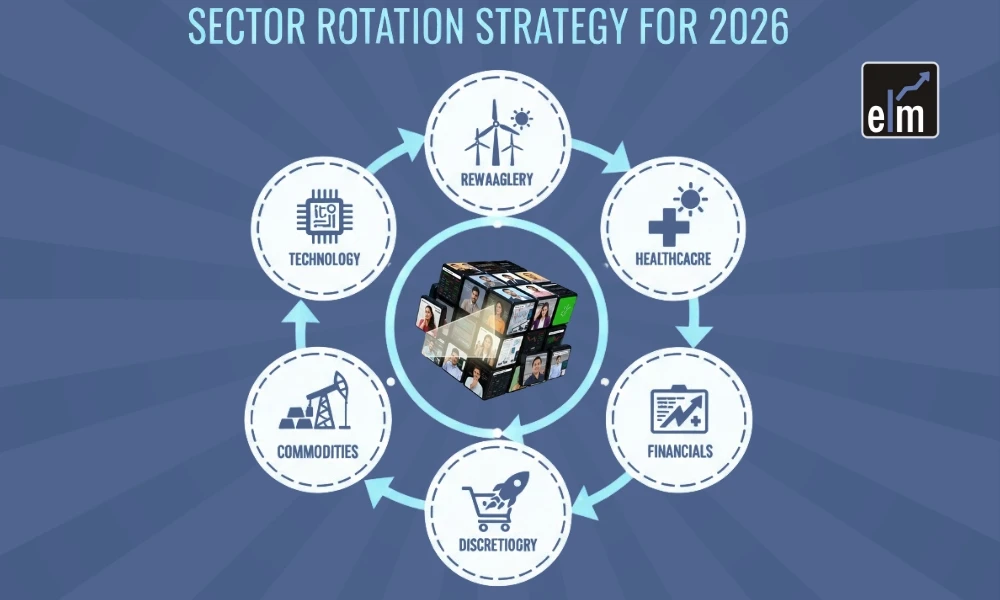
Indian equity markets require investors to understand sector rotation, as it often leads to better returns. The stock market opportunities in 2026 stem from index changes and new economic trends that require people to study sector movements. The guide establishes sector rotation strategies, which you can learn starting from entry-level stock market courses to advanced online stock market courses.
Understanding Sector Rotation: The Foundation
Sector rotation involves moving capital between industry sectors based on economic cycles. The approach identifies different economic development periods when various sectors demonstrate their best performance, which distinguishes it from buy-and-hold investment strategies.
The concept holds essential value for students pursuing stock market education programs. Economic growth periods tend to boost performance for cyclical sectors, which include banking and capital goods, while defensive sectors such as FMCG and pharmaceuticals maintain their strength during economic downturns.
The 2026 Landscape: Banking vs IT vs Capital Goods
Three sectors dominate the current market narrative in 2026, each presenting unique opportunities and challenges:
Banking Sector Dynamics
The banking industry is experiencing its most significant evolution since SEBI announced its index changes in October 2025. The Nifty Bank index expansion from 12 to 14 constituents, coupled with weight caps reducing concentration risk, has fundamentally altered sector dynamics. PSU banks have achieved an impressive recovery because the Nifty PSU Bank index reached its highest point in several years. State Bank of India's market valuation, which exceeded ₹10.9 trillion in February 2026, marks the beginning of this comeback. The study serves as a practical example for share market course students who want to learn about detecting market pattern changes, which happen to be their primary focus.
The banking sector enjoys advantages from credit growth, which operates at a 13-15% yearly rate, together with better asset quality and supportive interest rate conditions. The online share market courses teach students to track regulatory adjustments because these changes affect capital requirements, while they also impact stock prices through merger rumours.
IT Sector Positioning
The information technology sector will start its new phase in 2026 after achieving consecutive years of pandemic-driven growth. The worldwide business sector has reached a state of growth stabilisation after its digital transformation projects reached their final stage. IT stocks depend on international markets for 70-80% of their revenue, making currency fluctuations essential. The online stock market analysis courses teach students to monitor USD-INR rates because these rates serve as primary predictive indicators. The next-generation technology companies will experience growth through AI, cloud migration, and cybersecurity solutions.
Capital Goods Renaissance
The capital goods sector experiences a structural bull run, with infrastructure spending and "Make in India" and supply chain realignment established as drivers that benefit India. Power equipment companies, defence contractors, and industrial machinery manufacturers achieve multi-year order forecasting capabilities.
The online stock market courses demonstrate how government capital expenditures, which total ₹11.11 lakh crore in Budget 2025-26, directly influence this industry's performance.
Index Restructuring: The Game-Changer for 2026
SEBI's index reforms deliver the most important market transformation in decades, which stock market educational programs now use as their main teaching framework. Nifty 50 stock concentration reduction requires passive funds that manage over 7 lakh crore to sell their holdings because they must rebalance their portfolios. The process creates automatic buying and selling activities that occur without any connection to market fundamentals.
The Nifty Bank expansion presents stricter weight restrictions that lower single-stock danger while raising mid-cap bank selection value. Structured stock market programs teach students how to detect candidates for index inclusion before their official announcements.
Flow Impact on Sectors:
Index rebalancing creates substantial fund flows. Passive funds typically invest between ₹300 crores and ₹500 crores when new stocks join the Nifty 50 index. Financial certification courses now include "event-driven sector rotation" modules, which enable investors to position themselves before upcoming market transformations.
Union Bank of India's 6% surge following the Nifty Bank expansion announcement demonstrates this opportunity.
ETF-Based Rotation Models: Practical Implementation
Exchange-traded funds represent the most effective method for implementing sector rotation strategies, which enables investors who study stock market fundamentals through online courses to execute their investment plans.
Building Your ETF Rotation Framework:
Online stock market courses teach a systematic approach to ETF rotation. The first step requires assessment of the economic cycle to determine whether the economy experiences early expansion, mid-expansion, late expansion, or contraction.
The combination of GDP growth rates, PMI data and interest rate trends establishes economic indicators. The stock market courses for beginners require students to follow RBI policy statements together with quarterly GDP releases.
Step 2: Sector Strength Analysis. The analysis employs relative strength indicators to evaluate how sectors perform compared to the overall market. The banking sector demonstrates strength when Nifty Bank shows 5% better performance than Nifty 50 during three-month time spans. Online share market courses offer students tools that enable them to monitor these particular performance indicators.
Step 3: ETF Selection and Allocation Select highly liquid, low-cost exchange-traded funds that track your specified market sectors. For 2026, consider: Banking: Nifty Bank ETF (for diversified exposure), IT: Nifty IT ETF (for export-driven growth), Capital Goods: Nifty Infrastructure ETF (broader exposure)
Step 4: Rebalancing Triggers Set quarterly review schedules aligned with earnings seasons. The stock market trading courses teach students to practice discipline when they learn to practice stock market discipline. The rebalance process requires data-driven decisions, while emotional factors should not provide any basis for decision-making.
The 2026 Rotation Playbook
The online finance courses provide a tactical framework that requires assessment of current indicators to execute. The period from Q1 to Q2 2026 will show banking with 35 to 40% credit growth and index flows, while capital goods will show 30 to 35%, which results from the infrastructure peak, and IT will show 25 to 30% through its selected AI and cloud service operations.
The online platform for stock market courses teaches students to maintain flexibility when there are changes in macroeconomic conditions.
Learning Resources: Building Your Expertise
The process to learn sector rotation requires educational programs that provide organised learning materials. Beginners should start their learning journey with stock market courses, which teach them basic concepts before they move to online share market courses, which focus on sector analysis. The online stock market courses provide portfolio management training to intermediate learners who want to expand their skills.
The NSE's NCFM financial certification programs establish professional validation through their certification process. Advanced practitioners can develop their expertise through dedicated online stock market derivatives courses, which build their capacity for advanced trading strategies.
The best stock market education websites use three elements, which include video teaching, real-time trading evaluation, and hands-on learning tasks.
Conclusion: Your Sector Rotation Journey
The 2026 sector rotation presents investors with unique chances. Investors can use systematic strategies because of the market conditions, which enable them to access both index changes and separate sector movements together with exchange-traded funds. The path to success in financial certification programs and beginner stock market courses requires learners to follow a systematic approach while executing their tasks.
Your stock market education should begin with online courses that deliver real-world teaching methods. People who understand stock market dynamics through systematic learning methods will achieve better results in markets where timing is essential.