Heavy equipment failures rarely start with dramatic breakdowns. Most begin with one poorly machined Sector Gear that develops backlash six months earlier than expected, throws alignment off by 0.8 mm, and slowly damages the surrounding assembly. Procurement teams usually notice the issue only after downtime starts eating into dispatch schedules.
That’s where experienced Sector Gear Manufacturers separate themselves from catalog traders.
Precision-cut sector gears are in additional demand due to their growing use in steel factories, mining conveyors, cement processing units, hydraulic lifting systems, and automated gate systems since 2023.Indian manufacturers exporting engineered transmission components to 31 countries are now competing directly with European suppliers on tolerance consistency, lead time, and batch reliability.
And yet, many buyers still evaluate suppliers almost entirely on unit cost.
That mistake gets expensive fast.
Why Heavy Industries Depend on Precision Sector Gear Systems
A Sector Gear is not just a partial gear segment. In heavy industrial machinery, it controls rotational movement under load conditions where torque fluctuation, vibration, and shock resistance matter every hour of operation.
Which means even a small machining inconsistency can create uneven tooth engagement, premature wear, and eventually system instability.
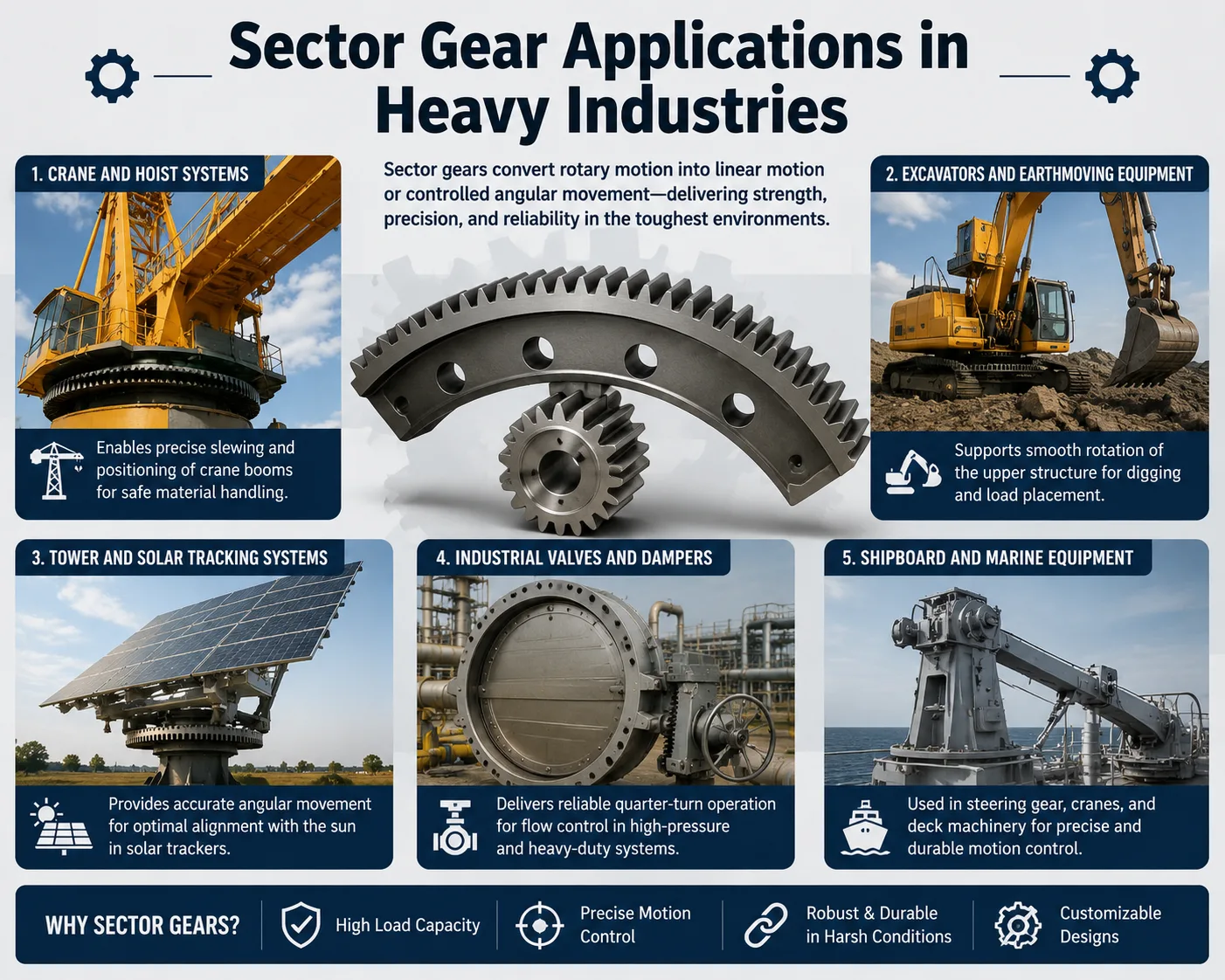
Industries using Sector Gear Manufacturers regularly include:
- Steel rolling mills
- Construction equipment manufacturing
- Railway infrastructure systems
- Material handling plants
- Power generation equipment
- Hydraulic gate control systems
- Packaging automation lines
Many of these industries also source associated transmission products from Helical Gear Manufacturers and Timing Pulley Manufacturers because integrated motion systems rarely operate with a single component category.
The Spec Detail Most Buyers Skip
Tooth Profile Accuracy Matters More Than Raw Material Grade
Buyers often obsess over alloy composition while ignoring tooth geometry reports.
That’s backward.
A perfectly certified steel grade still fails if tooth spacing variation exceeds operating tolerance. In heavy-duty industrial assemblies, cumulative pitch errors can create vibration patterns that damage bearings long before the gear itself fails.
Experienced Sector Gear Suppliers provide:
- Tooth profile inspection reports
- Lead accuracy documentation
- Hardness consistency records
- Heat treatment traceability
- Backlash measurement data
A supplier who says “our QC team checks everything manually” without documented inspection data is usually hiding capability gaps.
Surface Hardness Is Only Half the Story
Induction hardening depth matters.
Some low-cost suppliers harden only the outer tooth layer to reduce processing cost. The gear initially performs well, then micro-cracks develop under repetitive loading cycles. Buyers discover the issue after installation — the worst possible stage to find a manufacturing shortcut.
Most industrial-grade sector gears used in mining and steel operations require controlled hardening depth between 2.5 mm and 5 mm depending on load application.
Material Selection Depends on Operating Environment
Not every heavy industry requires identical metallurgy.
For example:
ApplicationPreferred MaterialMining equipmentEN24 alloy steelHydraulic systemsCast steelCement plantsHardened carbon steelMarine assembliesStainless steel variantsThat’s also why many procurement teams work with both Stainless Steel Gear Manufacturers in India and specialized Oil Pump Gears Suppliers in India for different operational environments.
5 Supplier Evaluation Criteria Most Procurement Teams Learn Too Late
1. Ask for Failure History — Not Just Success Stories
Every serious manufacturer has dealt with failures.
What matters is how they handled them.
If a supplier claims they’ve “never had a rejection,” you are probably speaking to a trading company, not an actual manufacturing operation.
Real factories track rejection trends obsessively.
2. Check Batch Consistency Across Repeat Orders
First samples are easy.
Consistent repeat production is harder than most buyers expect, especially with customized Sector Gear assemblies requiring tight machining tolerances. Many suppliers outsource overflow production quietly during high-demand months.
That’s where quality collapses.
Ask whether the same production line handles both sampling and commercial batches.
3. Heat Treatment Outsourcing Can Delay Entire Projects
Some Sector Gear Manufacturers cut gears in-house but outsource heat treatment to third-party vendors located 200–300 km away.
Which means:
- Longer lead times
- Higher rejection risk
- Transportation damage possibilities
- Less process accountability
A delayed heat treatment cycle can stall an entire OEM production schedule.
4. Certification Alone Doesn't Guarantee Capability
ISO certification helps. It does not automatically prove machining quality.
Nobody tells you this early enough.
Several suppliers maintain valid certifications while operating outdated hobbing machines incapable of maintaining repeatable precision under volume production.
Request:
- Machine list
- Inspection setup details
- Calibration records
- Sample inspection reports
5. Evaluate Response Speed During Technical Discussions
Slow technical responses usually become slower after payment.
A supplier taking four days to clarify module specifications before order confirmation will not suddenly become operationally sharp during dispatch disputes.
How the Right Supplier Protects Margins in Heavy Industries
Reduced Downtime Losses
Industrial shutdown costs add up fast. Steel processing units have production targets that take a long time to achieve. If the processing units experience just one hour of unexpected downtime, they can miss their targets.
Premature wear and the need to replace parts earlier than expected can be mitigated by dependable Sector Gear Suppliers.
Better Torque Transmission Stability
Precision-cut gears maintain smoother load distribution under variable operating conditions. That directly affects equipment life.
Which means fewer emergency maintenance calls.
Longer Replacement Cycles
Poorly machined gears often fail within 8–12 months in heavy-load environments.
Properly heat-treated industrial sector gears can operate reliably for several years under controlled lubrication and alignment conditions.
Lower Inventory Pressure
Procurement managers hate unpredictable replacement schedules because it forces excess inventory stocking.
Reliability of a component lowers the need for emergency buying.
Fits with Larger Motion Systems
Most heavy machinery systems combine:
- Helical gears
- Timing pulleys
- Sector gears
- Shaft systems
- Couplings
And more
Having a well-established partnership with Helical Gear Manufacturers and Timing Pulley Suppliers can ensure buyers remain within compatible limits for interconnected transmission systems.
Why the World is Watching India as the New Center for Industrial Gear Manufacturing
India is now the fastest growing region for industrial components, particularly for precision engineering exports, since 2020.
Several reasons explain the shift:
- Lower production cost compared to Europe
- Faster custom manufacturing capability
- Growing CNC machining infrastructure
- Export-focused engineering clusters
- Better raw material accessibility
Cities across Gujarat, Maharashtra, Punjab, and Delhi NCR now support large-scale gear manufacturing ecosystems.
That’s why international buyers increasingly source from:
- Sector Gear Manufacturers
- Timing Pulley Manufacturers
- Helical Gear Supplier networks
- sintered gear manufacturer india facilities
- Specialized Oil Pump Gears Suppliers in India
And freight matters more than many buyers realise.
For example, manufacturers located near ICD export hubs usually dispatch faster during container shortages because they already maintain established logistics relationships.
About Us — Built Around Industrial Reality, Not Catalog Claims
At Swadeshi Gears, we’ve spent years manufacturing industrial transmission components for buyers who care more about repeatability than marketing language.
We manufacture precision-engineered:
- Sector Gear
- Timing Pulley
- Helical gears
- Spline shafts
- Worm gears
- Industrial gear assemblies
Our production systems support exports to 31 countries, and we know exactly where industrial projects usually get delayed — inspection approvals, drawing mismatches, last-minute tolerance revisions, and inconsistent heat treatment scheduling.
Back in 2021, we replaced one of our subcontracted hardening processes after repeated feedback from overseas buyers operating high-load conveyor systems in humid environments. Surface hardness looked acceptable on paper. Field wear data told a different story. We changed the process instead of arguing with customers.
That’s factory-floor learning, not brochure writing.
Send Technical Drawings Before Asking for Final Pricing
If you’re sourcing from experienced Sector Gear Manufacturers, send:
- Module details
- Material grade
- Quantity requirement
- Application type
- Heat treatment expectation
- Gear dimensions
- Delivery timeline
We usually respond to technical inquiries within one working day.
MOQ depends on component complexity and machining setup requirements, but most industrial orders begin from small-to-medium batch production quantities.
For technical discussions or RFQ submissions, visit:
Swadeshi Gears Contact Page
Final Thoughts on Choosing the Right Sector Gear Manufacturer
The difference between average and reliable Sector Gear Manufacturers rarely shows up during quotation comparison. It shows up after installation, during pressure loads, continuous shifts, and unexpected operating conditions.
Most procurement failures are not pricing problems. They are verification problems.
As industrial automation expands across India and export markets, buyers who choose technically capable suppliers early will spend far less time dealing with breakdowns later.
Here is another blog you might be interested in.
Top 7 Factors to Consider Before Choosing Timing Pulley Manufacturers
FAQs
How do I evaluate reliable Sector Gear Suppliers in India?
Request inspection reports, heat treatment documents, machining capabilities, and repeat batch references. Be cautious about suppliers who avoid technical discussions and only focus on pricing.
Do manufacturers of Timing Pulleys produce custom industrial gears?
Yes. Larger engineering companies that provide a broad range of power transmission components often produce both. However, smaller companies focus on one category. Always check in-house capability.
Why do customers prefer Indian Helical Gear Manufacturers?
Export-oriented manufacturers have significantly reduced lead times since 2022 after the implementation of CNC hobbing and controlled heat treatment systems. While the cost of manufacturing is a factor, the main reason is the efficiency of their systems.
Can small-volume buyers buy from Timing Pulley Suppliers?
Yes. Due to custom tooling and setup costs, suppliers will charge more for low quantities. Some suppliers deprioritize small orders during peak production, so check dispatch times.
Are any local Oil Pump Gear Suppliers in India export grade?
A number of them are. However, the easier forms of manufacturing only scratch the surface of basic export capability. It is largely dependent on high standards of inspection and packaging.
What industries would purchase from Indian Stainless Steel Gear Manufacturers?
Manufacturing in the food and beverage, marine, pharmaceutical, and chemical industries need gears made of stainless steel. In those applications, corrosion resistance is prioritized over the capacity to carry a direct load.
Are sintered gears from Indian manufacturers a good deal for heavy-load machinery?
Yes, for a moderate-load and high-volume application, they are likely a good choice. However, for violent and extreme shock-load industrial applications, machined alloy steel gears are a better option. You shouldn't base your material choice soley on the unit cost.