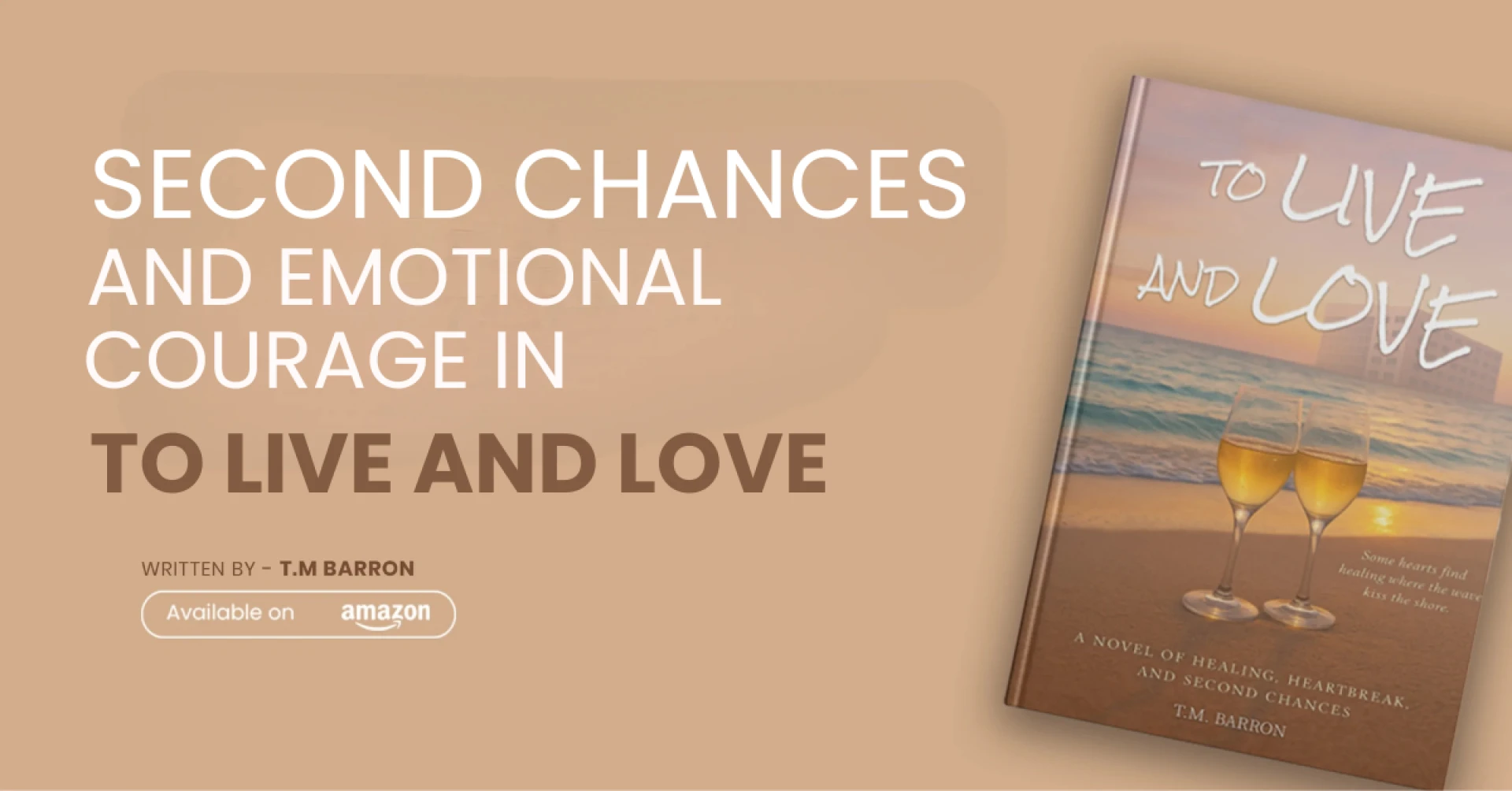
Second chances often arrive quietly, disguised as ordinary moments rather than dramatic turning points. In To Live and Love, T. M. Barron explores how love can reenter a life not through perfect timing, but through emotional readiness. This novel is a thoughtful meditation on vulnerability, risk, and the courage it takes to choose connection again.
Kennedie begins the story emotionally exhausted. Years of working as a nurse have left her accustomed to caring for others while neglecting her own needs. Loneliness has settled into her life not as a crisis, but as a constant presence. Her trip to the Turks and Caicos Islands is meant to be temporary; a pause rather than a transformation. Yet it becomes a space where long-suppressed emotions finally surface.
Gunner’s struggle is different but equally familiar. As an architect driven by ambition and family expectation, he has built a life that looks successful from the outside. Internally, however, he wrestles with uncertainty and the pressure to meet standards that may not align with his own desires. His emotional restraint mirrors Kennedie’s guardedness, making their connection feel natural rather than forced.
Barron’s greatest strength lies in her refusal to portray love as a cure-all. Kennedie and Gunner do not “fix” each other. Instead, their relationship becomes a space where honesty feels possible. They are drawn together not by fantasy, but by recognition; seeing in one another the same quiet longing for something more meaningful.
The novel also examines the fear that accompanies second chances. Past heartbreak leaves scars that make vulnerability feel dangerous. Barron captures this hesitation with subtlety, allowing readers to feel the tension between desire and self-protection. Love, in this story, is not about abandoning caution, but about choosing courage despite it.
The island setting serves as an emotional contrast rather than an escape. While the surroundings offer beauty and calm, the characters’ internal conflicts remain unresolved. This reinforces one of the novel’s central messages: changing scenery does not automatically change emotional reality. True transformation requires introspection and choice.
Importantly, To Live and Love respects the complexity of adult relationships. Career paths, family responsibilities, and personal boundaries all influence the characters’ decisions. Barron does not simplify these challenges or offer easy resolutions. Instead, she presents love as something that must coexist with responsibility rather than replace it.
By the novel’s conclusion, the question is not whether love is perfect, but whether it is worth the risk. Barron suggests that second chances are less about rewriting the past and more about choosing differently in the present. It is this emotional honesty that gives the story its lasting impact.
For readers who appreciate romance rooted in realism and emotional depth, To Live and Love offers a moving reminder that love does not demand certainty; it asks for courage.
Amazon Link: To Live and Love