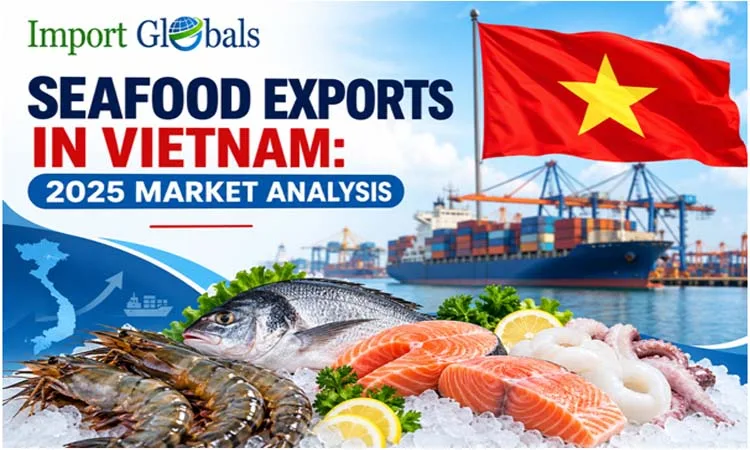
As a result, the seafood industry is successful in supplying and serving its importers, distributors, retailers, and wholesalers across continents such as Asia, North America, and Europe. Moreover, thanks to favourable geographical location and numerous free trade agreements, the country has been able to strengthen its position in seafood supply and trade networks. The major types of Vietnamese seafood include shrimp, pangasius, tuna, lobster, cephalopods, crab, and various types of value-added seafood products, as per Vietnam Shipment Data.
Vietnam import and customs data allow various businesses to get complete information on feed, raw materials, processing equipment, packaging, and finished seafood products. Vietnam shipping data provides the latest updates on how international purchases are made. As a result, 2025 became another successful year due to increasing global demand, success in the production of high-value products, and the wide array of markets and consumers.
THE IMPORTANT CONTRIBUTION OF VIETNAM TO GLOBAL SEAFOOD TRADE
Vietnam is among the countries that have been successfully involved in seafood trading. Due to being highly productive in aquaculture year-round, and because of modern processing facilities and the reliability of suppliers, the industry is favourable for trade. The work of various organizations that negotiated treaties, such as the CPTPP, has helped to expand the clientele for seafood products.
Vietnam can be mentioned as one of the selling countries whose products are bought by customers in many countries such as China, the USA, Japan, South Korea, and the EU. These products are sold in retail stores and food industries. Moreover, the sector creates a great demand for fish meal, feed mix, packaging materials, and different chemicals and equipment for production. Companies can get information on the seafood industry and trade from the data provided by seizures, and also from customs information.
A THOROUGH ANALYSIS OF VIETNAMESE SEAFOOD EXPORTS IN 2025
Vietnam seafood exports in 2025 hit the USD 11 billion milestone for the first time, just exceeding USD 11.34 billion, which was approximately a 13% growth compared to the volume of exports in 2024. According to the Vietnam Trade statistics, shrimp has become the main factor in the growth of seafood exports with a solid turnover of around USD 4.65 billion. Within this category, the leading item was White leg shrimp, while Black tiger shrimp had a minor but stable volume.
Pangasius remained the second most important seafood export category with total values of USD 2.19 billion supported by stable demand from Asian markets such as China. Tuna exports were also very strong and totalled USD 924 million, leading to a constant rise in processed and canned products in the tuna category despite the problems with raw material supply and traceability. Lobster exports were also remarkable, with an increase to around USD 817 million.
Seafood processors are widely employing automation solutions, new freezing technologies, and traceability methods. Vietnam Export Data provide detailed information regarding shipment operations at the level of individual orders, including descriptions of products, destination markets, shipment volume, and trading companies dealing with deliveries.
MOST SOLD SEAFOOD PRODUCTS ABROAD BY VIETNAM IN 2025
The high-volume and premium categories of seafood exports of Vietnam have been driving the country’s hoods. Various products are grouped into categories of sales, and here are the top-selling products
Shrimp - Shrimp is a leader and accounts for about 41% of exported cash inflow (about $4.65 billion). The most popular segments in the category are white shrimp, black tiger shrimp, and shrimp products, as per Vietnam Customs Data.
Pangasius – This category accounts for about 19.3%, which gives $2.19 billion, and is very popular among customers (the shipments can be fillets and finished products).
Other marine fish – Takes about 19% of the entire export cash inflow (about $2.16 billion). The reason for this success is the variety of markets and increasing demand for processed fish.
Tuna – Approximately 8.1% of the total cash inflow comes from the exports of tuna (around $924 million). Tuna can be delivered either canned, in pouch, or in the form of loins.
Lobster - Lobster is a growing niche of seafood exports that currently comprises about 7.2% of the exported revenue (about $817 million).
WHAT DETAILS ARE INCLUDED IN VIETNAM CUSTOMS DATA?

IMPORT-EXPORT DATA OF VIETNAM: A STRATEGY FOR BUSINESS DEVELOPMENT
Data on the imports and exports of Vietnam are useful for the seafood industry. While Vietnam assumes the role of a significant fish exporter, its processing sector still relies heavily on imported raw materials as well as feed, packaging materials, and equipment.
Import statistics provide firms operating in this area with information about traders using fish meal, feed additives, various packaging, and equipment. Vietnam Import Data on historical trade enables firms to find out who their importers are and what their purchasing patterns are. Companies can also assess the development of different volumes and categories of goods. Besides this, data about shipments from Vietnam allows companies to evaluate their competitors, as it provides complete insights into shipment activities.
HOW CAN THE IMPORT-EXPORT INFORMATION OF VIETNAM ASSIST IN COMPANY DEVELOPMENT?
- Knowing potential buyers and suppliers – Vietnam's customs information enables businesses to identify processors, importers, exporters, and distributors. Furthermore, product details and the HS codes provide them with up-to-date information for their trade activities.
Tracking competitors’ shipments – Vietnam shipment data allows businesses to keep track of the sourcing process and learn the purchasing habits of other companies. Thus, they can find out the exporting countries and shipping routes that would strengthen their competitive positions.
Analysing the market demand – Vietnam trade data is a tool for analysing product demand growth or decrease and making timely corrections.
THE OUTLOOK OF FUTURE VIETNAMESE SEAFOOD EXPORTS
The outlook for Vietnamese seafood exports is dependent on several factors, including international demand for their products, levels of investment in processing, government compliance, and sustainability norms. Core products are expected to comprise shrimp and pangasius, and value-added products will include high-end products such as lobster. The industry expects to generate revenues close to USD 11.5 billion by the end of 2026.
Companies can take advantage of data related to Vietnam imports, Vietnam trade statisticsto get a clear picture of developments in the industry and identify opportunities coming their way.
Conclusion - Vietnam ranks among the important nations for the production and export of fishery products. The remarkable success of 2025 can be attributed to a talented manpower pool, sufficient aquaculture capabilities, and well-developed markets. The most important groups among the fishery exports are shrimp, pangasius, tuna, lobsters, and other ocean fish. Producers rely on imported feed, raw materials, and equipment to improve productivity. The trade data of Vietnam provides an excellent opportunity for companies to track such flows, while shipping data of Vietnam enables them to find active buyers and suppliers.
CTA
Looking for the latest market opportunities in Vietnam seafood trade? You have landed on the right platform here. Import Globals helps businesses get detailed information regarding the active coverage of seafood shipments. Subscribe to www.importglobals.com or drop an email at [email protected] for detailed analysis of Vietnam's seafood trade in order to accelerate your long-term business growth.
FAQ’s
Que - What are the top seafood products exported from Vietnam in 2025?
Ans - Shrimp and pangasius are some of the top seafood products exported from Vietnam in 2025.
Que - What is the total trade value of Vietnam seafood exports in 2025?
Ans - The valuation of seafood exported from Vietnam in 2025 is 11.34 billion US dollars.
Que - How does Vietnam import-export data support business growth?
Ans - Vietnam import-export data support business growth via proper identification of buyers, suppliers, analysis of market demand, and development of effective market expansion strategies.
Que - What information is available in Vietnam trade data?
Ans - Vietnam trade data covers importer names, exporter names, shipment date, HS code, product details, quantity, values, pricing information, origin country, importing country, and port details.
Que - How frequently is the Vietnam trade data updated?
Ans - Vietnam trade data is updated on a monthly basis.
Que - Where can you obtain detailed information on Vietnam trade data?
Ans - Visit www.importglobals.com or drop an email at [email protected] for detailed updates on Vietnam trade data.