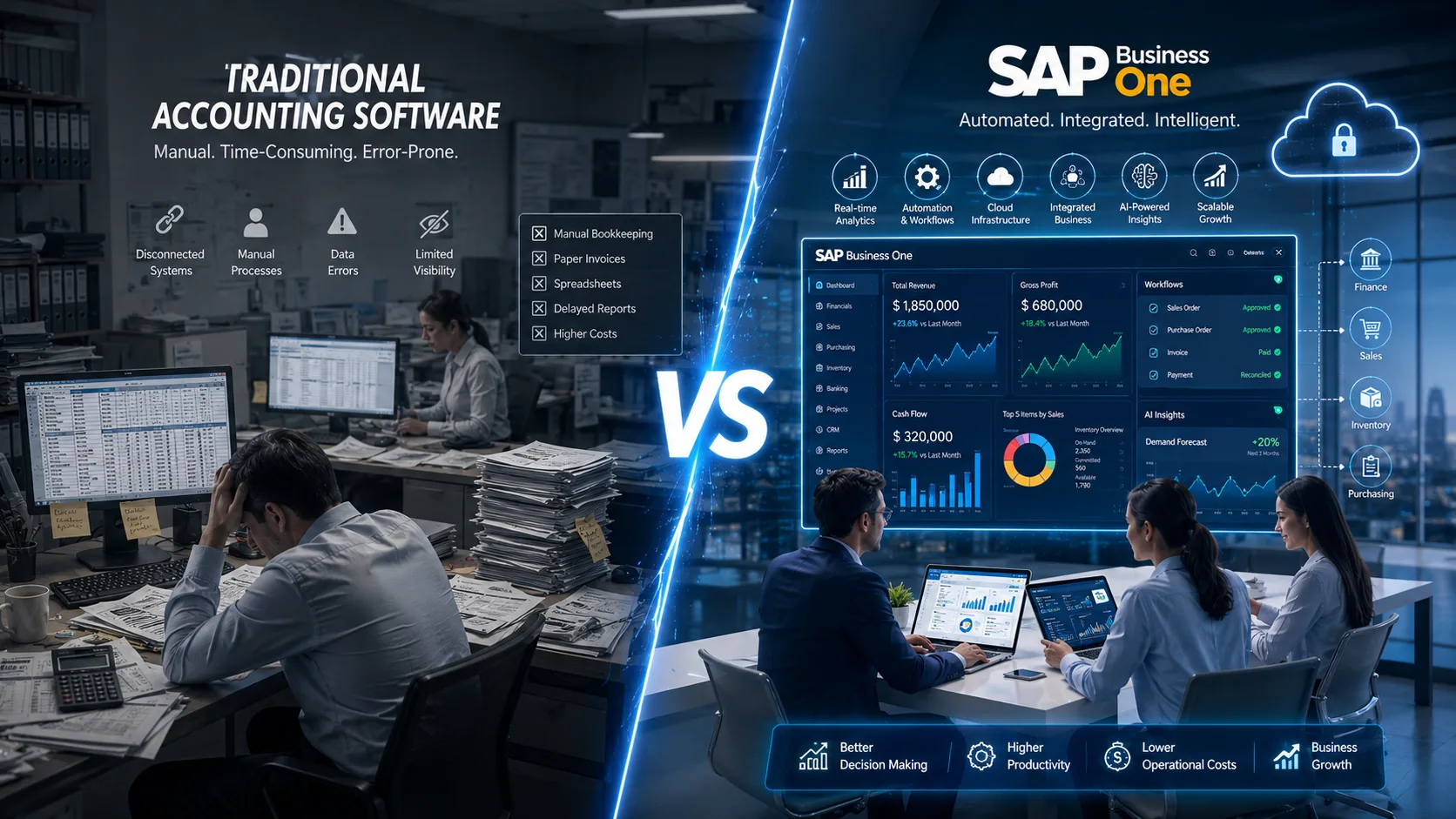
Many emerging organizations find conventional accounting software useful in their early years, as it helps them manage bills, expenses, and accounts. However, as their organization expands, companies may encounter issues beyond the capabilities of such accounting software.
At this point, SAP Business One ERP becomes relevant. Modern companies require more than traditional accounting, they need transparency, automation, collaboration, and decision-making support. To understand why, let us explore the key differences between traditional accounting software and SAP Business One ERP.
1. Accounting vs Business Management System: The conventional accounting package deals primarily with financial transactions. Some basic operations of the accounting software are:
# Billing and Invoicing
# Calculation of GST
# Accounts Payable and Receivable
# Basic Financial Reporting
While these are essential components of any business process, they capture only a portion of an organization's operations. This is where SAP Business One stands out, as it combines several business processes within a single system, encompassing areas of finance, sales, procurement, inventory management, production, customer relationship management, service management, analytics/reporting, etc.
2. Real-Time Visibility: A key weakness of conventional accounting software is that it does not provide any form of operational visibility. Firms use spreadsheets, coordination processes, and disparate systems to control inventories, manufacturing, and order management.
The problem here is inefficiency, duplication, and mistakes. In SAP Business One, firms get operational visibility into all activities. Managers can see in real time:
# Inventory
# Sales orders in process
# Manufacturing operations
# Financials
# Purchasing needs
# Client interactions
This is useful for decision-making and efficient management.
3. Effective Inventory and Warehouse Management: While standard accounting solutions normally provide only basic inventory management functionalities, expanding businesses may find themselves needing:
# Batch management
# Serial number management
# Visibility across multiple warehouses
# Bin management
# Demand forecasting
# Inventory aging analysis
These features are not easily obtainable with stand-alone accounting systems. The intelligence of the SAP Business One inventory management system enables better avoidance of stockouts, overstocking, and confusion. This is highly crucial for industries such as manufacturing, pharmaceuticals, chemicals, and trading.
4. Automation: Even many firms using conventional methods in accounting are dependent on manual activities and multiple data entries. Such as:
# Information about sales is entered manually in accounting software as well as inventory software.
# Approvals regarding purchases may come via emails or documents.
# Reporting requires manual effort.
It becomes prone to errors and wastage of time. With SAP Business One, companies will find themselves able to cut down their manual efforts in approving tasks, reporting, alerting, and other activities. The result would be increased efficiency and accuracy.
5. Scalability: Accounting software may be suitable for small businesses, but as companies expand, things get complicated. Companies start dealing with:
# Branches
# Greater inventory
# Increased manpower
# Increasing number of clients
# Complicated logistics
# Production processes
This is when many firms realize that the accounting software they are using is not scalable enough. This is why SAP Business One was created. It helps expanding companies to evolve without constant software changes.
6. Better Reports and Analytic Tools: In conventional systems, reports tend to be inflexible and finance-oriented. It could be difficult for the management to get immediate insights about the business.
Using SAP Business One, companies can have live dashboards and analytics tools to facilitate tracking of KPIs within departments. It will become easier for managers to make quicker and more intelligent decisions based on the current status of business operations rather than waiting for manual reports.
Closing Thoughts:
Conventional accounting applications are great for handling basic accounting tasks. But businesses in the modern world need much more than just accounting. For competitiveness, businesses need integration, automation, visibility, and scalability, among others. With SAP Business One, businesses can achieve more.
SoftCore Solutions offers customized SAP B1 ERP solutions for businesses across industries. Be it manufacturing, pharma, chemical, textile, or others, we ensure each business grows seamlessly with the help of SAP Business One. Book a live demo to experience the possibilities with SAP Business One. Frequently Asked Questions (FAQs):
1. Can SAP Business One help manufacturing companies?
A. Absolutely. Manufacturing businesses can manage production planning, bills of materials (BOM), MRP, and shop floor operations efficiently.
2. How secure is SAP Business One?
A. SAP Business One includes role-based access controls, data security features, and audit trails for secure operations.
3. What is the implementation time for SAP Business One?
A. Implementation timelines vary depending on business size and complexity, but it can generally be implemented in a period of 8-12 weeks.