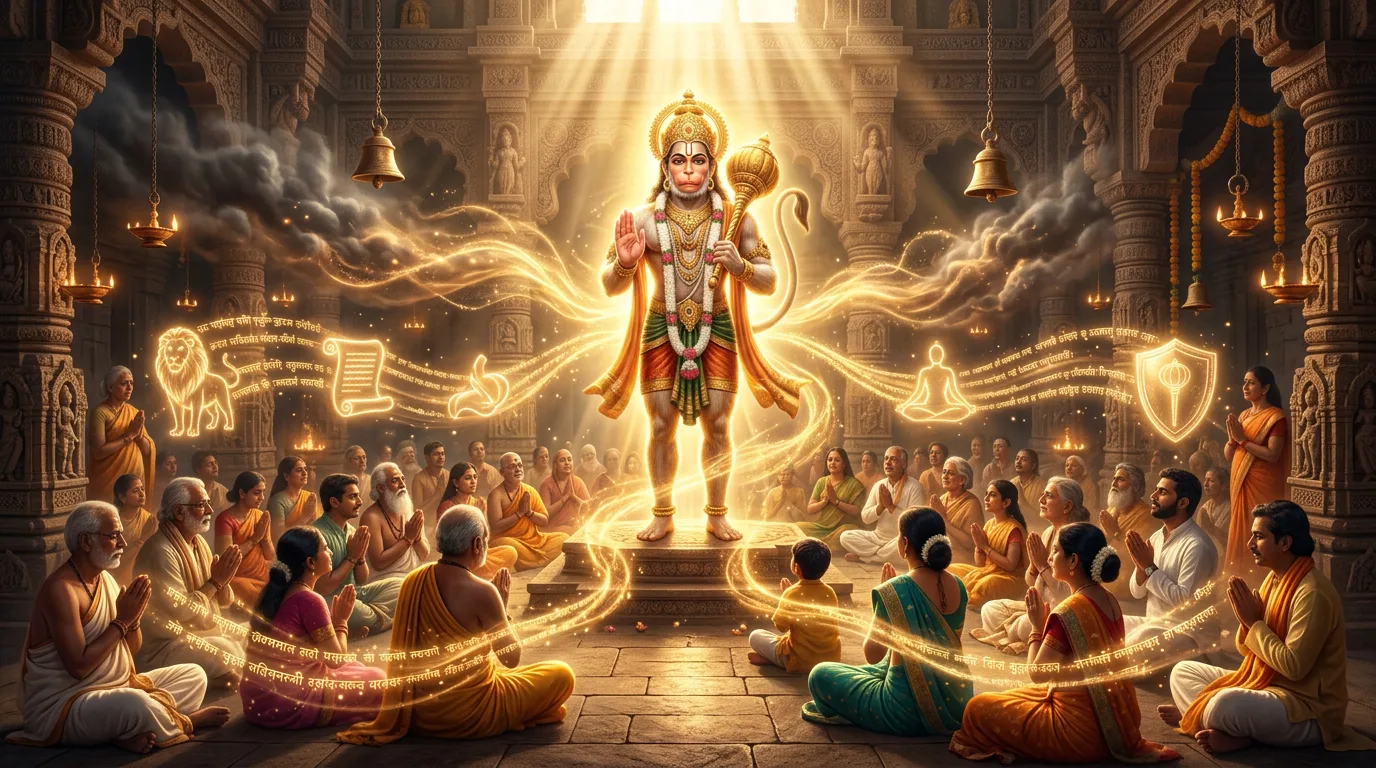
Most of us have faced a moment when a problem felt too heavy to carry alone. In Hindu devotional tradition, that is often when people turn to Hanuman, known as Sankat Mochan, the remover of troubles. One of the most cherished prayers to him is the Sankat Mochan Hanuman Ashtak.
What Is the Hanuman Ashtak?
"Ashtak" means a hymn of eight verses. This one is traditionally attributed to Tulsidas, the 16th-century poet-saint who also composed the Hanuman Chalisa. Each verse recalls an episode from the Ramayana in which Hanuman rescued someone in distress, and each ends with the same refrain: who in the world does not know you as Sankat Mochan?
That refrain gives the prayer its emotional pull. The devotee remembers the past rescues and then, in the final verse, asks for help with their own trouble.
The Eight Episodes It Recalls
- The child and the sun: Young Hanuman mistakes the sun for a fruit and swallows it, and the world goes dark until the gods intervene.
- The meeting of Rama and Sugriva: Hanuman brings Rama to the exiled Sugriva and ends his fear of Bali.
- The search for Sita: He revives a discouraged search party by finding news of her.
- Ashoka Vatika: He comforts Sita and hands her Rama's ring.
- The Sanjeevani herb: He carries an entire mountain to save the fallen Lakshmana.
- The serpent-noose: He frees Rama's army from the Nagpash during the battle with Ravana.
- Ahiravan in Patala: He rescues Rama and Lakshmana from captivity in the underworld.
- The personal plea: The devotee asks him to remove whatever trouble they carry today.
A short doha follows, praising Hanuman's red form and his diamond-strong body.
Why People Recite It
Devotees chant the Ashtak for courage, protection and peace of mind. Reading the stories in sequence has a steadying effect, because every verse shows an impossible situation being met with devotion, humility and action.
A Simple Way to Recite It
- Pick the day: Tuesdays and Saturdays are traditionally associated with Hanuman.
- Settle in: Sit somewhere quiet and clean, and light a diya if you wish.
- Know the story: Understanding each verse makes the recitation more meaningful than rote repetition.
- Combine prayers: Many devotees recite it alongside the Hanuman Chalisa.
- Bring sincerity: The devotion behind the chant matters more than the ritual around it.
Read the Lyrics in English
If you'd like to follow along as you chant, the complete text is available in English, along with a video rendition by Hariharan, in this guide to the Sankat Mochan Hanuman Ashtak lyrics on Bhakti Marg.
Jai Shri Ram. Jai Hanuman.