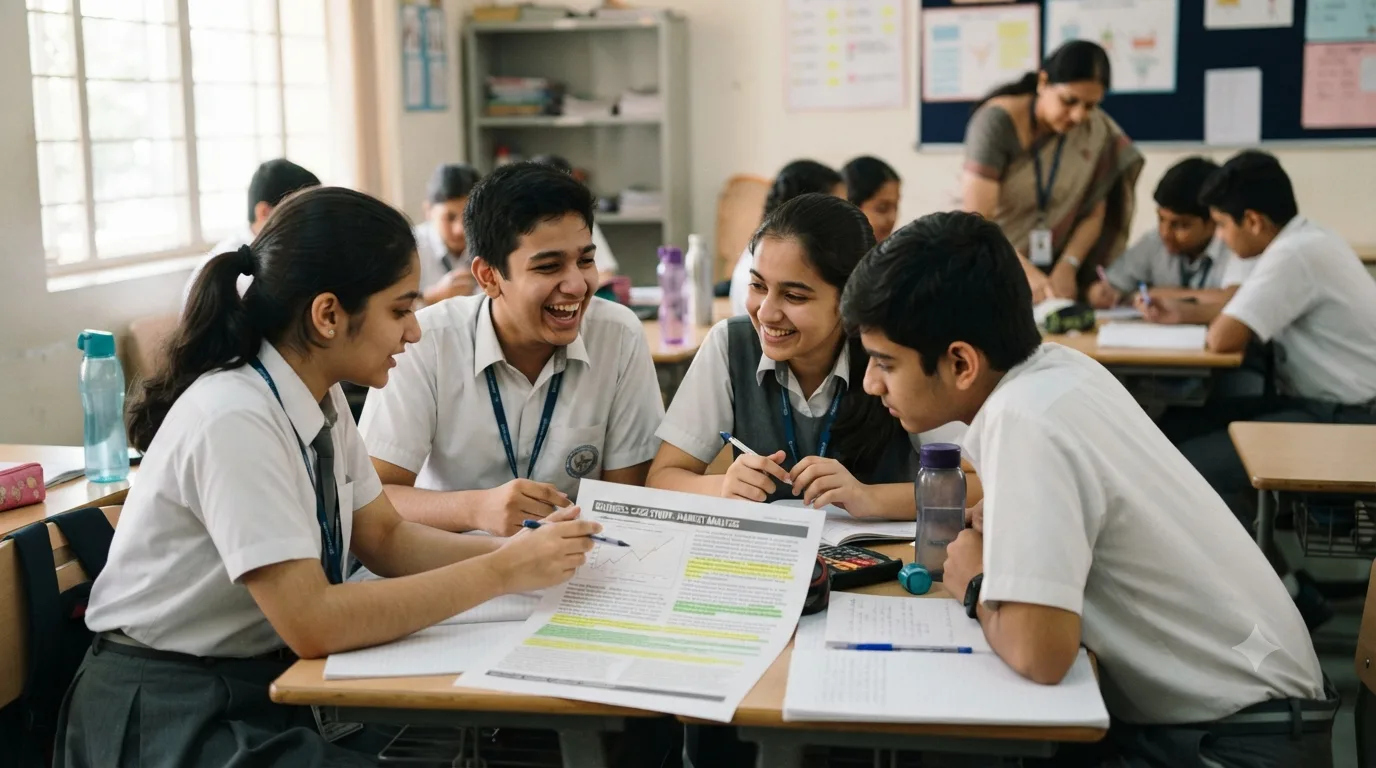
For decades, a good board result in India meant one thing: remembering a lot, and writing it down accurately. That is changing. In its 2026 board exam pattern for Classes 10 and 12, the Central Board of Secondary Education (CBSE) has made a clear statement about what it wants students to be able to do: apply what they know, not just recall it.
This article explains what has changed, why the change was needed, and what students, parents and schools can do to adapt.
What has changed in the CBSE exam pattern
According to CBSE's circular of 9 February 2026, as reported by Business Today, half of each paper now consists of competency-based questions. These include case studies, source-based questions and application-oriented problems that test real-world reasoning. The board says the overhaul is aimed at improving efficiency and transparency for nearly 46 lakh students.
The broader paper structure, as widely reported, works out like this:
- 50% competency-based questions (case-based, source-based, data interpretation, situational problems)
- 20% objective or select-response questions such as MCQs
- 30% traditional short and long answers
Class 10 students also now have two board exam opportunities a year, a reform inspired by the National Education Policy (NEP) 2020 and intended to reduce the pressure of a single high-stakes attempt.
Why the shift was needed
The case for change is clearest in national learning data. The PARAKH Rashtriya Sarvekshan 2024, India's first large-scale competency-based assessment under NEP 2020, tested about 21 lakh students in Classes 3, 6 and 9 across 74,229 schools in 781 districts, as reported by the Free Press Journal. It found that younger students did comparatively well, with 57% showing language proficiency and 65% showing mathematics proficiency in Class 3. Performance then fell sharply in the upper grades.
The maths numbers tell the story. Average maths scores fell steadily as students moved up, from about 60% in Class 3 to about 37% in Class 9, according to ETV Bharat's coverage of the survey data. Educators quoted in that report attribute the decline largely to rote memorisation.
The pattern is familiar to anyone who has taught for long. A student can learn a method well enough to reproduce it in an exam, yet struggle when the same idea appears in an unfamiliar form. Competency-based questions are designed to expose, and then reward, genuine understanding.
What a competency-based question looks like
A recall question asks: Define a percentage. A competency-based question asks something like this:
A school bookstore offers a 15% discount on a bag priced at ₹2,400. A parent has a coupon for a further ₹100 off the discounted price. Is it cheaper to apply the coupon first and then the discount? Show your reasoning.
There is no formula to simply recite. The student must read the situation, choose a method, compare outcomes and explain the choice. The same logic runs through case studies in science, source-based questions in history and data interpretation in geography.
How students can prepare
- Understand before you memorise. After each chapter, try explaining the main idea aloud in your own words. If you cannot, revisit it.
- Practise with real-life contexts. Look for examples of each concept in daily life, such as discounts, travel timetables, news graphs or kitchen science.
- Work through sample papers. CBSE publishes sample papers and marking schemes on its academic website . Use them to get comfortable with case and source-based formats.
- Read the question twice. Case-based questions often hide the key information in the passage. Underline what is given and what is asked.
- Show your reasoning. Marks increasingly reward the thinking, not just the final answer.
How parents can help
- Ask "why" and "how do you know?" at home, rather than only "what did you get?"
- Encourage reading beyond the textbook, including newspapers, science articles and age-appropriate non-fiction.
- Treat mistakes in practice as useful information, not as failure. Application-based learning improves through trial and correction.
- Keep a balanced routine. Better understanding usually means less last-minute cramming, which helps with exam stress.
What schools can do
The shift cannot happen in the exam hall alone. It has to begin in everyday classrooms, well before Class 10. Schools that build discussion, project work, case-based tasks and regular low-stakes assessments into routine teaching give students years of practice in thinking, not just recalling. This is the approach that schools like National Public School work towards as they prepare students for application-based assessment from the middle years onwards.
Parents choosing a school in this changing landscape can ask a few practical questions. How often do students work on case-based or open-ended problems? Are teachers trained in competency-based assessment? Is feedback focused on understanding rather than only marks?
Key takeaways
- Half of CBSE board exam questions are now competency-based, testing application and reasoning over recall.
- National assessment data shows student performance in maths dropping steadily from primary to secondary grades, which is one of the problems this reform seeks to address.
- Preparation should focus on understanding concepts, practising in real-life contexts and explaining answers clearly.
- Parents and schools both play a role: curiosity and good questions at home, and application-based teaching in the classroom.
The move away from rote learning is not about making exams harder. It is about making learning more meaningful. Students who understand their subjects deeply will find that the new pattern rewards exactly that.
Sources
- Business Today, CBSE 2026 board exams: What majorly changes for Class 10 and Class 12 students under NEP 2020 (February 2026)
- Free Press Journal, PARAKH 2024 Survey Highlights Learning Gaps
- ETV Bharat, 2 Education Startups Help Raise the Bar as Students' Math Scores Plummet in India (October 2026)