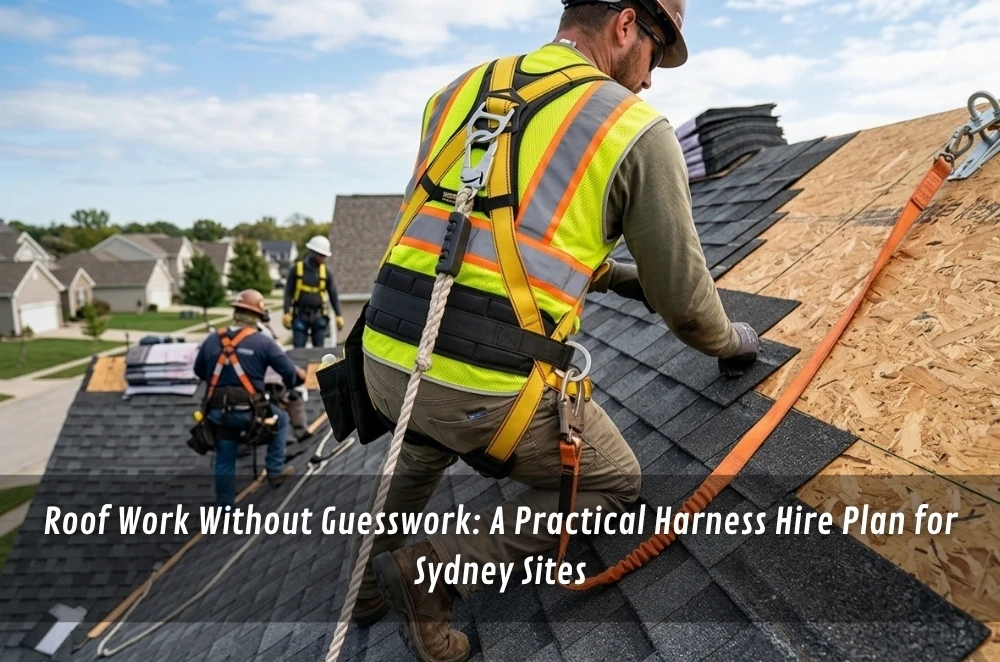
Roof work rarely fails because people don’t care; it fails because small changes stack up faster than the plan.
A dry roof becomes damp, an edge becomes closer than expected, and a “quick check” turns into an extra task with both hands busy.
That’s why thinking like an experienced roof safety company matters: the gear supports the system, but the system has to match the roof, the task, and the crew.
Most teams only discover the gaps when the job is already underway.
Why roof jobs go sideways even with capable crews
The most common pattern is “normal day, slightly abnormal moment”.
A ladder angle is marginal, a sheet is more fragile than it looks, or a worker steps sideways to get tool reach.
The second pattern is mismatch.
A restraint-style intention becomes fall-arrest reality because the connection method or working zone wasn’t defined clearly enough before the first person steps onto the roof.
The third pattern is speed pressure.
When access is awkward and neighbours are watching and the schedule is tight, teams compress pre-start steps until the plan exists only in someone’s head.
If the plan lives in someone’s head, it won’t survive the first surprise.
What a “good” roof safety setup needs to cover
A workable setup does three things: it reduces the chance of reaching an edge, it controls movement where people are most likely to drift, and it stays usable when the job gets fiddly.
Fit is the first gate.
If a harness isn’t adjusted properly, it becomes uncomfortable, workers loosen it, and the system loses reliability under real movement.
Connection is the second gate.
A lanyard type that feels fine on the ground can become a nuisance around penetrations, parapets, or tight corners, and nuisance is where shortcuts start.
Workflow is the third gate.
Where people connect, how they transition, where tools are staged, and when the job stops to reset all need to be decided before the roof becomes a workplace.
Simplicity is not “less safety”; it’s often the difference between a plan people follow and a plan people bypass.
Decision factors that matter when choosing a harness approach
Hire vs buy: frequency and variability
If roof work is occasional, variable, or split across different roof types, hiring can be a practical way to keep the kit suitable for the task without carrying long-term maintenance overhead.
If roof work is frequent and consistent, owning can make sense — but only if inspections, storage, and issuing routines are actually maintained, not just intended.
The best choice is the one you can operate reliably every time.
Kit inclusions: don’t assume “standard”
The words “harness kit” can mean different things depending on the job context and what’s expected to be supplied.
Before any hire or purchase decision, list what the job needs to function: how workers will connect, how they will move, and where the highest-risk transitions are likely to occur.
If the task includes stepping around skylights, vents, or different levels, treat transitions as a primary requirement rather than an afterthought.
A kit that’s missing one key component creates improvisation, and improvisation is where control breaks down.
Comfort and adjustability: compliance follows comfort
A harness that rubs, pinches, or restricts movement becomes “temporary” in the user’s mind, even when the risk isn’t temporary.
Comfort doesn’t replace safety engineering, but it supports correct wear, correct adjustment, and consistent use.
If multiple workers will use the same kit across different body sizes, adjustability and fit checks become non-negotiable.
Small fit issues turn into big behaviour issues.
Inspection and traceability: the boring part that prevents stoppages
Even for short tasks, you want a simple way to confirm what was issued, what condition it’s in, and who checked it.
Traceability reduces confusion when subcontractors rotate through and when gear moves between vehicles and sites.
It also prevents the classic morning-of scramble when something looks “not quite right” and nobody knows what the fallback is.
Order in the process reduces panic in the moment.
Roof reality: fragile zones, edges, and anchor practicality
Some roofs look straightforward until you identify brittle sheets, hidden voids, skylights, or areas where a slip would travel further than expected.
Roof pitch, surface condition, and access points matter as much as the task itself.
Plan the working zones and “no-go” zones in plain language that everyone can repeat back.
If people can’t describe the safe zone, they’ll create their own.
Common mistakes that quietly increase risk (and rework)
The most frequent mistake is treating the harness as the control rather than treating the harness as part of a method of work.
The next is unclear transitions.
If workers will disconnect and reconnect, the plan must specify where, how, and with what fallback controls.
Another common error is rushing donning and adjustment.
A harness that isn’t fitted properly can shift under movement, create pressure points, and encourage incorrect wear throughout the day.
Responsibility gaps cause the rest.
If it’s not clear who checks gear, who confirms the roof walk, and who calls stop-work, those decisions get made late and inconsistently.
Rescue planning is often assumed rather than designed.
Even a basic “what happens if someone goes over” discussion changes behaviour because it makes the risk feel operational, not theoretical.
Short jobs create long consequences when the setup is casual.
A simple first-actions plan for the next 7–14 days
Days 1–2: Write the one-page “roof job profile”
List the roof types you most commonly deal with, the tasks you most often perform, the typical crew size, and the movement patterns that bring people near edges.
Add the top three “surprise factors” you’ve encountered (weather changes, fragile areas, awkward access, shifting scope).
This becomes the reference point for choosing a consistent approach, not a one-off decision.
If it can’t fit on one page, it won’t be used.
Days 3–4: Build a pre-start checklist people will actually follow
Keep it short and practical: roof condition, fragile zones, weather, access, working zones, connection method, fit check, transitions, tool staging, stop-work triggers.
Make it easy to complete in under five minutes.
Write it in everyday language, not policy language.
If the checklist feels like paperwork, it will become paperwork.
Days 5–7: Run a 15-minute fit-and-use session
Have each worker put the harness on, adjust it, and walk through how they’ll move around a typical obstruction.
If you’ll need to rent a conveyor in Sydney for material handling on site, factor that into your staging plan so gear, tools, and movement paths don’t clash.
Watch for the point where people hesitate or start inventing a workaround.
Capture one improvement to the workflow and one improvement to the kit selection.
Practice on the ground saves decisions on the edge.
Days 8–10: Trial the workflow on a real job and debrief
After the job, ask two questions: “Where did we improvise?” and “What made the safe option slower?”
Change the checklist and the staging plan based on what actually happened.
Make one change at a time so the crew can feel the difference.
Debriefs turn lessons into routine.
Days 11–14: Lock in an issuing and return routine
Decide who signs gear in and out, where it’s staged, what gets checked before use, and what happens when something doesn’t pass inspection.
Keep the routine consistent across sites so subcontractors don’t have to guess.
Consistency is a control in itself.
If the routine only works when one person is present, it’s not a routine yet.
Local SMB mini-walkthrough: a typical Sydney roof maintenance job
Confirm roof access and set a clear exclusion zone before anyone climbs up.
Walk the roof edge, penetrations, and fragile sections together and mark no-go areas.
Stage tools to reduce movement and avoid carrying loads near edges.
Do harness fit checks on the ground and confirm who is supervising transitions.
Start with the highest-risk section first while attention is highest.
If wind or moisture changes, pause and reset the plan before continuing.
Operator Experience Moment
On small Sydney maintenance jobs, I’ve seen crews begin with a confident plan and then drift into improvisation when the task expands by “just one extra thing”. The turning point is usually a transition: stepping around a penetration, repositioning for reach, or moving tools to a better spot. When teams pre-decide transitions and staging, the job feels slower for five minutes and then runs smoother for the next two hours.
Practical Opinions
Choose the simplest system that prevents edge exposure for the specific task.
Prioritise fit and workflow over “tougher” gear that people avoid wearing properly.
Treat transitions as the highest-risk moments and design the day around them.
Key Takeaways
- A harness is only effective when it’s part of a clear method of work that covers zones, transitions, and stop-work triggers.
- Most roof risk appears during “slightly abnormal” moments, so the plan must survive change, not just ideal conditions.
- Comfort and fit aren’t cosmetic; they drive correct wear and consistent behaviour.
- A 7–14 day rollout (profile, checklist, fit session, trial, routine) builds repeatable habits without heavy disruption.
Common questions we get from Aussie business owners
How do we decide whether to hire or buy roof safety gear?
Usually the decision comes down to how often roof work happens and how much your roof types and tasks vary. Next step: list your last 10 roof jobs and note where the roof layout, access, or task changed; high variability usually favours a controlled hire process. In Sydney and across NSW, mixed building stock often means a “one kit forever” approach struggles unless you have strong issuing and inspection discipline.
What should we check before anyone uses a harness kit on site?
In most cases you want a quick routine: confirm all components are present, visually inspect for obvious wear or damage, and do a fit check for each worker before access. Next step: assign one person to run a two-minute check and record it the same way every time. Around Sydney, crews and sites can change daily, so a consistent check reduces confusion when subcontractors rotate in.
Is a harness enough on its own for roof work?
It depends on the roof, the task, and whether the method of work actually prevents people reaching an edge during normal movement. Next step: map the task into safe zones, transition points, and no-go areas in plain language, then build the connection method around that map. In most cases, skylights and brittle sections on older roofs create hidden risk that needs to be identified before anyone steps onto the surface.
How do we get better compliance when the job is busy and time is tight?
Usually compliance improves when the safe option is also the easy option, which is why staging, transitions, and comfort matter so much. Next step: after the next roof job, ask “Where did we disconnect or improvise?” and redesign that one transition first. In Sydney’s stop-start weather and tight scheduling, making the system frictionless is often more effective than adding more rules.