https://www.actowizsolutions.com/ride-hailing-fare-intelligence.php
Introduction
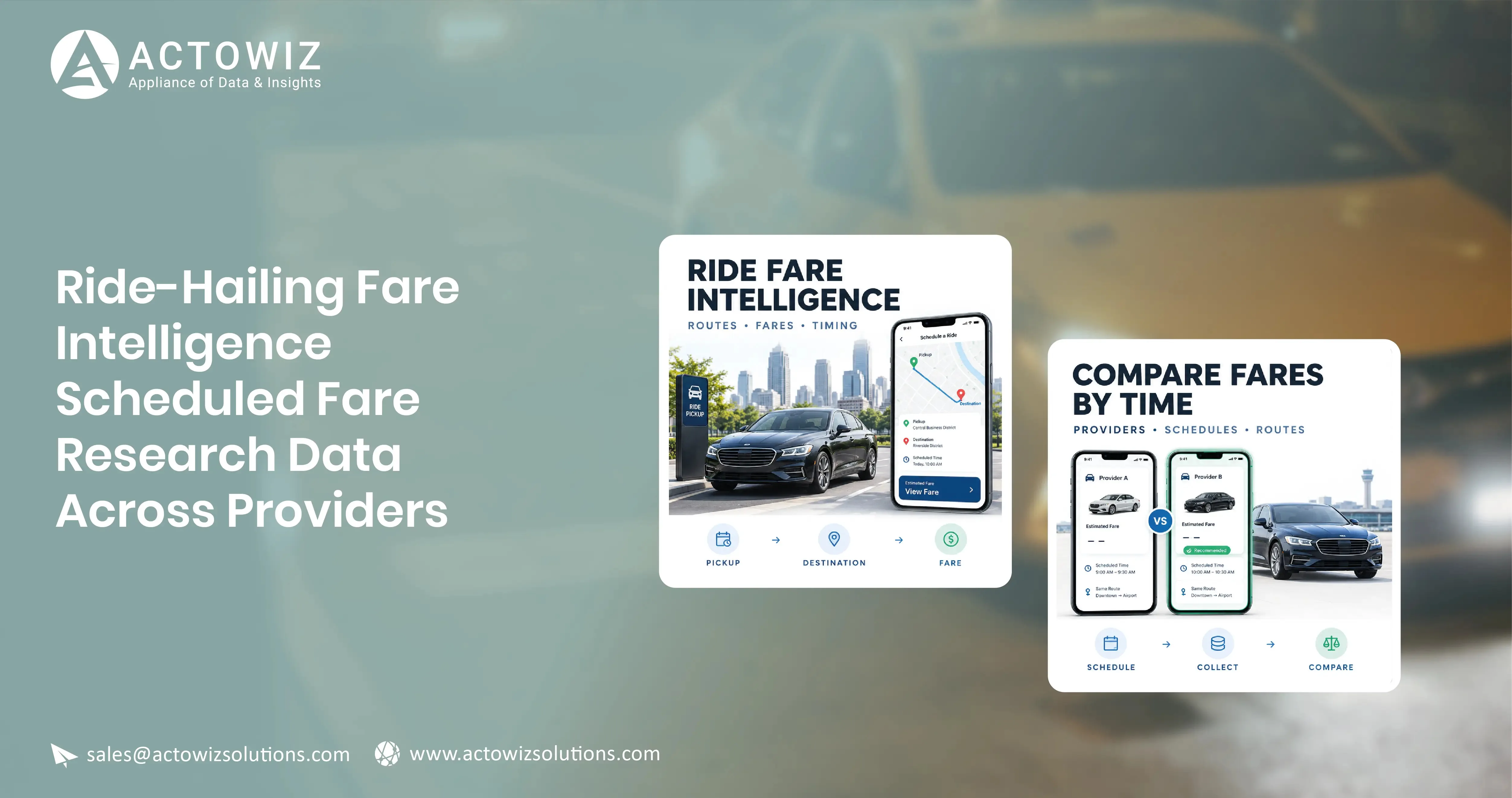
Ride-hailing fares change by route, time and provider. This page explains how fare research data collected on a fixed schedule for agreed routes, together with publicly shown service information, supports pricing studies and market research.
Why Ride-Hailing Data Is Different
Fares expire in minutes. A quote reflects one moment, so every observation needs a timestamp.
It's route-specific. A fare only makes sense for a given origin, destination and time.
Every provider differs. Providers calculate fares, surge and ETAs differently, so output must be normalized.
Surge is a signal. Where and when surge is displayed says something about demand and supply.
The defining requirement: a fixed, agreed route panel. Repeated scheduled observations on the same routes and dayparts make results comparable over time.
What Can Be Captured (per provider, per scheduled observation)
Route: Origin, destination, and observation timestamp.
Fare: Base/estimated fare as displayed, currency, and ride tier (Economy, Premium, XL).
Surge & Availability: Surge indicator/multiplier (where displayed) and no-cars/unavailable status.
Time: Estimated pickup ETA and estimated trip duration, captured at the time of observation.
Service Info: Publicly displayed vehicle categories and service areas.
Who Uses Ride-Hailing Fare Data
1. Pricing Studies & Product Research
Mobility and comparison products use historical panel data to understand price gaps between providers on representative routes. The data is not for showing live fares inside an app.
2. Providers & New Entrants
Benchmark fares against competitors on agreed city routes and dayparts, with surge recorded where displayed.
3. Analysts, Researchers & Cities
Study pricing patterns and transport policy using a consistent, timestamped series.
4. Corporate Travel & Expense Platforms
Benchmark typical ground-transport costs on agreed routes and cities.
How Actowiz Delivers It
Agreed route panels: you and we fix the routes, vehicle classes and dayparts before collection begins.
Cross-provider normalization: fares, surge flags, ETAs and tiers in one comparable schema.
Scheduled delivery: observations collected on an agreed schedule and delivered as files or stored-data API.
Pilot-first: a free pilot on a sample of agreed routes to check feasibility and quality before commitment.
Provider coverage: confirmed per project.
Real-World Example: Benchmarking Fares Across a City
A mobility team wanted to understand how fares on a set of representative routes compared across providers by time of day. Starting with a pilot on a small route panel, the team checked field coverage and consistency before moving to a scheduled, managed feed for its pricing study.
Is Ride-Hailing Data Collection Compliant?
Actowiz collects publicly available fare-estimate, ETA and surge information as shown to a prospective rider at scheduled times, without rider accounts or personal data, and scopes each provider during the pilot.
Frequently Asked Questions
Can fares be retrieved for any route?
No. We collect fare research data for an agreed panel of routes and times. We do not offer a live fare API or instant estimates for arbitrary pickup and drop-off points.
Which providers and regions?
Coverage is confirmed per project during scoping.
How often is data collected?
On an agreed schedule, for example selected dayparts on selected days.
Is there a trial?