

Why This Comparison Actually Matters in Real Hospitals
On paper, RFID and barcode both “solve tracking problems.”
But in real hospital environments, they don’t behave the same way at all.
Most facilities don’t switch because barcode is broken. They switch because barcode quietly stops working when the workload gets heavy.
And that’s really the core difference here—not technology, but reliability under pressure.
Barcode Systems: Simple, But Very Dependent on People
Barcode systems are easy to understand. Every item gets a label, and someone scans it when it moves.
It works fine in controlled environments.
But hospitals aren’t controlled environments.
In practice, a few things tend to happen:
- Staff forget to scan during busy shifts
- Equipment gets moved in emergencies without logging
- Labels get damaged or covered
- Data becomes outdated faster than expected
The system itself isn’t the problem. The dependency on manual action is.
If people don’t scan consistently, the data slowly drifts away from reality.

RFID Systems: Less Action, More Automatic Capture
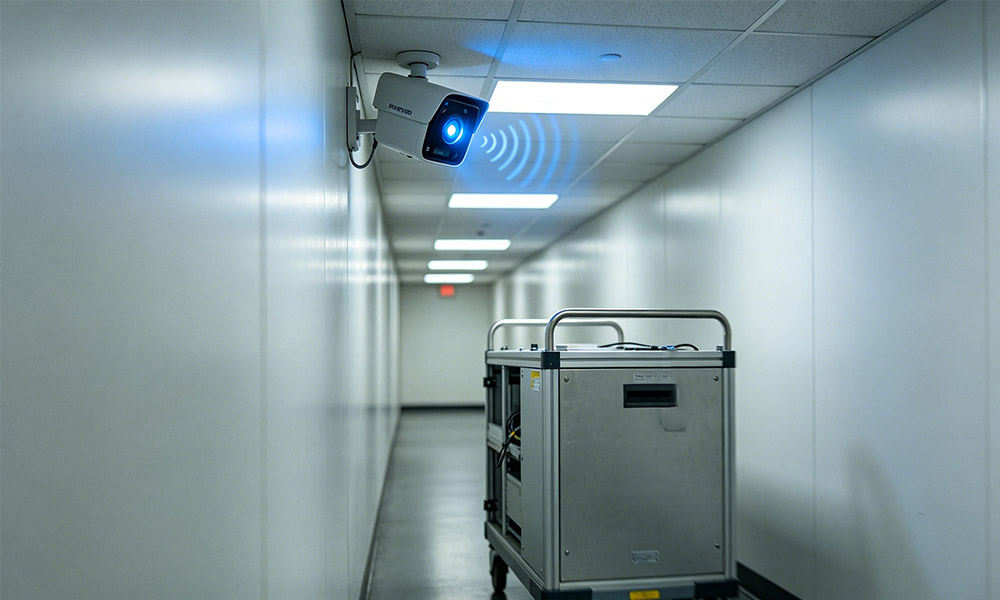
RFID works differently. Once tags are attached, movement is captured automatically when equipment passes through reader zones.
No scanning. No extra steps.
That alone changes how the system behaves in real life.
Instead of relying on staff remembering to update records, RFID just records what actually happens.
It doesn’t care how busy the shift is.
The Real Difference Shows Up Under Pressure
The gap between RFID and barcode isn’t obvious in a quiet environment.
But it becomes very visible when things get busy.
For example:
- Emergency situations
- Night shifts with fewer staff
- High patient turnover days
In those moments, barcode systems tend to fall behind because manual input gets skipped.
RFID keeps running in the background, unaffected.
That’s usually where hospitals start to notice the difference.
Accuracy: The Part Nobody Talks About Enough
Barcode accuracy depends on compliance.
RFID accuracy depends on coverage.
That’s a subtle but important distinction.
If someone forgets to scan a barcode, the system loses that event completely.
With RFID, as long as the equipment passes a reader, the event is captured automatically.
So instead of “did someone record it?”, the question becomes “did it pass a detection point?”
That shift makes data far more reliable over time.
Speed Isn’t Just About Technology
People often say RFID is “faster,” but that’s not the most important part.
The real improvement is not speed of scanning—it’s removal of scanning altogether.
Barcode requires:
- Stop → find label → scan → confirm
RFID requires:
- Move equipment normally
That difference doesn’t sound big, but across hundreds of daily movements, it adds up quickly.
Where Barcode Still Makes Sense
To be fair, barcode systems are not obsolete.
They still work well in:
- Low-movement environments
- Small clinics
- Non-critical inventory tracking
- Budget-limited setups
If everything is stable and controlled, barcode is still a reasonable option.
The issue starts when scale and movement increase.
Where RFID Becomes the Better Fit
RFID starts to make more sense when:
- Equipment moves frequently between departments
- Real-time visibility is important
- Inventory errors are costly
- Manual tracking becomes inconsistent
In those environments, automation matters more than simplicity.
That’s where RFID tends to justify itself.
Storage Control Makes the Difference Even Bigger
One area where RFID clearly extends beyond barcode is storage management.
Barcode systems can track items if someone scans them.
But they don’t naturally enforce control over storage activity.
That’s where solutions like an RFID medical cabinet system come in.
Instead of relying on manual logging, the cabinet automatically records:
- What goes in
- What goes out
- Who accessed it (depending on setup)
In practice, this reduces a lot of small but constant inventory errors.
It’s not just tracking—it’s controlled visibility.
Total Cost Isn’t Just About Hardware
A common misunderstanding is that barcode is “cheaper” and RFID is “expensive.”
That’s only partially true.
Barcode costs less upfront.
But it doesn’t account for:
- Time spent searching for equipment
- Replacing “lost” items that are actually misplaced
- Manual labor for inventory checks
- Rework caused by incorrect records
RFID shifts cost from manual work to infrastructure.
Whether that’s worth it depends on scale—but in larger hospitals, the equation often changes quickly.
A Simple Way to Think About It
If you strip away the technical terms, the difference is pretty simple:
- Barcode = system that records what people do
- RFID = system that records what actually happens
That’s really the core distinction.
One depends on behavior.
The other observes behavior.
Final Thoughts
RFID vs barcode isn’t really a competition between technologies.
It’s a question of how much manual work a system can realistically depend on.
Barcode systems can work—but only when people consistently support them.
RFID removes that dependency and lets tracking happen passively in the background.
In hospital environments where movement is constant and time is limited, that difference becomes hard to ignore.


