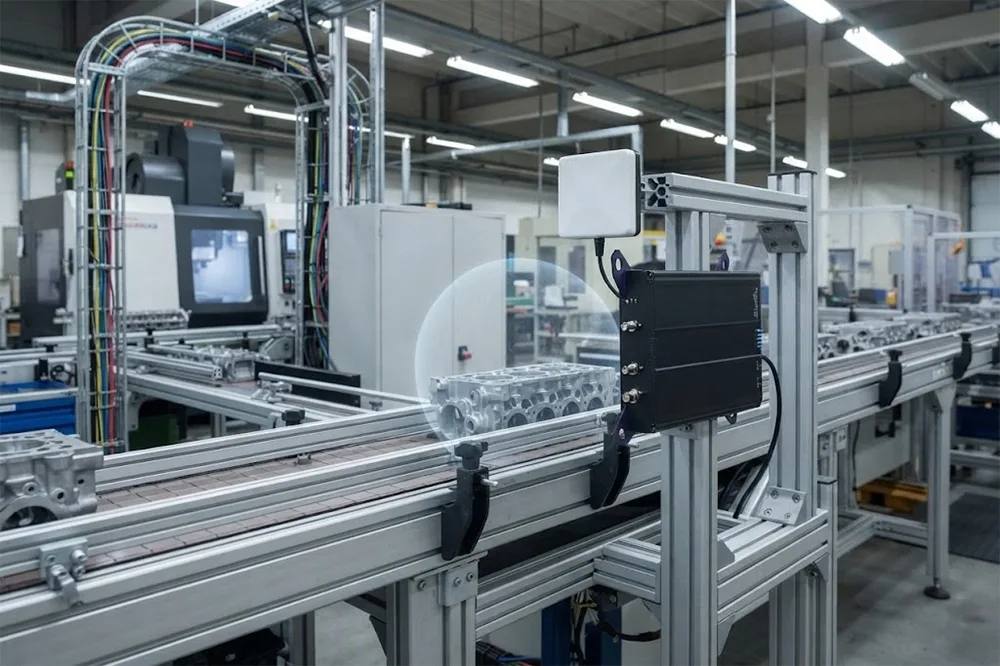
RFID readers can help industrial systems identify products, tools, pallets and workpieces automatically as they move through production and logistics processes. The practical choice depends on the production environment, reading distance, tag type, antenna position and system integration requirements.
Before integrating RFID into an automated production line, it helps to understand what happens between the tag, antenna and reader. Our guide explains how an RFID reader works and why the antenna and RF environment matter when designing an RFID system.
RFID Reader for Industrial Automation: Where Does It Really Fit?
A production line rarely waits for someone.
A conveyor keeps moving. A pallet reaches the next workstation. A component needs to be identified before the machine starts its next operation.
In an older production setup, an operator may scan a barcode, enter a number or press a button to confirm what has arrived.
That works.
Until the production volume increases.
Then small delays begin to add up.
A missed scan here. A wrong component there. Someone puts a tray in the wrong position. The machine continues because nobody told it otherwise.
This is one reason RFID readers have become interesting in industrial automation.
Instead of asking a worker to identify every item manually, an RFID reader can detect a tagged product or workpiece automatically when it reaches a defined point.
The idea sounds simple, but industrial environments are not particularly friendly to radio communication.
There is metal everywhere.
Motors are running.
Conveyors are moving.
Tags can face different directions.
Sometimes several tagged objects arrive together.
So the interesting question is not really “Can RFID work in automation?”
It is:
“Can the RFID system reliably identify the right item at the right point in the production process?”
RFID Reader + Production Line
A common industrial RFID setup includes four basic parts:
- RFID tag
- RFID reader
- RFID antenna
- Control or management software
The tag carries a unique identification number.
The reader communicates with the tag through radio frequency.
The antenna creates the reading area.
The control system decides what to do with the information.
For example, a tagged workpiece arrives at Station 3.
The RFID reader detects the tag.
The control system checks the tag ID.
The system knows which product variant has arrived.
The machine can then load the correct production parameters.
That can be much more useful than simply knowing that “something” arrived.
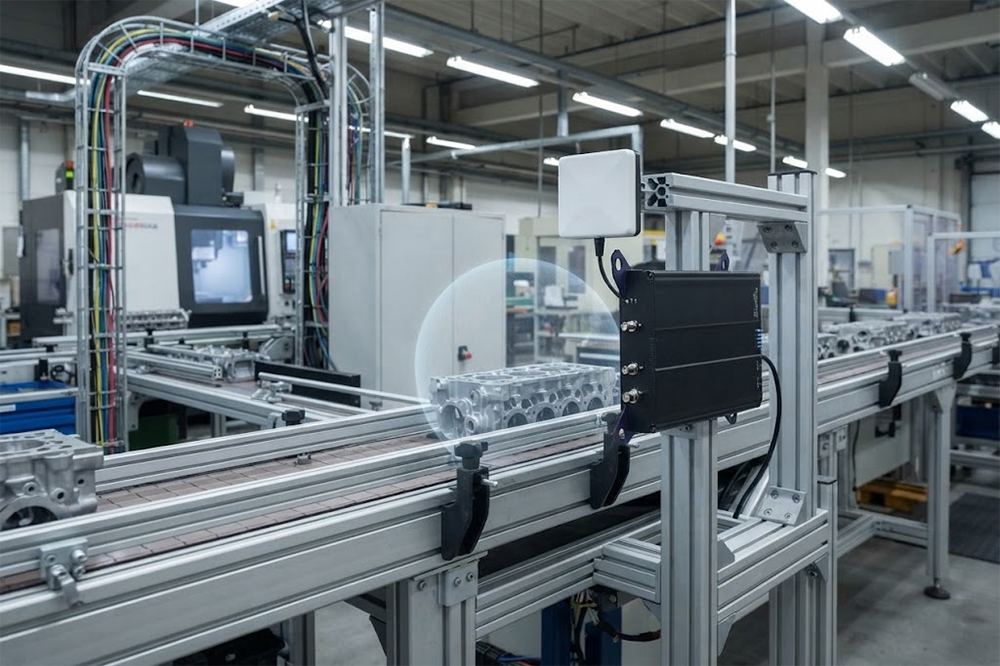
A Small Example From a Production Line
Imagine a manufacturer producing several versions of the same product.
The outside appearance is almost identical.
However, the internal components are different.
Normally, an operator checks the work order before the product reaches the next machine.
With RFID, each workpiece or production carrier can have its own tag.
When it reaches the workstation, the reader identifies it.
The software looks up the product information.
The machine receives the correct instructions.
If the wrong workpiece arrives, the system can stop the process or send an alert.
It is not necessarily about replacing workers.
In many cases, RFID simply takes over a repetitive identification step that people are not particularly good at doing hundreds of times per day.
RFID for Work-in-Process Tracking
Work-in-process tracking is one of the more useful industrial RFID applications.
A product may pass through ten or twenty production steps before it becomes a finished item.
Without automatic identification, it can be difficult to know exactly where each item is.
RFID can create checkpoints.
For example:
Assembly → Testing → Painting → Inspection → Packaging
At each station, the RFID reader detects the tag.
The manufacturing system records the event.
After several hours, the company can see the product’s movement history.
This is not continuous GPS tracking.
It is more like a series of reliable checkpoints.
For manufacturing, that can be enough.
RFID Readers on Conveyors
Conveyors create a fairly predictable RFID environment.
Products move along a defined path.
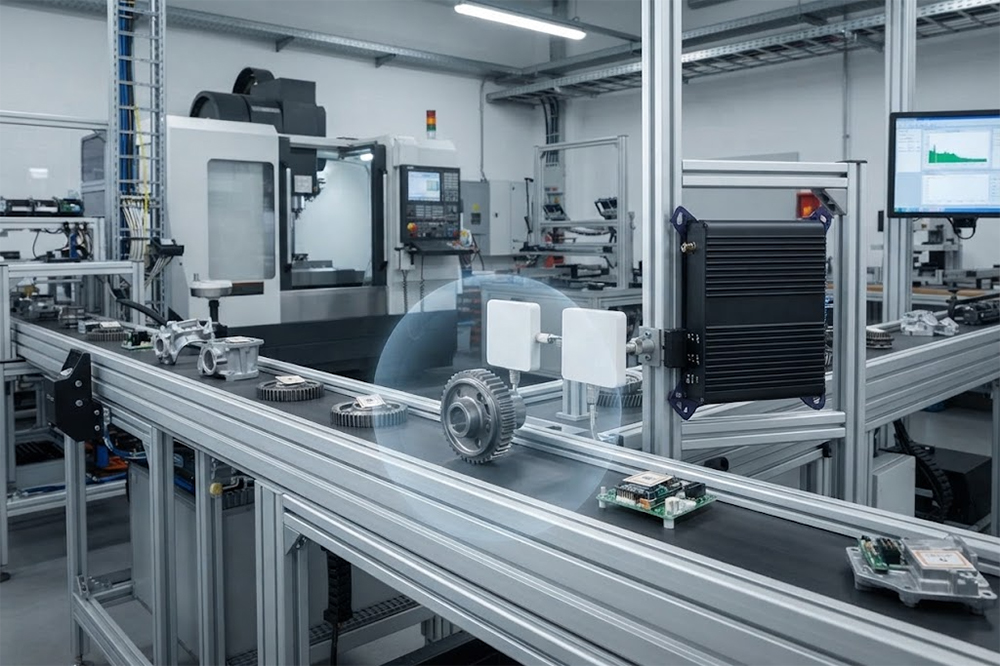
That makes it easier to create a controlled reading zone.
A fixed RFID reader can be installed beside the conveyor, with one or more antennas positioned toward the tags.
When the product reaches the reading area, the tag is detected.
The software can then trigger the next operation.
The exact antenna position matters.
If the reading area is too large, nearby products may also be detected.
If it is too small, a fast-moving product might pass through before the reader gets a reliable read.
So conveyor speed should be part of the technical discussion.
It is a small detail that can make a surprisingly large difference.
What If Products Move Quickly?
This is a common question.
RFID can identify fast-moving objects, but actual performance depends on the complete system.
You need to consider:
- Tag type
- Reader performance
- Antenna configuration
- Reading distance
- Product speed
- Tag orientation
- Number of tags
- RF environment
A tag passing directly in front of an antenna is one situation.
A tag mounted sideways on a fast-moving metal carrier is another.
For a production line, it is much better to test at the actual conveyor speed than to rely only on a laboratory reading-distance specification.
Metal Is a Major Consideration
Industrial automation often means metal.
Machines.
Steel frames.
Metal trays.
Production tools.
Motors.
Equipment cabinets.
Unfortunately, metal can affect RFID performance.
If the tag is attached directly to metal, a standard RFID label may not perform as expected.
An on-metal RFID tag may be more appropriate.
Even then, the final result depends on the application.
A small aluminum component and a large steel production carrier can produce very different RF behavior.
This is why industrial RFID buyers should provide actual product samples when possible.
A supplier can make a much better recommendation after testing the real object.
RFID Reader for Automated Identification
One of RFID’s biggest advantages in automation is that the identification process can happen without someone physically scanning each item.
Consider an automated sorting system.
Products arrive on a conveyor.
The reader detects the RFID tags.
The control system identifies each product.
The sorting equipment sends each item to the correct destination.
The operator does not need to stop the conveyor and scan every box.
This becomes particularly valuable when the same identification step happens thousands of times.
Even saving a few seconds per item can become significant over a full production shift.
Multiple RFID Tags Can Be a Different Problem
Industrial automation sometimes involves many tagged items in one area.
Suppose a pallet contains 30 tagged boxes.
A reader may detect multiple tags.
That is useful if the goal is to identify the entire pallet.
But it could be a problem if the system only wants to identify the item currently passing a workstation.
The antenna arrangement and reading zone need to reflect the actual business requirement.
This is where “long range” can become a misleading selling point.
For industrial automation, a controlled reading area is often more valuable than maximum range.
RFID Reader and PLC Integration
Industrial customers rarely want an RFID reader operating by itself.
The reader normally needs to communicate with the existing automation system.
Depending on the project, this could involve:
- PLC
- MES
- ERP
- WMS
- SCADA
- Industrial PC
- Custom software
The RFID reader provides identification data.
The control system uses that data to make a decision.
For example:
Tag detected → Product identified → PLC checks process → Machine starts operation
Or:
Unknown tag → PLC receives error → Conveyor stops
That is where RFID becomes part of automation rather than simply an inventory tool.
For system integrators, API and SDK support can therefore be an important purchasing consideration.
Cykeo provides RFID reader solutions for industrial applications and supports integration requirements for system developers and integrators. Cykeo RFID Readers
Fixed RFID Readers Are Usually the Starting Point
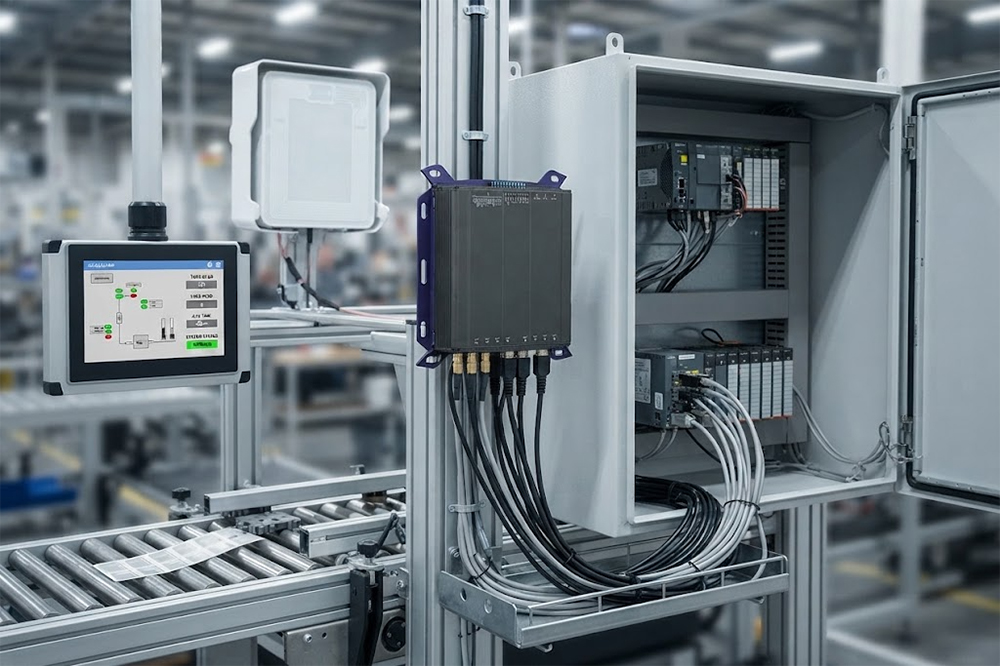
For industrial automation, fixed readers are often the natural choice.
The reader stays at the workstation.
The antenna stays in a known position.
The production item moves through the reading area.
This creates a repeatable setup.
Handheld RFID readers still have their place, particularly for maintenance, inventory checks and troubleshooting.
But if the goal is automatic identification during production, fixed RFID readers are generally more suitable.
The final configuration may include one antenna or several antennas depending on the physical layout.
Don’t Ignore Antenna Position
A reader can be technically powerful and still perform poorly if the antenna is installed in the wrong place.
Imagine a conveyor carrying products at waist height.
The tag is mounted underneath the product.
An antenna mounted above the conveyor may have difficulty reading it.
Move the antenna underneath or to the side, and the situation may change considerably.
This is why RFID installation is partly an engineering problem.
The antenna should be positioned according to:
Where is the tag?
How does the product move?
How fast does it move?
What is around the reading area?
What other tags are nearby?
Those questions are more useful than simply asking which reader has the longest range.
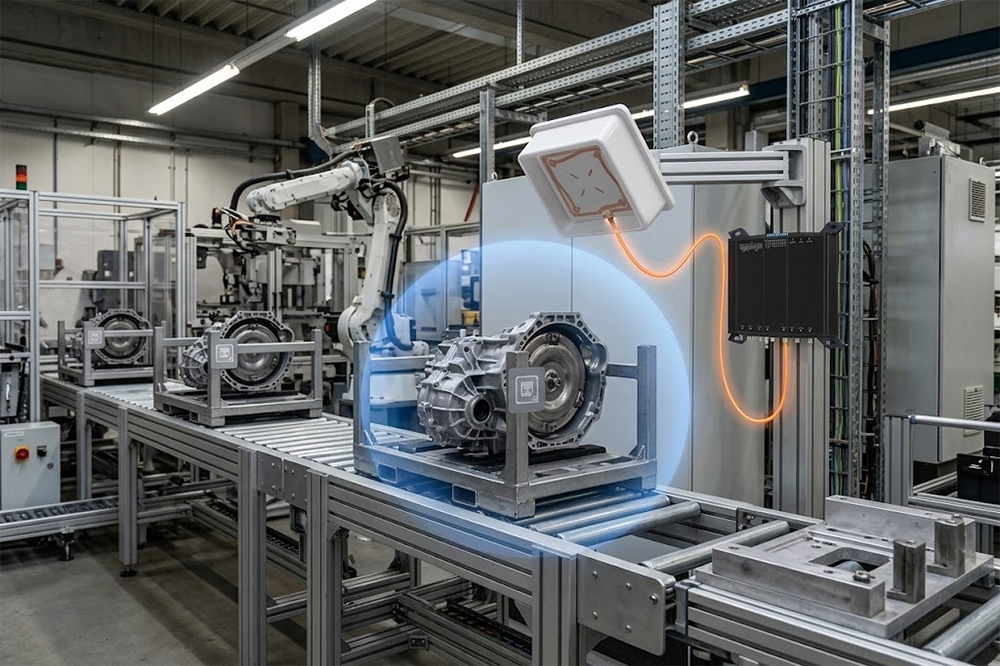
A Practical Automotive Manufacturing Example
Automotive production is a good example of where RFID can fit naturally.
Production carriers move components through different stations.
Each carrier can have an RFID tag.
At one workstation, the reader identifies the carrier.
The manufacturing system knows which vehicle or component is associated with it.
The machine loads the correct process information.
At the next station, another reader records the movement.
This creates a production history without requiring operators to manually enter every transition.
The same basic idea can be adapted to electronics, machinery, appliance manufacturing and other industries.
RFID for Tool and Fixture Identification
Not every RFID application involves the product itself.
Production tools and fixtures can also be tagged.
A factory may have hundreds of fixtures that look similar.
When a fixture arrives at a workstation, an RFID reader can identify it automatically.
The system can check:
- Fixture ID
- Production compatibility
- Maintenance status
- Usage history
- Current location
This connects industrial RFID with asset tracking.
If you are also considering RFID for tools, equipment or reusable assets, see the related guide on the RFID reader for asset tracking.
Choosing an RFID Reader for Industrial Automation
Before requesting a quotation, collect a few practical details.
Application: Production line, conveyor, sorting, tool tracking, etc.
Product: What exactly will be tagged?
Material: Plastic, metal, cardboard or mixed materials.
Tag location: Top, side, bottom or embedded.
Movement speed: Stationary, slow-moving or high-speed.
Reading distance: Approximate required distance.
Tag quantity: One tag or many tags in the reading zone.
Installation: Wall, machine, conveyor, cabinet or custom equipment.
Interface: PLC, PC, API, SDK or other control system.
Quantity: Sample, pilot project or bulk order.
This information helps the supplier understand the application before recommending hardware.
Test the Complete System, Not Just the Reader
This point is easy to overlook.
You can test an RFID reader on a desk and get an impressive reading distance.
Then install it beside a real machine and get a completely different result.
Why?
Because the real environment contains metal, moving machinery, cables, products and other RF effects.
The tag may also be mounted differently.
For industrial projects, test:
Reader + antenna + tag + actual product + actual machine environment.
If the product moves at 1 meter per second in the final system, test it at 1 meter per second.
If ten tagged carriers can be nearby, test ten.
If the reader needs to work continuously for eight hours, run a longer test.
A short sample test can reveal problems that would otherwise appear after mass installation.
When Should You Consider an Industrial RFID Reader?
RFID is worth considering when identification happens repeatedly and manually scanning creates unnecessary work.
Typical situations include:
- Automated production lines
- Conveyor tracking
- Work-in-process tracking
- Tool identification
- Production carrier tracking
- Automated sorting
- Manufacturing traceability
- Warehouse-to-production movement
- Equipment identification
It may not be necessary for every production process.
If a worker handles five products per day, manual identification is probably fine.
If a machine processes thousands of products per shift, automatic identification becomes much more interesting.
Final Thoughts Before Buying
The best industrial RFID reader is not necessarily the reader with the longest range or the largest specification sheet.
It is the one that can reliably identify the right tag at the right point in your production process.
For one project, that might mean a compact fixed reader and one antenna.
For another, it could mean several antennas, multiple readers and PLC integration.
And for a system integrator, API and SDK support may matter almost as much as RF performance.
If you are sourcing RFID readers for manufacturing automation, production lines, conveyor tracking or OEM equipment, you can review the Cykeo RFID reader product range and send the application details for a sample recommendation or wholesale quotation.
Frequently Asked Questions
Can RFID readers be used on production lines?
Yes. Fixed RFID readers can identify tagged products, carriers, tools or workpieces as they pass through defined production checkpoints.
Can RFID work around metal machinery?
Yes, but metal can affect RFID performance. On-metal tags, suitable antennas and careful installation may be required. Testing the actual machine environment is recommended.
Can an RFID reader connect to a PLC?
Yes. The exact integration method depends on the reader and PLC architecture. API, SDK and communication interfaces should be confirmed before selecting hardware.
Can RFID identify fast-moving products?
It can, provided the reader, antenna, tag and reading zone are properly designed. Conveyor speed and tag orientation should be included in the testing process.
Should I choose the longest-range RFID reader?
Not necessarily. Industrial automation often needs a controlled reading zone rather than maximum range. Excessive range can cause unwanted tag reads from nearby products.
In industrial automation, reading distance is only part of the equation. A reader that detects tags too far away may create unwanted reads, while insufficient range can cause missed products. Our guide to RFID reader reading distance explains the factors behind practical RFID range.
Production lines often need to track more than finished products. Tools, fixtures, production carriers and reusable equipment can also be identified with RFID. See our guide to the RFID reader for asset tracking for more practical examples.
Production and warehouse operations are often connected. Materials move from receiving to storage and eventually onto the production line. Our guide to the RFID reader for warehouse management explains how RFID can be used across warehouse receiving, inventory and shipping processes.