A June 2026 Minnesota DOT study repeats a rule of thumb credited to Skorseth: a gravel road loses about a ton of stone per mile each year for every vehicle that drives it daily. On a road with 200 vehicles a day, that’s around 200 tons a mile. Price your own replacement gravel against that tonnage and the annual cost of simply losing stone becomes concrete. Much of what’s lost leaves as dust.
Most road managers react to this by asking which product to spray. That is the wrong starting point. The federal guidance and the published field data agree on this much: what you get depends on the road underneath and on how the treatment goes on. Below is a way to fit dust suppression into your maintenance cycle. Most of the evidence comes from US sites, so check it against your own materials and weather.

Why Recurring Dust Is a Maintenance Issue, Not Just a Nuisance
The FHWA dust management handbook calls fines the “glue” of a gravel surface. When they blow away, the stone loosens. The road ravels and corrugates, and the grader and gravel truck come back sooner than planned.
It adds up nationally, too. A University of Alaska Fairbanks paper, submitted for journal review in 2025, says US unpaved roads put about 5.8 million tons of PM10 into the air each year, about 42% of stationary-source PM10. The same paper counts more than 200 named dust and stabilization products on the North American market. With that many choices, you need to be clear about what you’re trying to achieve before you shop.
- Dust suppression: cutting the dust traffic throws into the air.
- Fines preservation: keeping fine particles in the road.
- Surface stabilization: helping the surface resist damage.
- Structural and drainage maintenance: fixing bad shape, poor material, or failing drainage.
These overlap, but one doesn’t stand in for another. The UC Pavement Research Center built its selection tool around using chemicals to keep good roads good, not to rescue bad ones. If water sits on your road, a suppressant won’t move it.
Assess the Road Before Choosing a Suppressant
Before you compare products, gather this:
- Material: grading, fines content, plasticity, aggregate quality, surface condition.
- Geometry and drainage: crown, grades, where water goes, erosion, and repeat trouble spots.
- Traffic: volume, vehicle types, speeds, heavy trucks, seasonal peaks.
- Climate and exposure: rainfall, temperature, freeze and thaw, runoff paths, nearby streams, and homes.
- Maintenance baseline: complaints, watering, grading, gravel replaced, labor, spending.
A lot of agencies skip this. A 2025 Nebraska DOT study found that more than 90% of surveyed counties didn’t know the quality of their local road materials. The distresses they reported most were raveling, loss of crown, dust, and improper drainage. So many counties are choosing treatments for roads they haven’t fully measured. Note that this study and the Minnesota one share a lead author, so they aren’t independent of each other.
Early test results can also mislead. The Minnesota report’s literature review describes Iowa trials where chloride sections tested 10% and 33% stronger than the control after a month (Jahren et al., 2011). After a year and a half they matched the untreated road. If you judge a treatment at four weeks, you may be judging the wrong thing.
Finish the assessment with a plain verdict: ready to treat, needs prep first, needs an engineer, or probably not worth treating. Plenty of roads land in the second group. That’s a useful answer.
Integrate Dust Suppression Into the Preventive Cycle
The order is assess, diagnose, prepare, select, apply, measure, and review. FHWA puts it this way: it’s the process, not just the product, and a product can only be as good as the road under it.
Before treatment
Work out what’s causing the problem and what service level you need. Is the complaint about visibility, neighbors, ride quality, or cost? Then repair what’s broken, whether that’s drainage, shape, material, or structure. Decide your goal (less dust, fines retention, stabilization, or a mix) before you pick a product. FHWA also suggests checking product specs and safety data sheets with an independent accredited lab instead of taking the vendor’s word.
During application
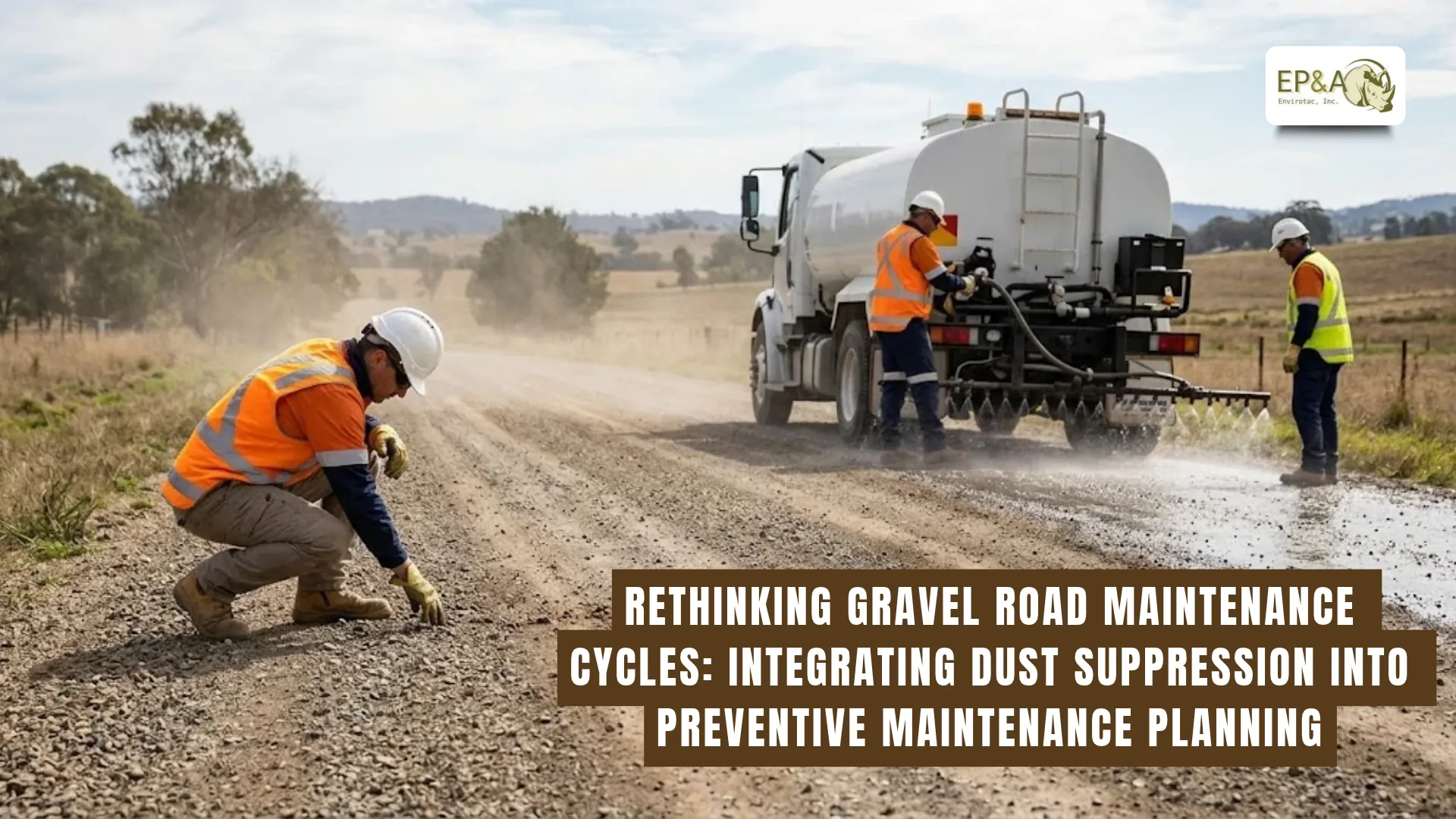
Write down the prep, product, rate, weather, and anything that went off plan. How the product goes on counts for as much as what it is. In the Minnesota study, covering 28 sites in five counties, spray-on chloride treatments had the weakest mechanical performance and the biggest cost and environmental burden. On the study’s combined index, the top three options scored 0.91 for blade-mixed Dustex, 0.90 for direct-injected calcium chloride, and 0.88 for blade-mixed BASE ONE. Spray-on calcium chloride scored 0.26 and spray-on magnesium chloride 0.13. That’s one set of Minnesota roads, but the gap between application methods is wide.
After treatment
Measure, inspect against your triggers, and carry what you learn into the next round. FHWA’s example from northern Idaho shows why the records matter. An untreated road there needed blading 18 times a year, at about $8,980 a mile. The treated road cost $4,460 in year one and $2,710 in year two, not counting replacement gravel. Those numbers belong to one district. What carries over is the habit of tracking them.
Set Inspection and Reapplication Triggers, Not Just Calendar Dates
Treatments wear out, and how fast depends on traffic and weather. A 1983 US Bureau of Mines study at three surface coal mines found chemical suppressants gave 40 to 60% control for the first two weeks, then faded. After week five, the thin data pointed to under 20%. Those were haul roads and older products, so don’t expect the same on your road. They do show why a date on the calendar makes a weak trigger.
Look for dust coming back, fines or gravel disappearing, a rougher ride, heavy rain or runoff, a change in traffic mix, or product moving off the road. Treat an inspection trigger and a reapplication trigger as different things. If performance drops, find out why before you spray again. A drainage fault or a new stream of trucks won’t be fixed by more product.
Rate matters too. The Alaska researchers warn that applying too little gives a short working life and that the best way to learn how long a treatment lasts is to sample the treated road in the field over time.
Compare Lifecycle Costs, Not Just the Purchase Price
A low price per gallon says little. Count the product and hauling, prep and aggregate, crew and equipment for application, inspections, reapplication, and your current maintenance bill. That last one is your real alternative.
The Minnesota study modelled a one-mile road with 200 vehicles a day over 30 years. Compared with leaving it untreated, it found savings of about $8,582 per mile per year for direct-injected calcium chloride and $7,746 for BASE ONE. Spray-on magnesium chloride added about $2,005 a year because it needed so much upkeep. Both are chloride treatments, yet the cost results went opposite ways depending on how they were applied.
Give it time, too. FHWA says most programs only earn back their cost after three or four years. A 1990s Colorado field project found treated sections kept 42 to 61% more aggregate and saved an estimated 28 to 42% against untreated ones. Take both as rough guides. Whatever you model, state your time horizon and assumptions, and leave out benefits you can’t measure.
Run a Pilot Before You Scale
A pilot gives you your own evidence instead of a supplier’s promise. Pick a section that reflects your real materials and traffic, not the easy stretch. Set the success measures before you apply anything. FHWA recommends comparing a treated section with an untreated one, which also costs less if the trial goes badly than committing the whole network.
Log dust measurements, surface condition, traffic, weather, application details, and costs. Keep those apart from impressions and opinions. The Minnesota team monitored its sites for two years. On traffic-normalized IRI degradation, treated roads worsened at 0.51 to 0.57 inches per mile per vehicle per year, against 1.08 for untreated roads. The units are awkward, but the point holds: a number tracked over time shows what a glance at the surface can’t. At the end, decide whether to expand, adjust, or stop, and write down what you still don’t know.
Prioritize Roads Across the Network
Few agencies can treat everything. Weigh how bad the dust is, how important the road is, its condition, safety, nearby streams and homes, upkeep burden, and budget. Put roads that are ready for treatment ahead of roads that need repair first. A scoring matrix gives your team a shared way to talk about it, but build it around your own network.
How to Evaluate a Supplier or Treatment
Selection tools help you decide, but they don’t replace an engineer’s judgment. Ask each supplier for:
- Proof the product suits your materials, climate, traffic, and goal.
- Safety documents and independent test results.
- Prep, equipment, and application requirements.
- Case studies that name their measurement, baseline, method, and duration.
- Reapplication criteria and how the product fits with routine grading.
- Pilot support and a fit with local regulations.
Read published numbers closely, including ones quoted secondhand. Figures as high as “up to 86%” less gravel loss get attributed to the Minnesota study; the final report doesn’t support that. It reports 80 to 82% less gravel loss for direct-injected calcium chloride and blade-mixed BASE ONE, and that’s gravel loss, not dust. A CanRos case study reports about 80% less dust at a Chilean copper mine, but the page doesn’t say how it was measured. Borregaard says Dustex cuts CO₂ by more than 55% compared with chloride salts, on a cradle-to-gate basis for Scandinavian conditions, and it cautions that impacts may differ elsewhere depending on local production. All three remain supplier claims until you’ve checked them.
Environmental Safeguards and Common Mistakes
Most failed programs trace back to a handful of avoidable errors: reaching for a surface treatment when the road has serious structural defects, skipping the material check, ignoring prep and drainage, using one reapplication interval for every road, taking supplier claims as independent proof, and scaling up with no pilot data.
In the environment, avoid both extremes. In the Minnesota study, salt-based treatments raised conductivity and some ion levels, which fell back to control levels in about a year. Metals stayed below EPA limits, and 48-hour Daphnia magna tests showed no acute toxicity under the test conditions. Two years of monitoring in five counties won’t cover every site, and chloride behaviour in acidic soils deserves its own look where that applies. Check where your runoff goes, keep inspection records, and have a way to report incidents.
A Practical Dust Management Checklist
- Record condition and your maintenance baseline.
- Confirm the material suits the treatment, and check drainage.
- Document traffic and climate.
- Set a goal and shortlist options.
- Plan the prep and application.
- Verify the supplier and environmental requirements.
- Set measures and inspection triggers.
- Track lifecycle costs.
- Review and decide the next cycle.
Make Dust Suppression Part of the Maintenance Decision
The same type of chemical can save thousands of dollars a mile or add to your costs. The Minnesota data shows it. What decides the outcome is the road, the application method, and the follow-up. Find the cause of the dust, fix what’s broken, test on a representative section with an untreated comparison, and keep the numbers. After a season or two you’ll know what dust control costs you and what it gives back.
Planning gravel road maintenance or dust suppression? Visit the EP&A Envirotac, Inc. website to see its gravel road maintenance, dust suppression, dust control, and road stabilization products, or to get in touch about your project.
About the Author
Ray Cooper
He writes about practical dust suppression for unpaved roads and construction sites, covering dust control product selection and the fundamentals of soil stabilization. His work focuses on helping road managers match a treatment to the road they actually have.