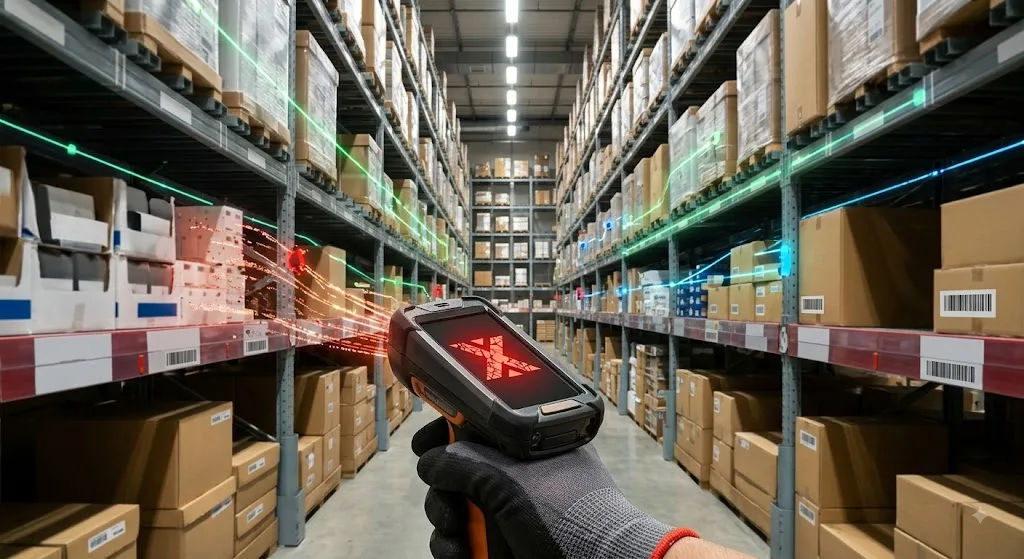
Retail inventory issues typically arise from small shortcuts rather than major system failures. Examples include entering product numbers after failed scans, printing unverified replacement labels, skipping scans during transfers, or recording quantities against the wrong stock-keeping unit. When repeated across locations and products, these errors distort inventory records essential for purchasing, fulfillment, and customer service.
A reliable barcode process acts as a control system for receiving, replenishment, order fulfillment, returns, pricing, and inventory reconciliation, not merely as a checkout convenience.
Key Takeaways
- Manual entry can introduce incorrect item numbers, quantities, locations, and transaction types.
- Inaccurate records influence purchasing, replenishment, picking, and customer promises.
- Better hardware helps, but accuracy also relies on clean master data, standardized workflows, validation, and effective exception management.
- Retailers should monitor failed scans, overrides, inventory variances, correction labor, and recurring exceptions together.
- The shift to 2D barcodes increases the importance of scanner readiness and software integration.
Why Manual Barcode Errors Stay Hidden
Barcode-related losses often go unnoticed because initial mistakes are minor and financial impacts surface elsewhere. For example, a receiving error can cause a later stockout, a duplicate scan may prompt unnecessary replenishment, and an incorrect return can affect both inventory and financial reporting.
Academic research defines inventory record inaccuracy as the difference between the recorded and actual physical quantity. Studies link this mismatch to weaker retail performance and unnecessary operational effort.
A Completed Transaction Can Still Contain Bad Data
This distinction matters because employees often continue working when a barcode does not scan, by entering digits manually, selecting a similar product, reusing an old label, or delaying correction.
These workarounds prevent immediate delays but remove the identification control that barcodes provide. As a result, transactions may complete with incorrect items, units, locations, or quantities in the system.
Where Retail Barcode Errors Enter the Workflow
Manual errors can occur at any inventory touchpoint. Risks increase under time pressure, with damaged labels, inconsistent procedures, or complex exception processes.
Receiving and Putaway
Receiving establishes the inventory record for the entire operation. Scanning the wrong carton, entering incorrect quantities, or assigning merchandise to the wrong location can affect an item throughout its lifecycle.
A robust workflow should validate the product identifier, purchase order, unit of measure, quantity tolerance, and destination before posting inventory. This supports integration with barcode scanning software, receiving automation, mobile data capture, and inventory management best practices.
Replenishment, Picking, and Transfers
Stock movement introduces additional risk. Employees may move items without scanning both the product and destination, confirm picks too early, or process similar products under a single barcode.
These errors can cause phantom inventory, misplaced stock, short picks, and unnecessary searches. Requiring scans during workflows reduces risk by confirming item-location relationships in real time.
Checkout, Returns, and Markdowns
Front-of-store transactions also affect accuracy. Manual product selection, unlinked markdown labels, and returns posted to the wrong item can alter both financial transactions and stock records.
Price accuracy, product identification, and inventory control should rely on governed product data and consistent transaction rules.
What Manual Barcode Errors Cost at Scale
The true cost is cumulative. While a single incorrect scan may be quickly corrected, recurring errors lead to rework, lost availability, poor decisions, and higher customer service costs across the retail network.
Error pathway Immediate impact Scaled business cost Incorrect item or quantity entry Inventory balance changes incorrectly Stockouts, excess ordering, and unreliable replenishment Skipped movement scan Item location is not updated Search time, delayed picking, and missed fulfillment promises Duplicate scan Inventory is overstated or understated Corrections, purchasing errors, and reporting noise Wrong label association Scanner reads valid but incorrect data Mispriced items, wrong shipments, and weak traceability Uncontrolled manual override Transaction bypasses validation Higher audit effort and repeated exceptionsThe most damaging effect is the feedback loop: inaccurate inventory leads to poor replenishment, which triggers emergency handling, increases manual intervention, and creates more opportunities for error.
A comprehensive cost model should include rework labor, lost gross margin from unavailable products, markdowns or waste from overstock, reshipment expenses, customer recovery efforts, and management time spent investigating discrepancies.
Why a Better Barcode Scanner Is Not Enough
Hardware quality is important, but the barcode scanner is only the input layer. Accuracy depends on system processes before, during, and after scanning.
IBM notes that barcoding enables more accurate data capture, faster processing, improved inventory visibility, and stronger auditability. These benefits result from integrating scanning into workflows, not just from owning scanning devices.
Four Controls Make the Difference
A dependable retail barcode program combines technology with process governance. Four key controls address common sources of preventable errors.
- Standardized product identification: Use governed identifiers and consistent labeling rules across suppliers, stores, and systems.
- Real-time validation: Reject unknown products, impossible quantities, duplicate transactions, and incorrect location matches before posting data.
- Structured exception handling: Provide employees with a clear process for damaged labels, unexpected items, and outages. Record manual work as an exception.
- Traceable audit data: Capture who scanned or overrode a transaction, when and where it occurred, and what changed.
A Practical Roadmap for Reducing Barcode Errors
Improvement begins with visibility, not large-scale technology replacement. Retailers can often reduce risk by addressing the most error-prone steps first.
Measure Manual Intervention
The first step is to identify where scanning fails. Key indicators include failed scan frequency, manual entry volume, overrides, inventory adjustments, repeated label printing, and cycle count discrepancies.
Review these measures collectively. Frequent failed scans and high adjustment volumes may indicate issues with label quality, devices, training, or workflows.
Standardize High-Risk Transactions
Next, document the required scan sequence for receiving, putaway, picking, transfers, returns, and markdowns. Eliminate unnecessary choices and require confirmation where errors would be costly.
Workflow automation can prefill known data, enforce item-location matching, and route exceptions to the appropriate role. Employee judgment should be used for genuine exceptions, not routine entries.
Close the Loop With Cycle Counts
Cycle counting should go beyond correcting balances. Each variance should prompt a root-cause analysis covering receiving, movement, checkout, returns, damage, labeling, and system integration.
This approach turns inventory reconciliation into continuous improvement and directs training and system changes toward the most costly error sources.
Preparing for the Shift to 2D Retail Barcodes
Retail barcode strategy is evolving. GS1 explains that traditional EAN/UPC barcodes primarily carry a product identifier, while 2D barcodes can also include expiration dates, batch or lot numbers, serial numbers, and links to online information.
This capability enables stronger traceability and more precise inventory processes, but only if scanners, point-of-sale software, host systems, and workflows interpret the data correctly. GS1 also notes that some environments may need software or equipment upgrades during the transition.
Retailers should approach 2D readiness as an end-to-end assessment, covering barcode quality, scanner compatibility, duplicate code handling, validation, exceptions, and employee productivity.
ConclusionManual barcode errors often go unnoticed because transactions appear successful. The resulting damage appears later as inventory variance, wasted labor, poor replenishment, fulfillment failures, and reduced trust in operational data.
The solution is not simply to scan more frequently. Retailers need barcode scanning workflows that validate transactions, guide employees through exceptions, maintain an audit trail, and link inventory movements to reliable product data. With these controls, barcodes become a dependable bridge between physical inventory and digital operations.