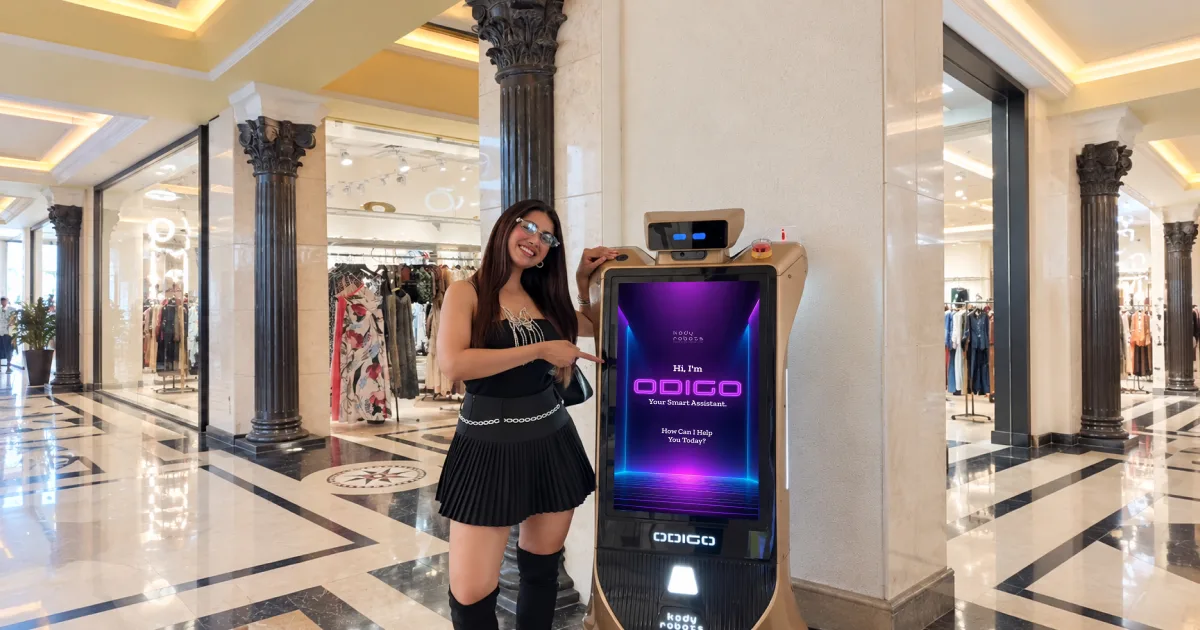
Physical retail is becoming more digital without becoming less important. Shoppers still want to see products, compare options, discover brands, ask questions, and receive help from people. What is changing is the technology available around those moments.
A retail robot can bring digital assistance or operational automation into the store. Depending on its role, robotics can help shoppers find destinations, present promotions, support navigation, clean large floor areas, monitor selected spaces, or move goods through defined workflows.
The wider service-robot market is also expanding. The International Federation of Robotics reported that global shipments of professional service robots increased 24% to almost 250,000 units in 2025.
For retailers, the lesson is straightforward. Robotics should solve a defined store problem. The strongest deployments begin with the job that needs support, not with the novelty of having a machine on the floor.
What Is a Retail Robot?
A retail robot is a robotic system designed to support customer-facing or operational work inside a physical retail environment.
The role can range from shopper assistance and interactive advertising to cleaning, security, and internal transport.
The category is broad because retail itself is broad. A supermarket has different requirements from a mall. A big-box store operates differently from a showroom. One location may prioritize shopper navigation, while another may need stronger cleaning or security support.
The better question is therefore not, “Which robot is best?”
Retailers should ask, “Which store workflow needs support?”
A Superstores Robot can be evaluated when large-format stores want robotics suited to high-footfall, multi-zone environments. The deployment should still begin with a specific customer or operational challenge.
Why Are Retail Robots Becoming More Relevant?
McKinsey's 2026 research suggests physical stores are increasingly being shaped around two broad missions: convenience and discovery.
Convenience-focused stores need speed, clear pathways, intuitive navigation, and reliable execution. Discovery-focused stores need stronger exploration, product guidance, storytelling, and human interaction.
A retail robot can support either mission when the job is clearly defined.
For convenience, robotics may help customers locate destinations or support routine operational tasks. For discovery, customer-facing automation may help shoppers explore information, promotions, and store areas.
NRF research also shows how digital assistance is entering the broader shopping journey. In its 2026 consumer study, 72% of surveyed consumers still shopped in stores, while 41% used AI assistants for product research.
Physical retail and digital assistance are increasingly becoming part of the same experience.
What Are the Main Types of Retail Robots?
Retail automation works best when different robot categories are matched with different jobs. One machine does not need to perform every function.
1. Retail Assistant Robot
A retail assistant robot is designed for customer-facing interactions.
The system can support destination discovery, store information, wayfinding, promotional engagement, and human handoff.
This category is particularly useful where shoppers repeatedly ask questions about departments, categories, service points, or directions.
Kody Robots can position Odigo in this role. Odigo is suited to customer assistance, wayfinding, engagement, advertising, and connecting shoppers with human support.
The goal is not to remove associates. Routine requests can be supported through robotics while employees remain available for recommendations, complaints, exceptions, and more complex conversations.
2. Retail Advertising Robot
A retail advertising robot brings mobility and interaction into in-store media.
Instead of limiting campaign content to one wall, entrance, or fixed digital screen, a mobile platform can operate across selected customer zones.
An Advertising Robot for Retail can also connect advertising with a useful next action. A shopper may engage with a promotion, request directions, scan a QR code, or continue toward the promoted category.
Odigo fits this role because advertising and customer assistance can form part of the same journey.
3. Retail Cleaning Robot
A retail cleaning robot supports repetitive floor-care workflows across defined areas.
Large stores, supermarkets, malls, and big-box environments can require consistent floor cleaning throughout long operating hours.
Vulcan from Kody Robots fits this operational category. Its role should remain clearly separate from Odigo. Odigo focuses on customer-facing experiences, while Vulcan supports cleaning operations.
This distinction makes each robot's business case easier to understand.
4. Retail Security Robot
A retail security robot supports monitoring and surveillance workflows across selected environments.
Kody Robots can position Athena for security-oriented retail spaces. Athena supports capabilities such as 360-degree UHD monitoring, thermal sensing, two-way intercom communication, and selected detection workflows.
Security robotics should support security personnel rather than replace them. Human teams remain responsible for judgment, escalation, and response.
5. Autonomous Transport Robot
Some retail environments can also benefit from an autonomous retail robot designed to move goods, supplies, or materials through defined internal routes.
Transportation and logistics accounted for 117,500 professional service robots sold in 2025, representing 47% of the professional service-robot market reported by IFR.
Retailers should consider this category only where store layouts, traffic patterns, routes, and safety procedures support autonomous movement.
What Are the Most Important Retail Robot Use Cases?
The strongest use cases solve repeatable customer or operational friction.
Product and Destination Discovery
Customers frequently know what they want but not where to find it.
Customer-facing robotics can give shoppers an interactive way to search for configured departments, categories, service points, or other destinations.
This reduces the distance between customer intent and the physical location.
Store Wayfinding
Large stores and shopping centers can be difficult to navigate.
A retail robot can support guidance through approved mapped areas and help shoppers move from a destination search toward the correct store area.
For Odigo, the customer journey can follow a logical sequence:
Question → Search → Destination → Guidance → Human Help
Interactive Advertising
Retail media becomes more useful when customers can take action after seeing a message.
A customer may notice an offer and then want to find the promoted category, learn more, scan a QR code, or request assistance.
Mobile advertising can connect those moments instead of ending with passive exposure.
Cleaning
Cleaning is a repetitive operational requirement.
Autonomous floor-care robotics can support planned cleaning across configured spaces while store employees focus on other responsibilities.
Vulcan gives Kody Robots a role in this operational part of the retail environment.
Security and Monitoring
Malls, supermarkets, showrooms, and other large spaces may require continuous visibility across public areas.
Security robotics can support monitoring and selected alert workflows while human security teams retain responsibility for decisions and response.
Athena fits this type of retail application.
Employee Support
The purpose of retail automation should not be to eliminate employees from customer service.
Robotics can support structured repetition. People remain responsible for judgment, exceptions, trust, recommendations, and complex customer needs.
That division makes automation more practical.
What Are the Benefits of Retail Robots?
Benefits vary depending on the job being automated.
Customer-facing robotics can provide another route to routine information and make departments easier to locate. Navigation can reduce unnecessary searching. Interactive media can connect advertising with useful shopper actions.
Operational robotics can support more consistent cleaning, monitoring, or transport workflows.
Employees may also spend less time handling highly repetitive tasks and more time helping customers with requests that need expertise.
A retail robot can create measurable activity as well. Depending on the use case, retailers can evaluate navigation requests, campaign interactions, QR actions, human handoffs, uptime, cleaning completion, or monitoring workflows.
The strongest benefit is not automation itself.
It is measurable improvement in a customer or operational process.
How Does AI Change Retail Robotics?
An AI retail robot can support request understanding, information retrieval, interaction flow, and navigation decisions.
However, AI should still operate inside clear business rules.
Retailers need control over which information customers receive, where the robot can operate, which campaigns appear, and when employees should take over.
For Odigo, AI can support assistance while the retailer remains responsible for defining the customer experience.
This assistive model is more practical than expecting technology to independently manage every retail interaction.
Which Kody Robots Are Suitable for Retail?
Kody Robots can address several retail needs because its robots serve different roles.
Odigo fits shopper assistance, wayfinding, advertising, and engagement.
Vulcan fits floor-cleaning workflows.
Athena fits security and monitoring environments.
The important point is role separation.
Kody Robots does not need to position every robot as solving the same problem. Each machine becomes easier to evaluate when its purpose is clearly defined.
For customer engagement, Odigo is the strongest fit. For cleanliness, Vulcan addresses an operational need. For monitoring-focused environments, Athena supports the security layer.
This gives Kody Robots a broader retail proposition without weakening the individual purpose of each product.
How Should Retailers Choose the Right Robot?
At the middle of the funnel, retailers need to move from understanding the category to evaluating deployment fit.
A Retail Store Robot should be selected based on the workflow it needs to improve.
Retailers should first determine whether the priority is customer assistance, advertising, cleaning, security, or internal movement. Next, they should define the operating area, required information, integrations, human handoff process, and measurable success criteria.
Technology specifications matter, but the operating environment matters just as much.
A retail robot should fit customer behavior, employee workflows, store layout, support processes, and business objectives.
How Should a Retail Robotics Pilot Be Measured?
Every pilot needs a baseline.
For customer-facing robotics, retailers can evaluate destination searches, navigation requests, promotional engagement, customer feedback, and staff handoffs.
Cleaning pilots should focus on coverage, completed cleaning cycles, interventions, and uptime.
Security pilots may evaluate monitoring coverage, system availability, alerts, and response processes.
Different jobs require different KPIs.
One universal ROI calculation cannot accurately measure every robot category.
Kody Robots can strengthen deployment planning by connecting each robot with metrics that match its purpose.
Why Do Some Retail Robot Deployments Fail?
A technically capable robot can still fail to deliver business value.
Common problems include unclear use cases, weak employee adoption, outdated information, unsuitable operating areas, confusing customer interactions, and poor support processes.
Retailers researching Why Retail Robots Fail should therefore focus on workflow design before scaling.
A retail robot needs a purpose that customers or employees can quickly understand. Store teams should know how the technology fits their responsibilities. Maps, content, operating rules, and human escalation also need clear ownership.
Kody Robots can make deployments more credible by keeping each product tied to a specific customer-facing or operational goal.
Why Consider Kody Robots for Retail?
Kody Robots can support multiple areas of the physical retail environment without asking one robot to perform every task.
Odigo can support customer assistance, wayfinding, advertising, and engagement. Vulcan can support autonomous cleaning. Athena can support monitoring and security-oriented workflows.
Retailers should still begin with the business problem rather than the product.
The right deployment is the one that fits the store environment, makes an important task easier, and generates an outcome the retailer can measure.
Kody Robots can then be evaluated on usability, deployment fit, operational consistency, customer experience, and workflow performance.
What Does the Future of Retail Robots Look Like?
Retail robotics is likely to move away from isolated demonstrations and toward defined operational roles.
IFR reported that professional service-robot shipments grew 24% in 2025, indicating continued commercial adoption. Transportation, professional cleaning, and security are already recognized service-robot application categories.
At the same time, physical stores remain important even as AI changes how shoppers research and discover products. McKinsey expects store strategies to become more clearly aligned around convenience or discovery.
That creates a practical future for robotics in retail.
Customer-facing systems can make stores easier to navigate and more engaging. Operational systems can support cleaning, monitoring, and selected movement workflows.
Employees remain essential wherever judgment, empathy, trust, or complex service is required.
Frequently Asked Questions
What is a retail robot?
A retail robot is a robotic system used to support customer-facing or operational tasks inside physical retail environments. Common roles include assistance, wayfinding, advertising, cleaning, security, and internal transport.
What are the main types of retail robots?
Common categories include customer-assistance robots, advertising robots, cleaning robots, security robots, and autonomous transport robots.
Can retail robots replace store employees?
No. Robotics is better suited to structured and repeatable work. Employees remain essential for recommendations, complaints, exceptions, complex customer service, safety decisions, and situations requiring human judgment.
Which Kody Robots are suitable for retail?
Odigo is suited to customer assistance, wayfinding, engagement, and advertising. Vulcan supports cleaning workflows, while Athena can support security and monitoring environments.
How should retailers choose a retail robot?
Retailers should begin with a specific business problem, define the operating environment, identify required data or integrations, establish human handoff rules, and set measurable pilot KPIs.
How can retail robotics improve customer experience?
Customer-facing automation can make information easier to access, support navigation, connect advertising with useful next actions, and provide another route to employee assistance.
Conclusion
A retail robot creates the most value when its role is clear.
Some robots belong close to shoppers. Others are better suited to cleaning, security, or transport workflows. Trying to make one machine solve every store problem weakens the business case.
Kody Robots can build a stronger retail proposition through role-based deployment. Odigo supports customer assistance, wayfinding, engagement, and advertising. Vulcan supports cleaning. Athena supports security and monitoring.
The goal is not a store without people.
It is a store where robotics handles structured work while employees focus on situations that require human judgment.
As professional service robots become more common across commercial environments, retailers have an opportunity to move beyond novelty and evaluate robotics through measurable customer and operational outcomes.
Sources
International Federation of Robotics, World Robotics 2026 Service Robots
Used for current professional service-robot shipment data and application trends.
McKinsey & Company, Shopping in the Age of AI: Redefining Stores for a New Era, 2026
Used for current research on convenience-led and discovery-led physical retail strategies.
National Retail Federation and IBM, Own the Agentic Commerce Experience, 2026
Used for current research on physical-store shopping and AI-assisted product research.