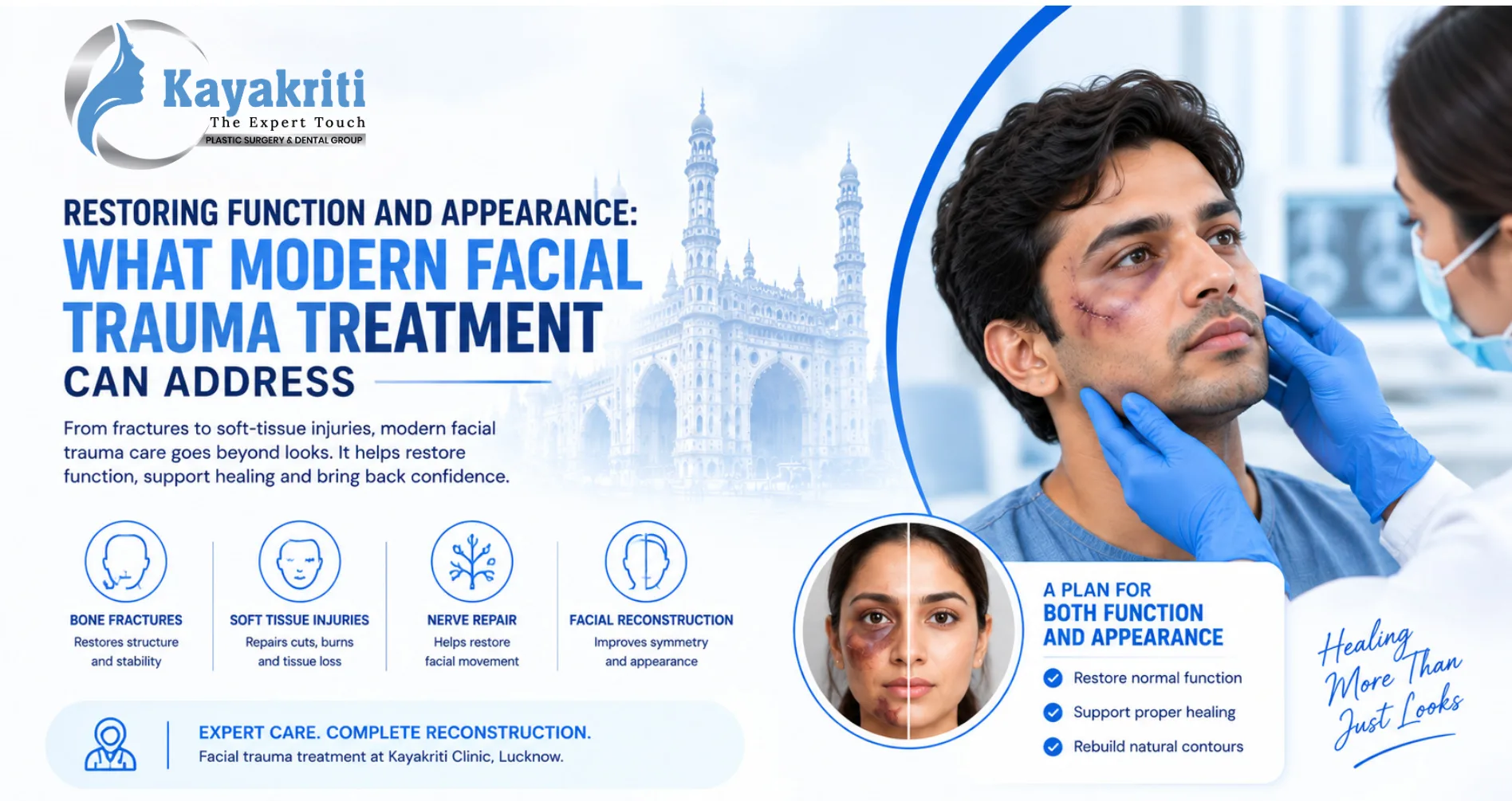
Facial trauma can change much more than the way a person looks. A road accident, fall, sports injury, burn, or other traumatic event can affect facial bones, skin, muscles, nerves, and structures involved in everyday activities. Depending on the injury, facial trauma treatment may therefore need to address breathing, chewing, speaking, swallowing, facial movement, and structural stability alongside appearance.
Modern facial trauma care can involve everything from wound management and fracture treatment to later facial injury reconstruction, scar revision, and restoration of facial contours. The appropriate approach depends on the structures affected, the extent of damage, and the patient's functional recovery needs.
For people researching facial injury treatment, understanding how function and appearance are connected can make it easier to evaluate treatment options and have more productive discussions with a reconstructive specialist.
What Functions Can Be Affected by Facial Trauma?
The face contains structures that contribute to several essential functions. Facial injuries can interfere with these functions when bones, soft tissues, nerves, or surrounding structures are damaged.
Depending on the location and severity of the injury, problems may involve:
- Eating and chewing: Jaw fractures or altered dental alignment can make biting and chewing difficult.
- Speaking: Injuries affecting the jaw, lips, or surrounding structures may influence speech.
- Swallowing: Trauma involving the mouth and facial structures can sometimes interfere with swallowing.
- Breathing: Injuries involving the nose or midface may affect the normal airway.
- Eye-related function: Trauma around the orbit can affect surrounding structures and, in some cases, eye movement.
- Facial expression: Injury to facial muscles or nerves can alter facial movement and symmetry.
This is why facial trauma treatment is not necessarily a cosmetic procedure. Facial trauma surgery may be required to restore the structural relationships that support normal facial function.
A treatment plan can therefore have two connected objectives: restoring damaged structures and helping the patient regain as much normal function as possible.
What Types of Facial Injuries Affect Both Appearance and Function?
Some injuries have both visible and functional consequences. Facial fractures are a common example. A displaced fracture can alter facial contours while also affecting the bite, jaw movement, breathing, or other functions.
The lower jaw plays an important role in chewing and speaking. A fracture can sometimes produce difficulty opening the mouth or disturb the alignment between the upper and lower teeth. Midface fractures can similarly alter facial proportions and structural support.
Soft-tissue injuries can create another set of challenges. Deep cuts, burns, and tissue loss may leave scars, contour irregularities, or restricted movement. When the injury involves the lips, eyelids, or other mobile areas, the repair must consider function as well as appearance.
As a result, facial injury treatment may combine several objectives. Facial reconstruction can restore damaged or missing structures, while facial injury repair may focus on wound closure, soft-tissue alignment, and preservation of movement.
At Kayakriti Lucknow, facial reconstruction services cover facial fractures, soft-tissue injuries, and post-traumatic deformities, providing an example of how multiple aspects of an injury can be considered within one reconstructive plan.
How Can Facial Reconstruction Restore Facial Symmetry?
Facial symmetry depends on the position and proportions of numerous structures, including the facial bones, soft tissues, nose, cheeks, jaw, and surrounding features.
Trauma can disrupt these relationships. A displaced bone may change the contour of one side of the face, while tissue loss or scarring can create differences in volume, texture, or movement.
Facial reconstruction aims to restore these relationships as closely as possible. Depending on the injury, treatment may involve repositioning fractured bones, reconstructing missing tissue, using tissue flaps, bone grafting, or revising scars.
Modern planning can also incorporate detailed imaging. Three-dimensional imaging may help a surgeon understand complex fracture patterns and plan reconstruction around the patient's individual anatomy.
The goal of facial injury reconstruction is not necessarily absolute symmetry. Small differences can remain even after successful treatment. Instead, reconstruction aims to restore structural balance, useful function, and a natural appearance to the extent reasonably possible.
This distinction is important when considering facial trauma because expectations should be based on the nature of the injury rather than on an assumption that surgery can recreate the face exactly as it looked before the trauma.
The Role of Soft-Tissue Repair
Not every facial injury involves a broken bone. Cuts, lacerations, burns, and tissue loss can damage the skin and underlying soft tissues even when the facial skeleton remains intact.
In such cases, facial injury repair may involve careful wound management, layered closure, or reconstruction of missing tissue. The location of an injury can be particularly important because scars around the lips, eyelids, or other mobile areas can affect function as well as appearance.
More complex injuries may require facial trauma surgery involving local tissue flaps or microsurgical reconstruction. These techniques can help replace damaged tissue while considering colour, texture, contour, and movement.
At Kayakriti, reconstructive planning can involve techniques such as microsurgery, local flaps, bone grafting, and scar revision when clinically appropriate. The selected technique depends on the defect rather than following a standard approach for every patient.
A key objective of facial injury treatment is therefore not simply closing a wound. It is restoring the relationship between the different tissue layers while preserving or improving movement and facial form.
Bone Reconstruction After Facial Trauma
Facial bones provide structural support for the eyes, nose, cheeks and jaw. When these bones are fractured or displaced, restoring their position can be important for both function and appearance.
Facial trauma surgery for fractures may involve repositioning broken bone segments and stabilising them with appropriate fixation. Plates and screws can be used in selected cases to hold accurately repositioned bones in place while healing occurs.
Three-dimensional CT imaging can be particularly useful in complex facial fractures because it can help reveal the location and extent of skeletal disruption. This information can contribute to surgical planning and help the surgeon understand how different facial structures relate to one another.
Not every fracture requires surgery. Some minimally displaced injuries may be managed conservatively, while displaced or complex fractures may require operative treatment. The decision depends on factors such as fracture location, functional impairment, associated soft-tissue injuries and the patient's overall condition.
This is why facial trauma requires individual assessment rather than a treatment decision based solely on how dramatic the injury appears externally.
How Is Facial Injury Repair Planned Around Functional Recovery?
Functional recovery should be considered from the beginning of facial injury reconstruction. A treatment plan may need to account for wound healing, bone stability, dental alignment, soft-tissue movement and nerve function.
For example, repairing a fractured jaw involves more than restoring its visible contour. The relationship between the upper and lower teeth and the patient's ability to open and close the mouth are also important. Similarly, reconstruction around the eyelids needs to consider closure and movement, while repairs around the lips need to preserve mobility required for speech and eating.
At Kayakriti Lucknow, complex facial reconstruction can involve focused examination, imaging and multidisciplinary input when dental, rehabilitation or other specialist involvement is appropriate.
This approach is particularly relevant when injuries involve several structures. Facial injury treatment may need to be staged rather than completed in a single procedure, with immediate priorities addressed first and later refinement performed after healing.
Why Scar Management Is Part of Facial Reconstruction
Scarring is a normal part of wound healing, but facial scars can sometimes become prominent, contract or interfere with movement. Their location can also determine how noticeable they appear.
Scar management can therefore become an important part of facial injury reconstruction. Depending on the scar's characteristics and maturity, management may involve observation, non-surgical measures or surgical scar revision.
Scar revision may be particularly relevant when a post-traumatic scar affects facial contour, movement or the relationship between important facial features.
Burn-related scars can present additional functional concerns. Contracture around the lips, for example, can interfere with mouth movement, while scarring around the eyelids may affect normal eye closure.
For this reason, facial injury repair should consider not only how the wound looks after initial healing but also how the repaired tissue may behave as healing continues.
Why Facial Trauma Treatment May Be Staged
Complex facial trauma treatment does not always allow every reconstructive objective to be addressed in one operation. The immediate priority may be controlling bleeding, treating wounds, stabilising fractures or managing another urgent concern.
Once the initial injury has healed, subsequent procedures may address residual asymmetry, scars, contour irregularities or functional limitations.
At Kayakriti, staged facial reconstruction can involve an initial procedure for urgent injuries followed by later refinement of scars, contour and symmetry. The overall treatment timeline depends on the extent of the injury and how the patient heals.
A staged approach can therefore be a normal part of facial reconstruction, particularly when multiple structures have been affected.
Patients considering facial trauma surgery should ask whether their treatment is expected to involve one procedure or several stages, what each stage is intended to accomplish and how functional recovery will be evaluated.
Choosing a Specialist for Complex Facial Injury Treatment
When facial trauma involves fractures, tissue loss, significant scarring or complex reconstruction, the surgeon's qualifications and relevant experience are important considerations.
People searching online for the best plastic surgeon in Lucknow should look beyond rankings or promotional descriptions. Useful factors include specialist training, experience with reconstructive procedures, familiarity with complex facial injuries and the ability to explain realistic treatment goals.
At Kayakriti Lucknow, Dr. Amit Agarwal serves as Chief Plastic, Aesthetic and Reconstructive Surgeon. His qualifications include FRCS (Edinburgh), American Board certification, MCh, DNB, FACS and FICS, with fellowship training in microsurgery, hand and brachial plexus surgery, and aesthetic and facial plastic surgery.
His practice also includes craniofacial and reconstructive procedures, making relevant surgical experience an important consideration for patients evaluating facial trauma surgery.
The phrase 'best plastic surgeon in Lucknow' may be useful when beginning an online search, but a more meaningful evaluation involves matching the surgeon's qualifications and experience to the specific injury and reconstructive requirements.
What to Discuss During a Facial Trauma Consultation
A consultation for facial trauma treatment should give patients an opportunity to understand the injury and the proposed recovery pathway.
Useful questions include:
- Which facial structures have been damaged?
- Is the injury affecting function as well as appearance?
- Are the facial bones displaced or unstable?
- Is soft-tissue reconstruction required?
- Could dental, jaw or nerve function be affected?
- What imaging is required?
- Is one procedure sufficient, or might reconstruction be staged?
- What type of scar can reasonably be expected?
- Could scar revision or additional reconstruction be required later?
- What rehabilitation or follow-up may be necessary?
Patients should also understand the limitations of facial reconstruction. Even with advanced surgical techniques, complete restoration of pre-injury appearance or function is not always possible.
The objective should therefore be realistic improvement in structure, function, and appearance rather than an absolute promise of recreating the face exactly as it was before the injury.
Restoring More Than Appearance
The central purpose of modern facial trauma treatment is not simply to make an injured face look better. It is to restore as much structure, movement, and function as the injury allows while addressing visible changes.
Whether the problem involves a fracture, soft-tissue wound, tissue loss, facial nerve problem, or post-traumatic scar, facial injury treatment should be based on the structures affected and the patient's recovery needs.
At Kayakriti Lucknow, Dr. Amit Agarwal provides facial and reconstructive surgical care that includes facial fractures, soft-tissue injuries, post-traumatic deformities, and scar-related concerns. Facial reconstruction may incorporate microsurgery, local flaps, bone grafting, or scar revision depending on the individual defect.
For people researching facial trauma, understanding these possibilities can make conversations with a reconstructive specialist more productive. Instead of focusing only on finding the best plastic surgeon in Lucknow, patients can consider qualifications, relevant experience, diagnostic assessment, treatment planning, and realistic expectations.
Ultimately, facial trauma treatment is highly individualised. Facial injury reconstruction, facial injury repair, facial trauma surgery, and broader reconstructive surgery techniques may each have a role depending on what has been damaged.
With appropriate assessment and careful planning, modern facial reconstruction can address functional needs and visible changes after traumatic injury while keeping long-term recovery at the centre of treatment.
Disclaimer:
This article is intended for general educational and informational purposes only and should not be considered a substitute for professional medical advice, diagnosis, or treatment. Facial injuries vary significantly in severity and anatomical involvement, and the appropriate form of facial injury treatment, facial trauma surgery, facial injury repair, or reconstructive surgery can only be determined following an individual clinical assessment. Treatment requirements, risks, recovery periods, and outcomes vary between patients, and complete restoration of pre-injury appearance or function cannot be guaranteed. In an emergency, patients should seek immediate medical attention rather than relying on information provided in this article.