For years, remote patient monitoring had a billing problem hiding inside a good idea. Medicare wouldn't reimburse a device-supply claim unless a patient transmitted data for at least 16 days a month, and wouldn't pay for clinical management time under 20 minutes. Patients who transmitted for a week, or needed only a brief check-in, generated real clinical work that nobody could bill for. As of January 1, 2026, CMS closed both gaps with two new CPT codes — and that changes what's worth building in healthcare app development this year.
What Actually Changed
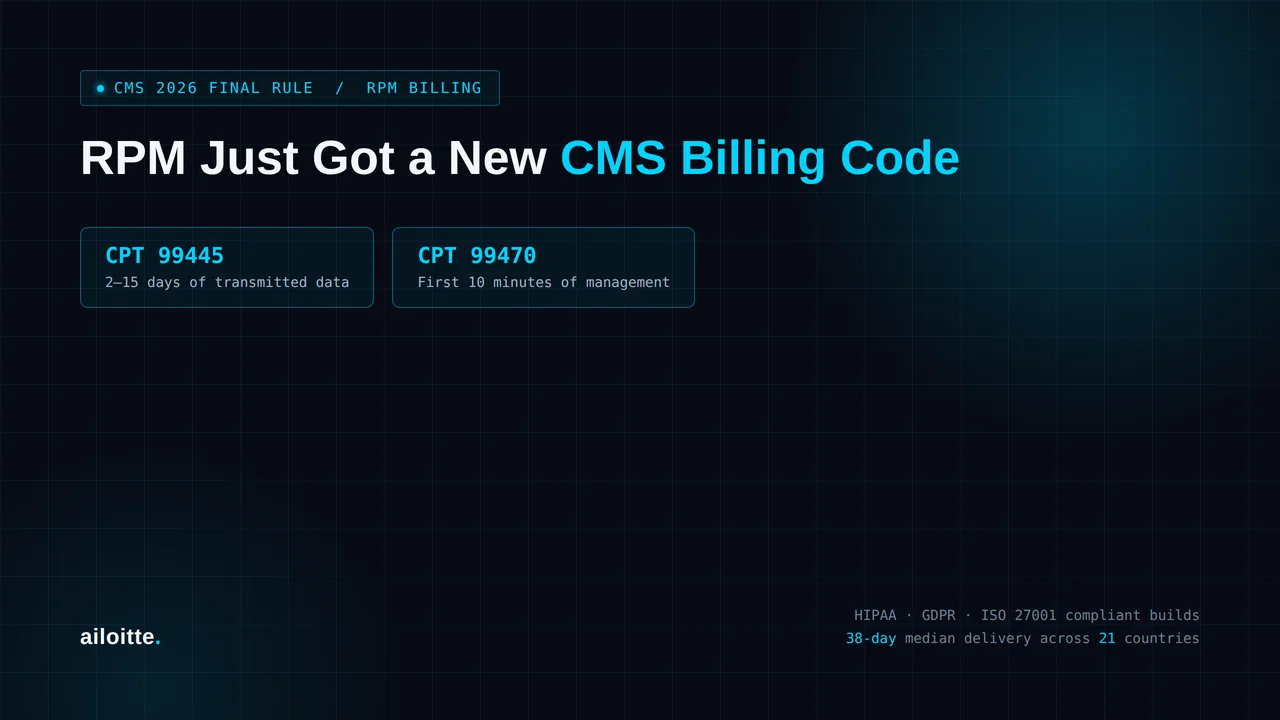
CMS finalized CPT code 99445, a shorter device-supply code covering 2 to 15 days of transmitted data in 30 days, reimbursed at roughly the same rate as the existing 16-day code. Alongside it, CPT 99470 now covers the first 10 minutes of monthly treatment management, down from the old 20-minute floor. The legacy codes — 99453, 99454, 99457, 99458 — all remain in place; these new codes sit alongside them rather than replacing anything.
The result: episodic and short-duration monitoring — a post-discharge blood pressure check, a short medication-titration window, a brief post-op recovery period — is now billable in situations the old thresholds used to exclude entirely.
Why This Matters for What Gets Built
Before this change, a lot of custom healthcare app development for RPM defaulted to long-duration chronic care use cases, because that's where reimbursement reliably existed. Shorter, episodic monitoring products were harder to justify financially, even when the clinical case was strong.
That constraint just loosened. Products built around short-term, transitional monitoring — post-discharge recovery, medication titration, short-term weight or vitals tracking — now have a clearer reimbursement path than they did a year ago. For teams evaluating whether to build an RPM feature at all, this is a meaningful shift in the underlying business case, not just a coding update.
What This Means for the Build, Not Just the Business Case
1. Documentation needs to track shorter windows precisely. A 2–15 day billing code requires the same rigor as the 16-day one — accurate device transmission logs and time tracking matter just as much for a shorter monitoring period.
2. Interactive communication still has to be real-time. Both new and legacy management codes require live, synchronous interaction with the patient — text messages or manual uploads alone don't qualify, so the app's communication layer needs to capture and log that distinction clearly.
3. Code selection logic belongs in the app, not just the billing office. Since the 2–15 day and 16-plus day codes are mutually exclusive, a well-built healthcare mobile app development product can surface which code applies automatically, reducing claim denials from manual coding errors.
Building for Where Reimbursement Is Heading
A healthcare app development company building RPM products in 2026 should be designing for this more flexible reimbursement landscape from the start, not retrofitting it later. Ailoitte's healthcare app development services build billing-code logic and documentation requirements into the architecture from the first sprint, so RPM products are ready for real-world reimbursement the day they launch.
FAQ
Q: What are the new 2026 RPM CPT codes? A: CMS added 99445 for 2–15 days of transmitted data and 99470 for the first 10 minutes of monthly treatment management, lowering the previous 16-day and 20-minute thresholds.
Q: Do the new codes replace the existing RPM billing codes? A: No. The legacy codes (99453, 99454, 99457, 99458) remain in place — the new codes add options for shorter monitoring periods and management times, not a replacement.