For centuries, real estate ownership has been one of the most reliable paths to wealth creation. Property has represented stability, legacy, and long term financial security. Yet despite its importance, real estate ownership has remained inaccessible to a large portion of the global population. High capital requirements, complex legal processes, geographic limitations, and illiquidity have historically restricted ownership to a privileged few.
A quiet transformation is now underway. It is not driven by flashy headlines or speculative hype but by structural innovation. Real estate tokenization is reshaping how property is owned, accessed, and exchanged. Rather than overturning the real estate industry overnight, it is gradually redefining who gets to participate in it.
This shift is not merely technological. It is social, financial, and generational. Tokenization challenges long held assumptions about ownership, investment size, and participation. As this model gains traction, it raises a fundamental question. Who truly gets to own property in the modern economy?
The Historical Barriers to Property Ownership
To understand the significance of real estate tokenization, it is important to examine why property ownership has been so exclusive.
Traditional real estate investment demands significant upfront capital. Down payments, closing costs, legal fees, taxes, and ongoing maintenance costs create a high financial threshold. Even income generating properties often require years before delivering meaningful returns.
Geography has been another barrier. Investors are typically limited to markets they understand, can physically access, or can legally navigate. Cross border property investment introduces currency risks, regulatory complexity, and trust issues that deter many potential participants.
Liquidity has also played a defining role. Real estate is inherently illiquid. Selling a property can take months or even years, and investors cannot easily exit partial positions. This makes real estate unsuitable for individuals who require flexibility or shorter investment horizons.
Finally, institutional gatekeeping has reinforced exclusivity. Premium commercial assets are often reserved for large funds, family offices, or private equity firms. Retail investors are largely excluded from these opportunities, regardless of their interest or capability.
Together, these factors have shaped a system where property ownership is concentrated rather than distributed.
What Real Estate Tokenization Actually Means
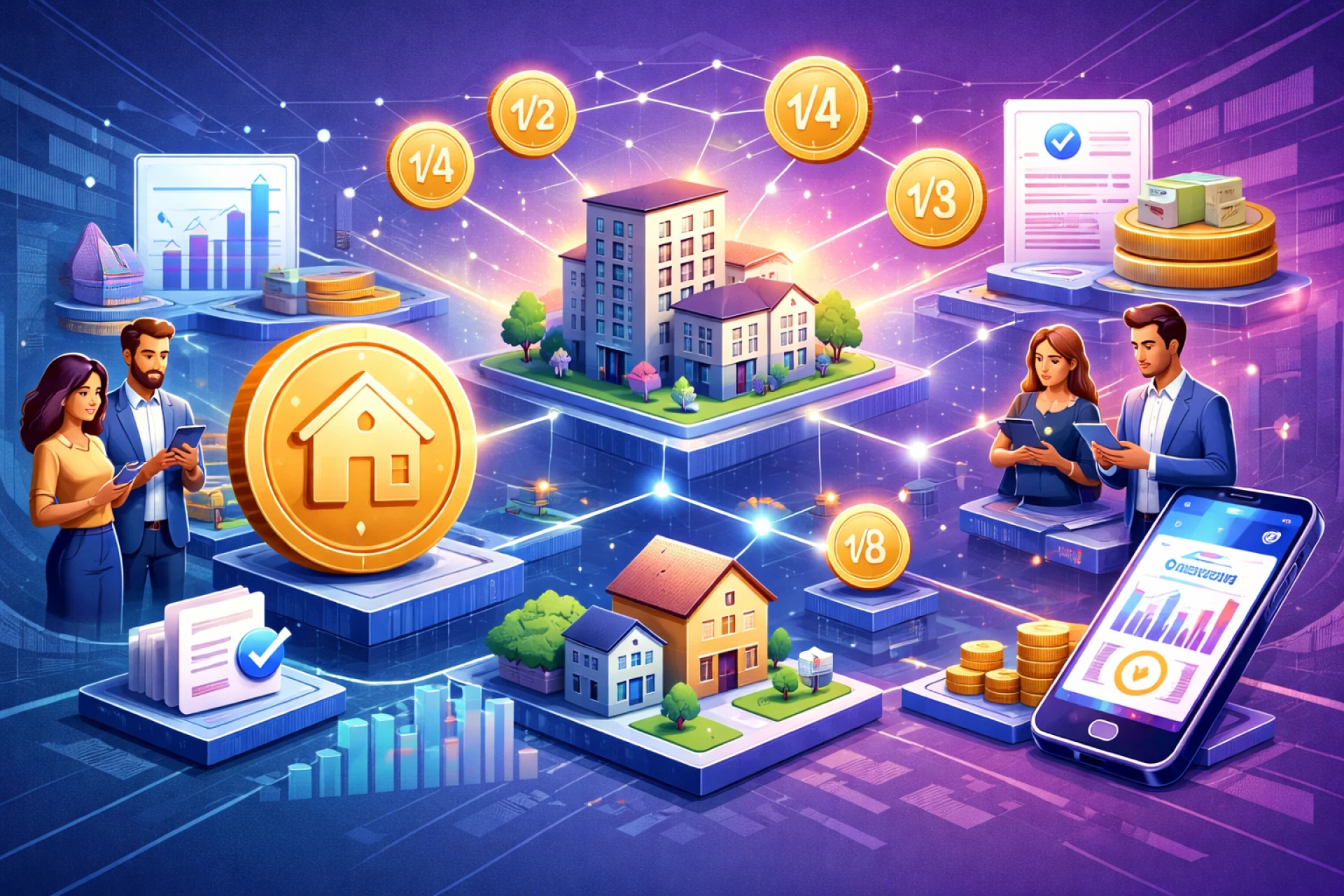
Real estate tokenization refers to the process of representing ownership rights in a property as digital tokens on a blockchain based infrastructure. Each token corresponds to a fractional share of the underlying asset.
Rather than purchasing an entire property, an investor can acquire a small portion of it through tokens. Ownership, income rights, and transferability are encoded into digital contracts, enabling transparent and programmable asset management.
Tokenization does not change the physical nature of real estate. Buildings, land, and infrastructure remain tangible and location based. What changes is the way ownership is structured, divided, and exchanged.
At its core, tokenization converts real estate from a monolithic asset into a modular one. Ownership becomes divisible, tradable, and accessible in ways that were previously impossible.
This shift may appear subtle, but its implications are far reaching.
Fractional Ownership and the Democratization Effect
One of the most transformative aspects of real estate tokenization is fractional ownership.
By lowering the minimum investment threshold, tokenization opens property markets to a broader demographic. Individuals who could never afford a full property can now own a portion of one. This includes younger investors, middle income professionals, and participants from emerging markets.
Fractional ownership does not dilute the value of real estate. Instead, it distributes access. A commercial building that was once owned by a single entity can now be shared among thousands of investors, each holding a stake aligned with their financial capacity.
This model changes the psychological relationship people have with property. Ownership is no longer an all or nothing proposition. It becomes incremental, flexible, and scalable.
Over time, this could redefine how wealth is built. Instead of saving for decades to purchase a single asset, individuals can accumulate diversified property exposure gradually.
Liquidity as a Structural Shift
Liquidity has long been the Achilles heel of real estate investment. Tokenization introduces mechanisms that significantly improve this dynamic.
Tokenized real estate assets can be transferred more efficiently than traditional property interests. Ownership changes do not require renegotiating deeds or navigating lengthy settlement processes. Transfers can occur at the token level while legal frameworks ensure compliance behind the scenes.
This does not mean real estate becomes as liquid as equities overnight. Market maturity, regulation, and infrastructure still matter. However, even partial liquidity represents a meaningful improvement.
The ability to enter and exit positions more easily alters investor behavior. It reduces the risk premium associated with long lock in periods and makes real estate viable for a wider range of financial strategies.
Liquidity also enhances price discovery. When ownership interests can be exchanged more frequently, asset valuation becomes more dynamic and reflective of real market conditions.
Redefining Global Participation
Real estate tokenization is not confined by national borders in the same way traditional property investment is.
While regulatory compliance remains jurisdiction specific, tokenized structures can facilitate global participation. Investors from different regions can gain exposure to property markets they would otherwise never access.
This has profound implications for emerging economies and undercapitalized markets. Tokenization can attract global capital into local real estate projects without relying solely on institutional intermediaries.
At the same time, it allows individuals in high cost markets to diversify geographically without the complexity of direct foreign ownership.
Global participation does not eliminate risk, but it redistributes opportunity. Property markets become less insular and more interconnected.
Ownership Without Operational Burden
Another subtle but important shift introduced by tokenization is the separation of ownership from operational responsibility.
Traditional property ownership often involves hands on management or reliance on third parties. Maintenance, tenant relations, compliance, and administration require time, expertise, and effort.
Tokenized real estate structures typically abstract these operational burdens away from individual investors. Professional entities manage the asset, while token holders retain economic rights.
This model aligns real estate investment with modern portfolio management principles. Investors focus on allocation and performance rather than logistics.
By lowering the non financial costs of ownership, tokenization makes property investment more accessible to individuals who lack time or expertise.
Institutional Interest and Structural Validation
While retail accessibility often dominates discussions about tokenization, institutional interest plays an equally important role.
Large financial entities are exploring tokenized real estate not because it is novel, but because it offers efficiency gains. Reduced settlement times, improved transparency, and programmable compliance align with institutional priorities.
When institutions adopt tokenization, it validates the model and accelerates infrastructure development. This creates a positive feedback loop that benefits smaller participants as well.
Importantly, institutional involvement does not negate democratization. Instead, it creates shared marketplaces where different classes of investors can coexist.
Regulatory Evolution and Trust Building
Real estate tokenization operates at the intersection of finance, property law, and digital infrastructure. Regulation is therefore central to its long term success.
Rather than existing in regulatory gray zones, serious tokenization initiatives are increasingly designed within compliant frameworks. This includes investor protections, disclosure requirements, and governance mechanisms.
Regulatory clarity builds trust. Trust encourages participation. Participation drives liquidity and innovation.
As frameworks mature, tokenized real estate is likely to shift from experimental pilots to standardized financial instruments.
Cultural Implications of Shared Ownership
Beyond finance, tokenization carries cultural implications.
Ownership has traditionally been tied to identity and status. Owning property often symbolizes success, stability, and belonging. Tokenization reframes ownership as participation rather than possession.
Shared ownership challenges the idea that control must be exclusive. It introduces collaborative models where value is distributed rather than concentrated.
This aligns with broader generational shifts in attitudes toward assets. Younger investors prioritize access, flexibility, and diversification over singular ownership milestones.
Tokenization does not diminish the importance of property. It modernizes the way people relate to it.
Risks, Realities, and Responsible Adoption
While the potential of real estate tokenization is significant, it is not without challenges.
Market education remains a barrier. Many potential investors lack understanding of tokenized structures, associated risks, and long term implications.
Technology introduces new considerations around security, custody, and platform reliability. These must be addressed through robust design and governance.
Regulatory fragmentation across jurisdictions can limit scalability and create complexity.
Importantly, tokenization does not eliminate real estate risk. Market cycles, tenant demand, and economic conditions still apply.
Responsible adoption requires transparency, investor education, and realistic expectations.
A Gradual but Irreversible Shift
Real estate tokenization is not a sudden revolution. It is a gradual reconfiguration of ownership models.
Its impact will likely unfold over years rather than months. Early adopters will shape standards, frameworks, and best practices. As familiarity grows, adoption will accelerate.
What makes this shift powerful is not speed but direction. The trajectory points toward broader participation, increased flexibility, and more inclusive access to property markets.
Ownership is no longer defined solely by the ability to purchase entire assets. It is defined by the ability to participate meaningfully.
Who Gets to Own Property Now
The most profound impact of real estate tokenization is philosophical.
It challenges the idea that property ownership must be exclusive, capital intensive, and geographically constrained. It introduces a model where ownership is modular, accessible, and adaptable.
This does not mean everyone will own property. It means more people can.
It means ownership is no longer reserved for those who cross high financial thresholds early in life. It becomes something that can be built gradually, diversified intelligently, and accessed globally.
In redefining ownership, tokenization reshapes opportunity.
Quietly, steadily, and structurally, real estate tokenization is changing who gets to own property.