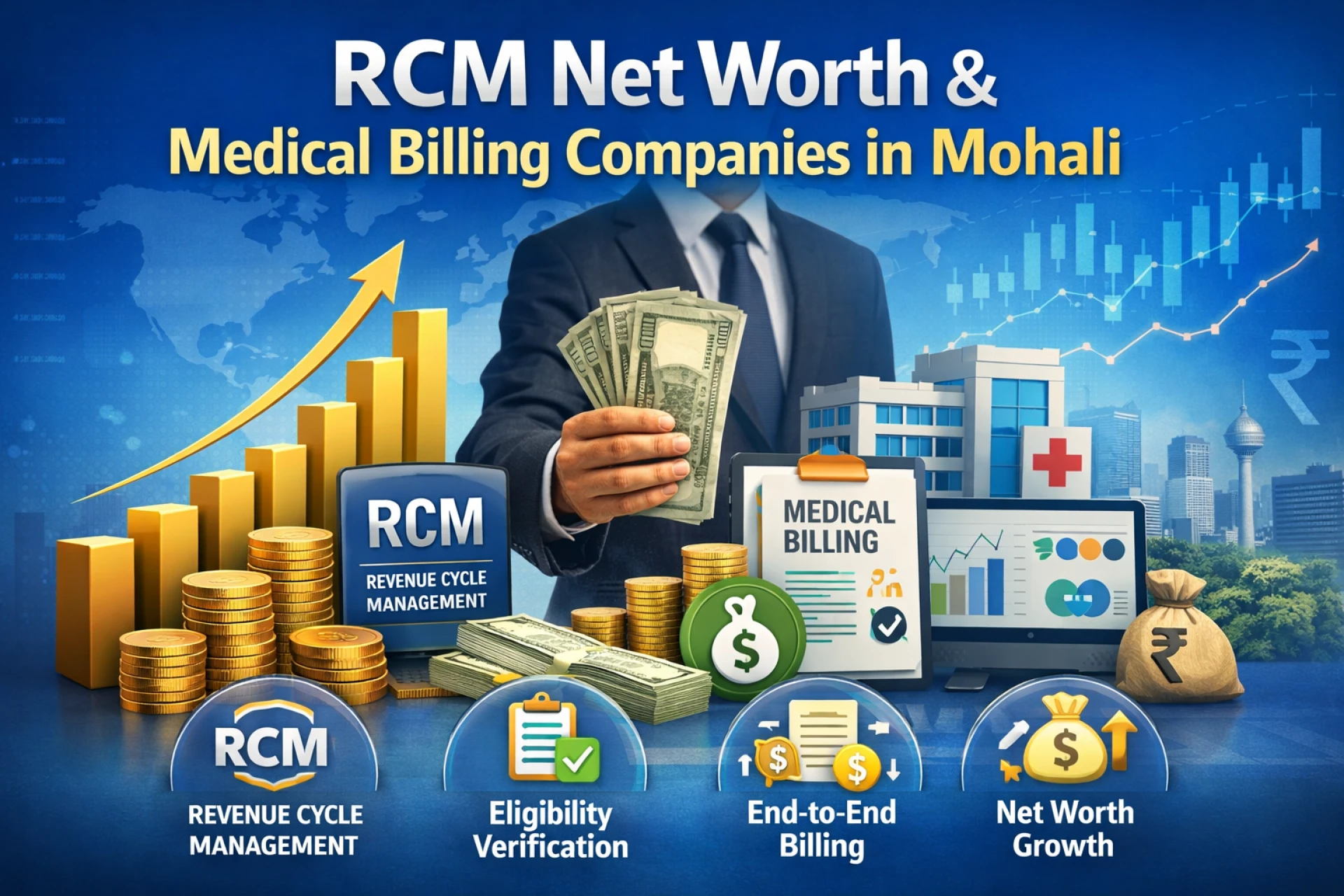
The healthcare industry relies heavily on efficient financial operations, and this is where Revenue Cycle Management plays a vital role. As healthcare providers increasingly outsource their billing operations, interest in RCM net worth, RCM owner net worth, and RCM business net worth has grown rapidly. India, especially Mohali, has emerged as a major destination for RCM services, attracting global healthcare organizations.
In this blog, we will explain the RCM full form, explore how RCM companies generate revenue, discuss medical billing companies in Mohali, and understand the services that contribute to the growing RCM company net worth.
RCM Full Form and Its Importance in Healthcare
RCM stands for Revenue Cycle Management, the crucial financial process in healthcare tracking patient revenue from scheduling to final payment, ensuring providers get paid for services. Its importance lies in maintaining financial stability, reducing claim denials, improving cash flow, ensuring compliance, and ultimately allowing providers to focus on quality patient care by streamlining complex billing and collection tasks.
How RCM Works (The Cycle)
RCM covers the entire financial journey of a patient encounter.
- Appointment Scheduling & Registration: Gathering patient info and verifying insurance.
- Charge Capture: Recording all services provided.
- Medical Coding: Assigning correct codes (ICD, CPT) for billing.
- Claim Submission: Sending clean claims to payers (insurers, government).
- Payment Posting: Receiving and applying payments.
- Denial Management: Handling rejected claims and appealing denials.
- Patient Billing & Collections: Billing patients for co-pays, deductibles, and collecting balances.
Importance of RCM in Healthcare
- Financial Stability: Ensures timely revenue, preventing financial losses.
- Reduced Denials: Minimizes errors, leading to fewer denied claims and faster reimbursements.
- Improved Cash Flow: Accelerates payment collection, vital for operations.
- Better Patient Experience: Prevents overcharging and provides clear billing, boosting satisfaction.
- Operational Efficiency: Automates tasks, freeing staff to focus on clinical care.
- Regulatory Compliance: Helps meet complex healthcare billing rules.
Understanding RCM Net Worth and Networth RCM Growth
The term "RCM" can refer to several concepts, primarily Revenue Cycle Management in business and healthcare, or specific companies such as R1 RCM Inc. and Networth RCM. The net worth and growth of each differ significantly.
Revenue Cycle Management (RCM) in Business/Healthcare
Revenue Cycle Management (RCM) is the end-to-end financial process businesses use to manage revenue, from initial customer interaction to final payment collection. Effective RCM is critical for an organization's financial health, aiming to maximize cash flow and reduce claim denials.
RCM Market Growth
The RCM market itself is a significant and growing industry:
- The global RCM market was valued at approximately $307 billion in 2023.
- It is expected to grow at a compound annual growth rate (CAGR) of over 11% from 2024 to 2030, potentially reaching a value of up to $900 billion within the next decade by some estimates.
Growth is driven by the increasing demand for workflow automation in healthcare, the complexity of medical billing, and the shift towards value-based care models.
RCM Owner Net Worth: What Determines It?
An RCM owner's net worth is determined by the total value of their assets minus their total liabilities. The specific factors influencing it depend on whether the "RCM" refers to a company (like a medical billing firm or a direct selling business) or an individual business owner.
Why Mohali Is a Preferred Destination for Medical Billing
Mohali is a preferred destination for medical billing due to its emergence as a high-value services hub, robust infrastructure, access to a skilled workforce, and supportive government ecosystem.
Key Factors
- Emerging IT and Healthcare Hub: Mohali is undergoing significant investment and growth in the IT, BPO (Business Process Outsourcing), and healthcare sectors. It is developing a "Medicity" and has attracted top institutions and investors, creating a strong ecosystem for healthcare-related services like medical billing.
- Talent Pool: The region has a vast and skilled workforce with expertise in medical billing and coding. Companies actively recruit for roles like AR (Accounts Receivable) callers and medical billing executives, often providing specific training on US healthcare processes and compliance (e.g., HIPAA).
- Advanced Technology and Infrastructure: Companies in Mohali leverage state-of-the-art technology, cutting-edge software, and workflow management tools to provide efficient and high-quality solutions to global healthcare clients. This focus on technology minimizes errors and ensures compliance with evolving regulations.
- Cost Efficiency: Outsourcing medical billing to Indian cities like Mohali offers significant cost savings for healthcare providers in other countries (e.g., the US) while maintaining high-quality service standards.
- Time Zone Advantage: India's time zone allows for efficient 24/7 task management and quick turnaround times through night shifts, enabling a seamless workflow for international clients, particularly those in the US healthcare industry.
- Government Support: The growth in Mohali is driven by government support and infrastructure upgrades through initiatives like Invest Punjab, which help attract corporate presence and foster a stress-free work environment.
Role of Medical Billing Companies in Mohali in RCM Success
Medical billing companies in Mohali, like Networth RCM, are crucial for RCM success by handling complex tasks such as eligibility verification, denial management, claims submission, and AR follow-up, ultimately improving cash flow, reducing costs, and freeing providers to focus on patient care, ensuring compliance and optimizing revenue streams through expert processes.
Key Roles in RCM Success:
- Streamlined Processes: They implement efficient workflows, often using advanced tech (EDI/EFT), for quick claim submission and faster payments, as seen with companies like MHBS RCM.
- Denial Management: Expertly handling claim denials and appeals, reducing write-offs, and ensuring providers get paid correctly, notes Networth RCM.
- Financial Reporting & AR: Managing accounts receivable (AR), providing detailed financial reports, and tracking collections to boost provider cash flow.
- Specialization: Catering to various specialties (cardiology, orthopedics, etc.) with tailored billing services, notes Networth RCM.
- Compliance & Ethics: Ensuring adherence to the latest healthcare regulations, maintaining high ethical standards, and staying compliant with industry rules.
- Technology Utilization: Leveraging technology for accurate, efficient, and secure processing, enhancing the entire revenue cycle.
- Client Relationship Management: Acting as a dedicated point of contact (like Client Success Managers), ensuring service delivery and strong client trust, mentions Bikham Information Technology.
In essence, these companies serve as the financial backbone, managing the intricate link between providers, patients, and payers to ensure financial health for healthcare practices in and around Mohali.
Eligibility Verification in Medical Billing: A Critical Step
Eligibility verification in medical billing is a critical pre-service step confirming a patient's active insurance and benefits (copay, deductible, coverage) to ensure providers get paid, reduce claim denials, improve cash flow, and set accurate patient expectations, preventing billing errors and boosting satisfaction. It involves checking details like patient ID, group number, and authorization needs, done via phone or portals before treatment, making it a vital part of revenue cycle management (RCM).
Why it's critical
- Reduces Denials: Catches coverage gaps or incorrect info before submission, stopping rejections.
- Improves Cash Flow: Ensures faster, more reliable payments by avoiding lengthy claim delays.
- Accurate Estimates: Allows providers to tell patients their true financial responsibility upfront.
- Boosts Efficiency: Automating this front-end process streamlines the entire billing lifecycle.
End-to-End Medical Billing Services Explained
End-to-End Medical Billing Services manage the entire healthcare revenue cycle, from patient registration and insurance verification to final payment, using a comprehensive approach to ensure accuracy, compliance (like HIPAA), and maximum reimbursement for providers, covering everything from coding and claim submission to denial management and patient billing. This holistic management minimizes errors, speeds up cash flow, and frees providers to focus on patient care.
How RCM Company Net Worth Is Built
RCM companies build their net worth primarily through generating consistent and growing revenue, managing cash flow effectively, strategic acquisitions, and optimizing operational efficiency. For publicly traded RCM companies like R1 RCM Inc., net worth is represented by its market capitalization (total value of outstanding shares) or net assets (assets minus liabilities).
RCM Business Net Worth and Future Opportunities
The term "RCM Business" can refer to a specific Indian direct-selling company (RCM Business, associated with RCM Consumer Products Private Limited) or the general Revenue Cycle Management (RCM) industry in healthcare.
Why RCM Is a High-Growth Industry
The Revenue Cycle Management (RCM) industry is a high-growth sector primarily due to the increasing complexities of healthcare billing, rising healthcare costs and claim denials, and the widespread adoption of advanced technologies like AI and automation to enhance efficiency and ensure compliance.
Key Drivers of RCM's High Growth
- Increasing Complexity of Healthcare & Regulation: The healthcare industry is subject to constant changes in insurance requirements, medical coding standards (ICD-10, CPT, HCPCS), and government mandates (like the Affordable Care Act and HIPAA). RCM solutions are essential for navigating these intricate and frequently updated rules to ensure accurate billing and compliance, driving demand for specialized expertise and technology.
- Need for Operational Efficiency and Cost Reduction: Healthcare providers face immense pressure to optimize revenue collection and reduce administrative waste and operational costs. RCM solutions streamline labor-intensive administrative tasks such as eligibility verification, prior authorization, claim submission, and denial management, freeing up resources for patient care and improving cash flow.
- Technological Advancements (AI and Automation): The integration of Artificial Intelligence (AI), Machine Learning (ML), and automation is transforming RCM. These technologies help in predicting claim denials, automating coding, detecting errors in real-time, and personalizing patient billing experiences, leading to significant efficiency gains and improved financial performance.
- Increased Outsourcing of RCM Services: Many healthcare organizations, particularly small and medium-sized practices, are choosing to outsource their RCM operations to specialized third-party vendors. Outsourcing allows providers to tap into expert knowledge, advanced technology, and economies of scale, ensuring better compliance and financial outcomes.
Conclusion
The growing interest in RCM net worth, RCM owner net worth, and networth RCM reflects the rapid expansion of the healthcare revenue management industry. With experienced medical billing companies in Mohali delivering reliable, compliant, and scalable solutions, RCM businesses continue to grow in value.
From eligibility verification in medical billing to end-to-end medical billing services, RCM companies play a crucial role in supporting healthcare providers financially. As global outsourcing continues to rise, the RCM company net worth and RCM business net worth are expected to reach new heights in the coming years.