Rainfall is an indispensable part of the water cycle, nourishing the land and replenishing rivers and lakes. However, short-duration heavy rainfall and continuous downpours can easily trigger urban flooding, flash floods, landslides, and sudden rises in river levels, threatening the safety of people's lives and property. Traditional manual rainfall observation methods are limited by terrain and manpower, making it difficult to capture rainfall over a large area and at high frequency. Rainfall sensors can convert the rainfall process into standardized electrical signals, enabling automatic data collection and remote data transmission around the clock. They are important front-end sensing hardware in meteorological observation, hydrological flood control, and smart water management systems, and also serve as the first line of data defense for disaster early warning.
Mainstream Technical Approaches: Mechanical and Non-Mechanical Solutions Each Have Their Advantages
Currently, the industry mainstream is divided into three main technical approaches: tipping bucket type, weighing type, and piezoelectric type. Different solutions have trade-offs in measurement accuracy, maintenance workload, and adaptability to complex environments.
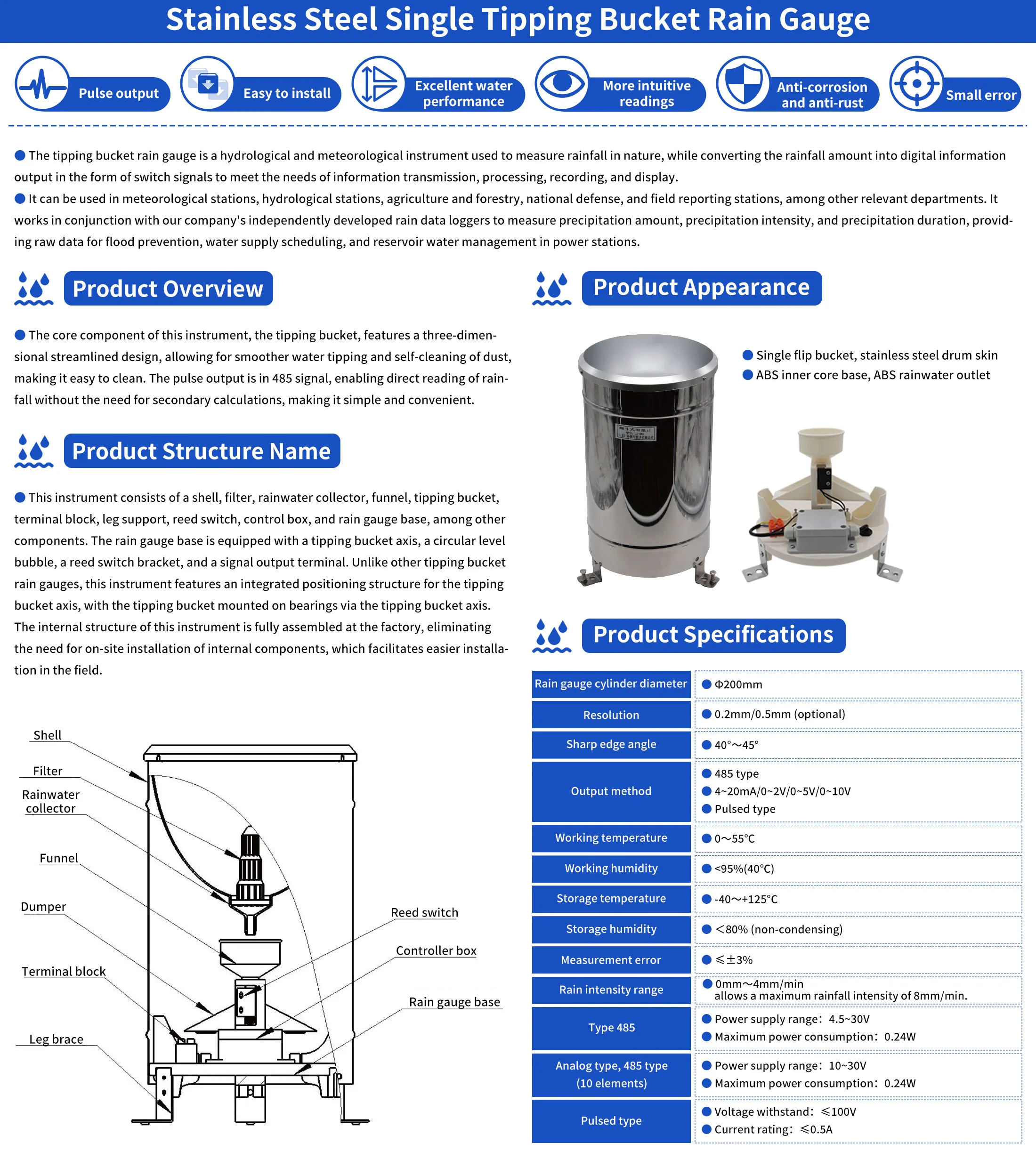
Tipping bucket rain gauges are the most widely used equipment in domestic hydrological and meteorological stations. Rainwater enters through a stainless steel rain inlet, and after a filter traps fallen leaves, insect debris, and other impurities, it flows into a double-tipping bucket cavity. When rainwater accumulates to a set volume, the tipping bucket tilts under gravity to empty the water, simultaneously triggering a reed switch to output a pulse signal. Each tilt corresponds to a fixed amount of rainfall. By counting the number of pulses, instantaneous rainfall intensity, daily rainfall, and cumulative total rainfall can be calculated. The double-tipping bucket structure can mitigate measurement errors caused by overflow during heavy rain. This technology is mature, cost-effective, and can be integrated with wind speed and direction, temperature and humidity, and air pressure sensors to form a unified weather station. Its drawback is that the mechanical movement structure is easily clogged by weeds and mud in the field, requiring regular maintenance and cleaning.
Weighing-type rain gauges directly weigh the total weight of precipitation in the collection container to calculate rainfall, unaffected by rainfall intensity. They can monitor rain, snow, hail, and both solid and liquid precipitation, meeting the WMO observation standards. They eliminate the risk of tipping bucket jamming and perform excellently in high-altitude and cold regions. However, the equipment is expensive and requires strict levelness of the installation base, making them primarily used in high-standard weather stations and scientific research monitoring sites.
Piezoelectric, mechanical-free rain sensors eliminate all moving parts, relying on raindrops impacting a piezoelectric sensing surface to generate electrical signals. Algorithms filter out interference from fallen leaves and vibrations. They eliminate the risk of jamming and require minimal maintenance, making them suitable for remote mountain slopes where personnel cannot easily reach. However, their accuracy is limited in light rain, generally serving as a supplementary monitoring method.
Multi-industry Applications: More Than Just Rainfall Recording – Empowering Risk Warning and Scientific Management
The value of rain sensors extends beyond simply recording rainfall in millimeters; it lies in transforming real-time rainfall data into early warning signals, supporting scientific management across multiple industries.
Flash Floods, Geological Disasters, and Watershed Hydrological Forecasting: Increased deployment of monitoring points in mountainous areas and small watersheds captures sudden, localized heavy rainfall. Once hourly rainfall intensity or cumulative rainfall reaches warning thresholds, the system automatically sends out alarms, buying valuable time for flash flood and landslide warnings and assisting in reservoir scheduling and river discharge decisions.
Urban Flood Control and Drainage & Smart Water Management: Urban grid-based deployment of sensing terminals, combined with pipeline level and water accumulation monitoring equipment, assesses the risk of urban flooding, coordinates with drainage pumping stations and sluice gates for pre-discharge and pre-release, reduces the impact of heavy rainfall on urban operations, and connects to the city's digital water management platform.
Agriculture, Forestry, and Water Resource Management: Rainfall data collected at farmland monitoring stations guides intelligent irrigation systems, adjusting irrigation amounts based on natural precipitation to conserve water resources; in forest areas, rainfall data is used to assess forest fire risk levels during droughts and evaluate geological disaster risks during periods of heavy rainfall; reservoirs and irrigation districts optimize water resource allocation based on rainfall data.
In addition, highway slope protection, port terminals, industrial park flood control, and high-altitude meteorological research all rely on continuous rainfall data output from rainfall sensors to support operational needs.