Rabbit Pellet Making Machine Price: What Determines the Cost?
For rabbit farms planning to produce their own feed, equipment cost is an important part of the investment decision. However, the price of a pellet machine depends on more than its size or motor power. Raw material preparation, required output, pellet specifications, and auxiliary equipment can all affect the final quotation.
When comparing rabbit pellet making machine price, buyers should look at the complete production requirements rather than choosing a machine simply because it has the lowest purchase price.
1. Production Capacity and Motor Power
Capacity is one of the main factors affecting equipment cost. A compact machine for a small rabbit farm generally requires a smaller investment than a system designed for commercial feed production.
Larger equipment may need a more powerful motor, stronger transmission components, and a higher-capacity feeding system. However, a high-capacity model is not automatically more economical.
Before selecting a machine, estimate daily feed consumption and determine how many hours the equipment will operate. A machine that matches the farm's actual workload can reduce unnecessary investment and avoid production bottlenecks.
Ask the supplier to clarify the expected output for your specific formula. The actual capacity may vary depending on ingredient characteristics, moisture, particle size, and pellet diameter.
2. Raw Material Preparation Requirements
Rabbit feed often contains forage ingredients such as alfalfa and grass, alongside grains and other formulated ingredients. These materials can have different physical properties and may require preparation before pelletizing.
Long fibers usually need suitable cutting or grinding. A hammer mill can reduce particle size, while a mixer distributes multiple ingredients more evenly.
If the farm already has suitable grinding and mixing equipment, it may only need the pellet mill and necessary downstream equipment. If the farm processes whole forage and several raw ingredients, the complete investment can be higher.
For an accurate quotation, describe the ingredients, initial particle size, moisture content, and expected feed formulation before asking the supplier to recommend a model.
3. Single Machine or Complete Feed System?
A standalone pellet machine may be sufficient for a farm that already has the equipment needed to prepare its feed.
A more complete setup may include a grinder, mixer, pellet mill, cooler, screening machine, conveyors, and packing equipment.
Each additional component affects the overall project cost. For example, automatic conveying and packing can reduce manual handling, but they may not be necessary for a small operation producing limited quantities for its own use.
For farms considering other livestock feed applications, a cattle feed pellet making machine price quotation can provide another reference for small-scale animal feed equipment. However, differences in feed formulation, fiber content, and required pellet specifications mean that the two projects should not be compared solely by machine price.
4. Pellet Diameter and Machine Configuration
The required pellet diameter should be established before the machine is selected.
Different die specifications can affect machine configuration and production performance. Buyers should also confirm whether alternative dies are available if they plan to change pellet sizes in the future.
The formula matters as well. Ingredients with different fiber characteristics or moisture levels may behave differently during compression, so the same machine may deliver different output rates with different feed mixtures.
Testing representative raw materials can help establish more realistic operating expectations.
5. Automation and Labor Costs
Manual and automated production systems have different cost structures.
A small farm may choose manual feeding and bagging to reduce initial investment. A commercial feed producer may prefer automatic weighing, conveying, and centralized controls to improve workflow and reduce repetitive labor.
Automation should be selected according to production volume, labor availability, and future plans. Paying for an elaborate system before the business needs it can increase costs without providing a meaningful benefit.
6. How to Evaluate the Total Investment
The equipment purchase price is only one part of the cost of producing rabbit feed.
A practical budget should include:
- Grinding and mixing equipment, if required
- Pelletizing and post-processing equipment
- Electrical installation and workshop preparation
- Electricity and labor
- Replacement dies and spare parts
- Routine maintenance and packaging
Buyers should also compare the quotation scope, warranty, installation assistance, training, and technical support offered by each supplier.
7. Is Producing Your Own Rabbit Feed Worth It?
The financial benefit depends on the farm's feed consumption, ingredient prices, labor, electricity, equipment utilization, and maintenance expenses.
A useful comparison is to estimate the cost of producing one ton of feed and compare it with the cost of purchasing equivalent commercial feed. The calculation should use nutritionally appropriate feed specifications rather than comparing products with different formulas.
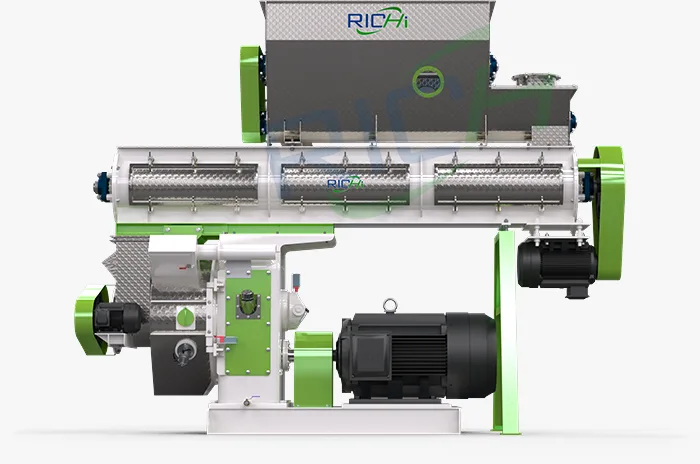
RICHI can configure feed pelletizing equipment according to the farm's ingredients, production target, and available budget. A suitable feed pellet machine may be supplied as an individual unit or combined with preparation and post-processing equipment.
Before making a purchase, confirm the actual output, required auxiliary machines, pellet dimensions, and total project cost. Learn more about animal feed pellet equipment and request a configuration based on your farm's production needs.