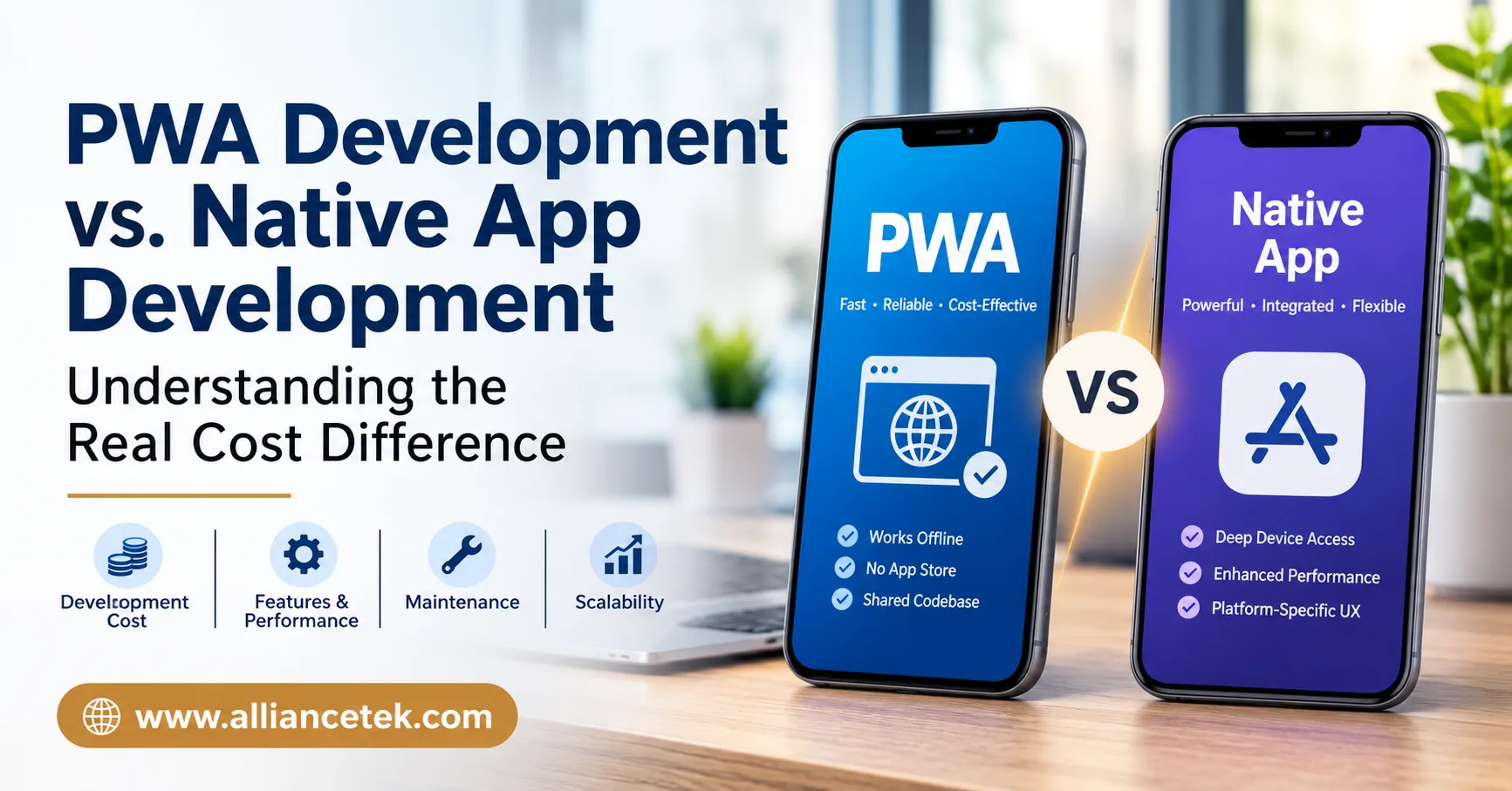
Businesses planning to build mobile applications often compare Progressive Web Apps (PWAs) with native applications to understand which approach offers better value. Both options provide different advantages in terms of development costs, performance, user experience, and long-term maintenance.
Choosing the right approach requires more than comparing initial development estimates. Organizations must also consider platform requirements, device capabilities, infrastructure, security, and future scalability.
A PWA can be a practical option for businesses looking to reach users through browsers without developing separate applications for multiple platforms. Native applications, on the other hand, offer deeper device integration and greater control over platform-specific experiences.
Understanding these differences helps businesses make informed technology investments.
Key Takeaways
- PWAs can reduce initial development costs by using a shared codebase across supported platforms.
- Native applications generally require platform-specific development for iOS and Android.
- PWAs can simplify deployment, updates, and ongoing maintenance.
- Native apps provide stronger access to device features and platform-specific capabilities.
- The most cost-effective approach depends on application complexity, performance requirements, and long-term business goals.
Understanding Progressive Web App Development
A Progressive Web App is a web application designed to deliver an app-like experience through a web browser. It combines standard web technologies with capabilities that improve accessibility, responsiveness, and user engagement. Businesses investing in progressive web app development services can build responsive applications that provide users with convenient access across supported devices and browsers.
PWAs can support features such as offline functionality, push notifications, home-screen installation, and responsive interfaces, depending on browser and operating system support.
One of the biggest advantages of PWA development is its shared codebase. Instead of maintaining completely separate applications for different mobile platforms, businesses can build a common application that works across supported browsers and devices.
This approach can reduce development effort and simplify maintenance.
For example, an eCommerce company planning to launch a mobile shopping experience may choose a PWA to provide product browsing, account access, and online purchasing without building separate native applications initially.
What Makes Native App Development Different?
Native applications are developed specifically for operating systems such as iOS and Android. Developers use platform-specific technologies and frameworks to build applications that work closely with the device's operating system.
Native development provides access to a broader range of device capabilities, including advanced camera functions, Bluetooth, background processing, location services, and operating system integrations.
These capabilities make native applications suitable for businesses that require advanced functionality or highly optimized mobile experiences.
For example, a financial services company developing a mobile banking application may require advanced biometric authentication, secure device integrations, and platform-specific security capabilities.
Native development provides greater flexibility when implementing such requirements.
However, developing separate applications for multiple platforms can increase initial investment, testing requirements, and maintenance responsibilities.
PWA Development Cost Factors
The cost of building a PWA depends on the application's functionality, technical architecture, integrations, and design requirements.
Several factors influence the overall development budget:
- Application complexity: A basic PWA with informational pages and simple user interactions generally requires less development effort than an application with user accounts, payment processing, real-time notifications, and advanced business workflows.
- UI and UX design: Responsive layouts must work across different screen sizes, browsers, and devices. More complex interfaces and customized interactions can increase design and development time.
- Backend development: Applications requiring databases, APIs, authentication systems, and third-party integrations need additional backend engineering.
- Offline capabilities: Implementing offline access, background synchronization, and service worker functionality requires additional planning and testing.
- Security requirements: Businesses handling customer information or financial transactions may need additional authentication, encryption, access controls, and security testing.
Because PWAs use shared web technologies, businesses can often reduce duplicated development work when supporting multiple platforms.
Native App Development Cost Factors
Native app development involves several cost considerations beyond writing application code.
- Platform-specific development: Developing separate iOS and Android applications can require additional engineering resources, particularly when platform-specific functionality is involved.
- Advanced device integration: Applications using GPS, cameras, biometrics, Bluetooth, or background processing may require specialized development.
- Testing and quality assurance: Native applications must be tested across different operating system versions, device models, and screen configurations.
- App store requirements: Publishing and maintaining applications through app marketplaces involves platform-specific submission processes, policies, and compliance considerations.
- Ongoing maintenance: Separate codebases can increase the effort required to implement updates, fix bugs, and introduce new features across platforms.
Native development can involve a higher initial investment, but it may provide better value for applications where performance, advanced functionality, and platform integration are essential.
Comparing Long-Term Development Expenses
Initial development costs are only one part of the total investment.
Businesses should evaluate the expenses associated with application updates, infrastructure, security, testing, and future enhancements.
PWAs generally offer simpler deployment because updates can be released through the web without requiring users to download a new version from an app store.
Native applications may require additional coordination between platform-specific development teams, especially when new features need to be released across iOS and Android.
However, maintenance costs depend heavily on the application's architecture and development quality. A complex PWA with extensive integrations can also require significant ongoing investment.
Infrastructure expenses should also be considered. Both approaches may require cloud hosting, databases, APIs, monitoring, and security services.
A realistic budget should account for the complete application lifecycle rather than focusing only on the initial development estimate.
How to Choose the Right Development Approach
Selecting between PWA and native development depends on the business objectives and technical requirements.
A PWA may be suitable when:
- The primary goal is to reach users through mobile browsers.
- The application requires broad accessibility across devices.
- Faster deployment and centralized updates are important.
- The business wants to reduce duplicated platform-specific development.
- Advanced device integration is not a major requirement.
Native development may be more appropriate when:
- The application depends on advanced device capabilities.
- High-performance interactions are essential.
- Complex background processing is required.
- The business needs deeper operating system integration.
- Platform-specific user experiences are a priority.
Some businesses may also benefit from a hybrid strategy. They can begin with a PWA to validate their product and expand into native applications when user expectations or technical requirements justify the additional investment.
The decision should be based on functionality, expected usage, development resources, and long-term product strategy.
Conclusion
Choosing between PWA and native app development requires a clear understanding of business priorities, technical requirements, and long-term costs.
PWAs offer advantages in development efficiency, accessibility, and centralized maintenance. Native applications provide deeper device integration, platform-specific capabilities, and greater flexibility for advanced mobile experiences.
There is no universal solution for every business. The right approach depends on the features an application needs, the users it serves, and how it is expected to grow.
Organizations evaluating their options can work with experienced development teams to assess technical requirements, estimate project costs, and select an architecture that supports future business needs.
AllianceTek helps businesses evaluate and develop software solutions aligned with their technical and operational goals. Talk to AllianceTek to discuss your application development requirements.
Frequently Asked Questions
Is PWA development cheaper than native app development?
PWA development can be more affordable because it often uses a shared codebase across supported platforms. However, the final cost depends on application complexity and required functionality.
Do PWAs support offline functionality?
Yes. PWAs can provide offline experiences through service workers and cached resources. The available functionality depends on how the application is designed and implemented.
Are native applications better for performance?
Native applications generally provide better access to platform-specific capabilities and can be optimized for demanding mobile experiences. However, well-developed PWAs can deliver strong performance for many business applications.
Can a business start with a PWA and move to native development later?
Yes. Businesses can begin with a PWA and introduce native applications as their requirements evolve. Proper backend architecture and API planning can make this transition easier.