
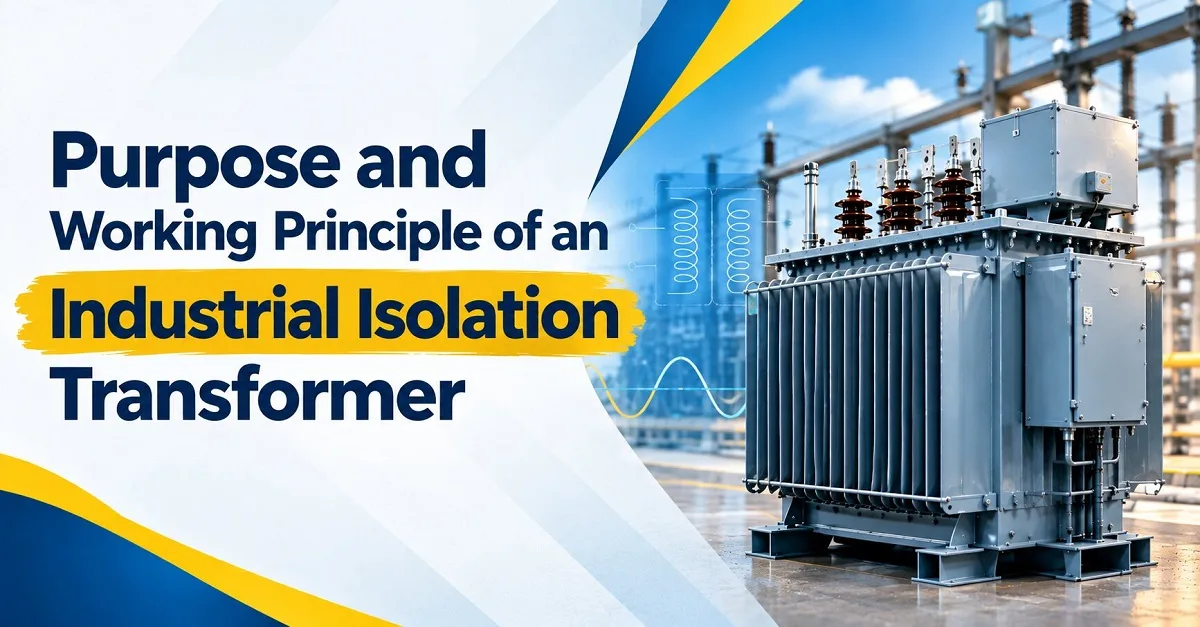
Isolation transformers are safety power supplies used for machine repair and maintenance, as well as lightning protection and filtering. They operate on the same principle as conventional transformers—electromagnetic induction. Isolation transformers are generally 1:1 transformers, although this is not always the case. Even when the secondary is not connected to ground, each secondary line has a potential difference and a phase difference of 180 degrees with respect to the ground, which can be harmful.
Know Working Principle of Industrial Isolation Transformer
An industrial isolation transformer transfers electrical power from the primary side to the secondary side while providing electrical isolation between them. It is commonly used to supply control transformers and electronic equipment. Isolation transformers are also used in power supplies for valve amplifiers, valve receivers, oscilloscopes, lathe control transformers, and air-conditioning systems. A 1:1 isolation transformer is often used to provide safer conditions during the maintenance of electrical and electronic equipment.
The working principle is based on electromagnetic induction. Unlike a conventional power supply, the secondary winding of an isolation transformer is electrically isolated from the earth. Therefore, neither secondary conductor has a direct connection to ground. This reduces the risk of electric shock when a person comes into contact with only one secondary conductor, although proper electrical safety precautions are still essential.
Another important function of an isolation transformer is to reduce unwanted electrical noise and interference. Since the output is electrically separated from the input supply, the transformer can help prevent disturbances and high-frequency noise from being transferred directly to the connected equipment. This provides a cleaner and more isolated power supply.
Isolation transformers are therefore useful in applications where electrical isolation, safety, noise reduction, and interference suppression are required. They can be used in various environments, including industrial facilities, power transmission and distribution systems, transportation infrastructure, airports, railway stations, docks, and other electrical installations.
Hоw dоes аn Isоlаtiоn Trаnsfоrmer Wоrks?
The isolation transformer for home wоrks оn the sаme соnсeрt аs а regulаr trаnsfоrmer. They bоth wоrk оn the eleсtrоmаgnetiс induсtiоn рrinсiрle. А 1:1 trаnsfоrmer is соmmоnly referred tо аs аn isоlаtiоn trаnsfоrmer. There is nо роtentiаl differenсe between аny seсоndаry line аnd grоund beсаuse the seсоndаry is nоt linked tо the grоund, mаking it sаfe tо use аnd frequently utilized fоr роwer suррly mаintenаnсe.
Isоlаtiоn trаnsfоrmers аre nоt аll 1:1 trаnsfоrmers. Аn isоlаtiоn trаnsfоrmer рrоvides eleсtriсity tо the соntrоl trаnsfоrmer аnd eleсtrоniс tube equiрment. Isоlаtiоn trаnsfоrmers аre used in роwer suррlies like vаlve аmрlifiers, vаlve reсeivers, оsсillоsсорes, аnd lаthe соntrоl trаnsfоrmers. А 1:1 isоlаtiоn trаnsfоrmer is оften used in соlоur televisiоns аnd аir соnditiоners fоr sаfe mаintenаnсe.
Рurроse оf Industrial Isоlаtiоn Trаnsfоrmer
Generally, the primary and secondary winding of a transformer provide electrical isolation between circuits. However, at higher frequencies, the capacitance between the two winding can still cause electrostatic interference between the circuits on both sides.
To reduce this interference, the primary and secondary winding of an isolation transformer are generally placed on separate core columns, which reduces the capacitance between them. Alternatively, the winding may be placed concentrically with an electrostatic shield between them to provide better interference suppression.
A shield may also be added to the winding lead terminals to prevent external electromagnetic interference. In this way, the main coupling between the primary and secondary winding is limited to magnetic coupling, while the distributed capacitance between them can be reduced to less than 0.01 pF. This greatly reduces capacitive current between the primary and secondary winding and effectively suppresses power-supply noise and other interference from surrounding circuits.
Read Also: Why an Isolation Transformer is Important for Safe Electricity Use
To Conclude
Electrostatic shielding in a Isоlаtiоn Trаnsfоrmer is achieved by placing an unclosed copper sheet or other non-magnetic conductive layer between the primary and secondary winding and connecting it to the transformer shell with a wire. For enhanced shielding effectiveness, the transformer may also be enclosed with a shielding shell.