Competitive intelligence teams are using product data scraping to maintain timely and relevant data analysis in rapidly evolving e-commerce markets by leveraging automation rather than manual checks to monitor competitor pricing, assortment and customer sentiment on products (SKUs).
Why Product Data Scraping Is Foundational to Modern Competitive Intelligence
Product data scraping is the automated gathering of product data (e.g., specifications, prices, images, etc.) from competitors' websites, marketplaces and online catalogs. It helps B2B and e-commerce companies in doing competitive intelligence analysis in their sectors.
Product data scraping is important because manually tracking competitor activity fails quickly. Online catalogs grow, SKUs increase and prices change much faster than most teams can analyze and respond to these changes.
Multiple studies on e-commerce pricing in Europe show online prices change frequently, with some changing more than once per month, making a "we'll check it weekly" approach dated. You can't glean market intelligence from competitor data that is already stale or outdated.
What Is Product Data Scraping?
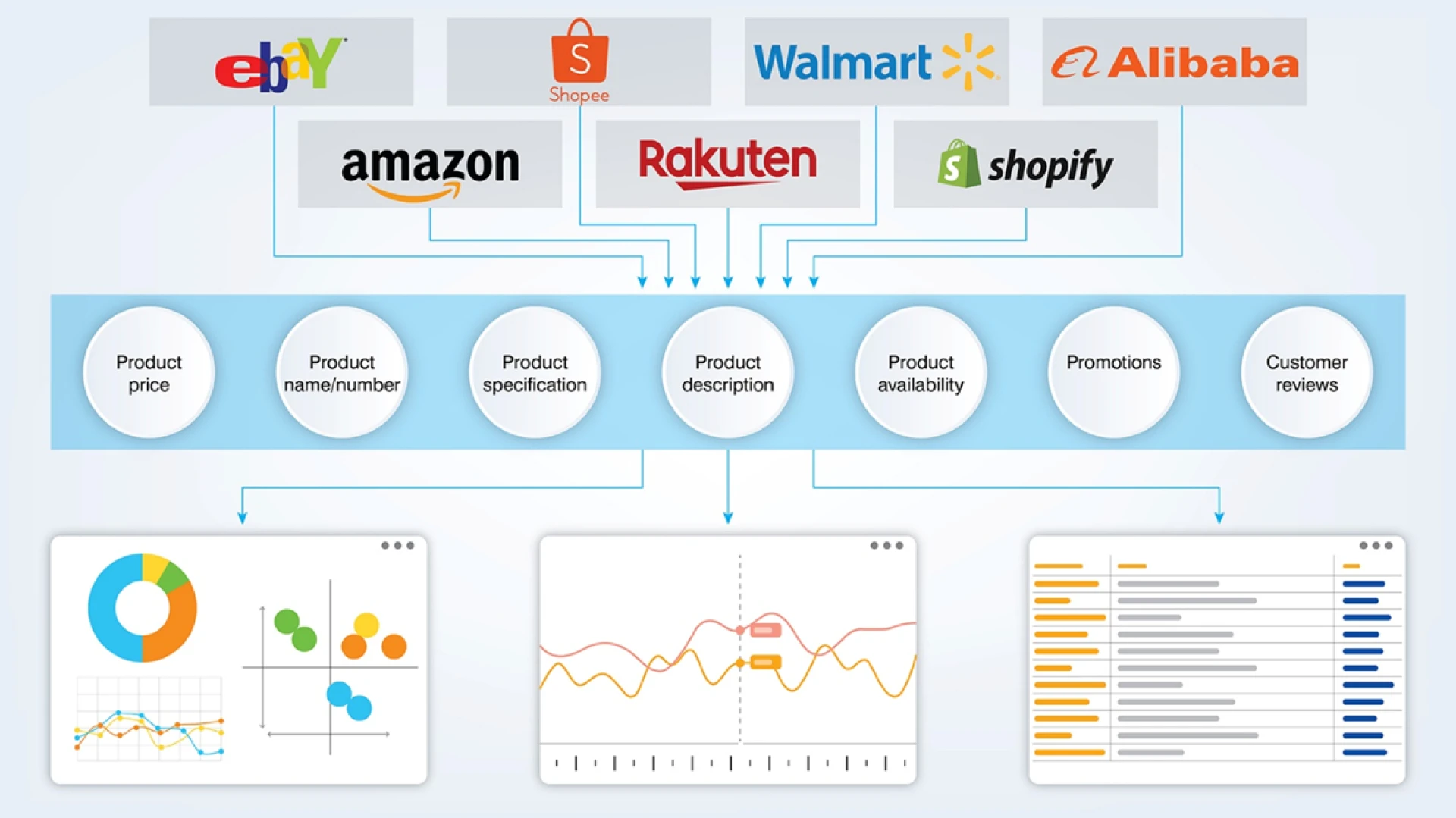
Product data scraping is the automated process of using tools and software to extract specific product information like names, prices, descriptions, reviews, availability, images from eCommerce websites and other online sources. Then this information is converted into structured formats like CSV or JSON to facilitate analysis, market research, competitor monitoring, or business intelligence. The entire process has proved its worth by saving significant time, efforts if compared to manual data collection and of course the dollars involved in the activity.
Web Crawling and Web Scraping and their Competitive Analysis
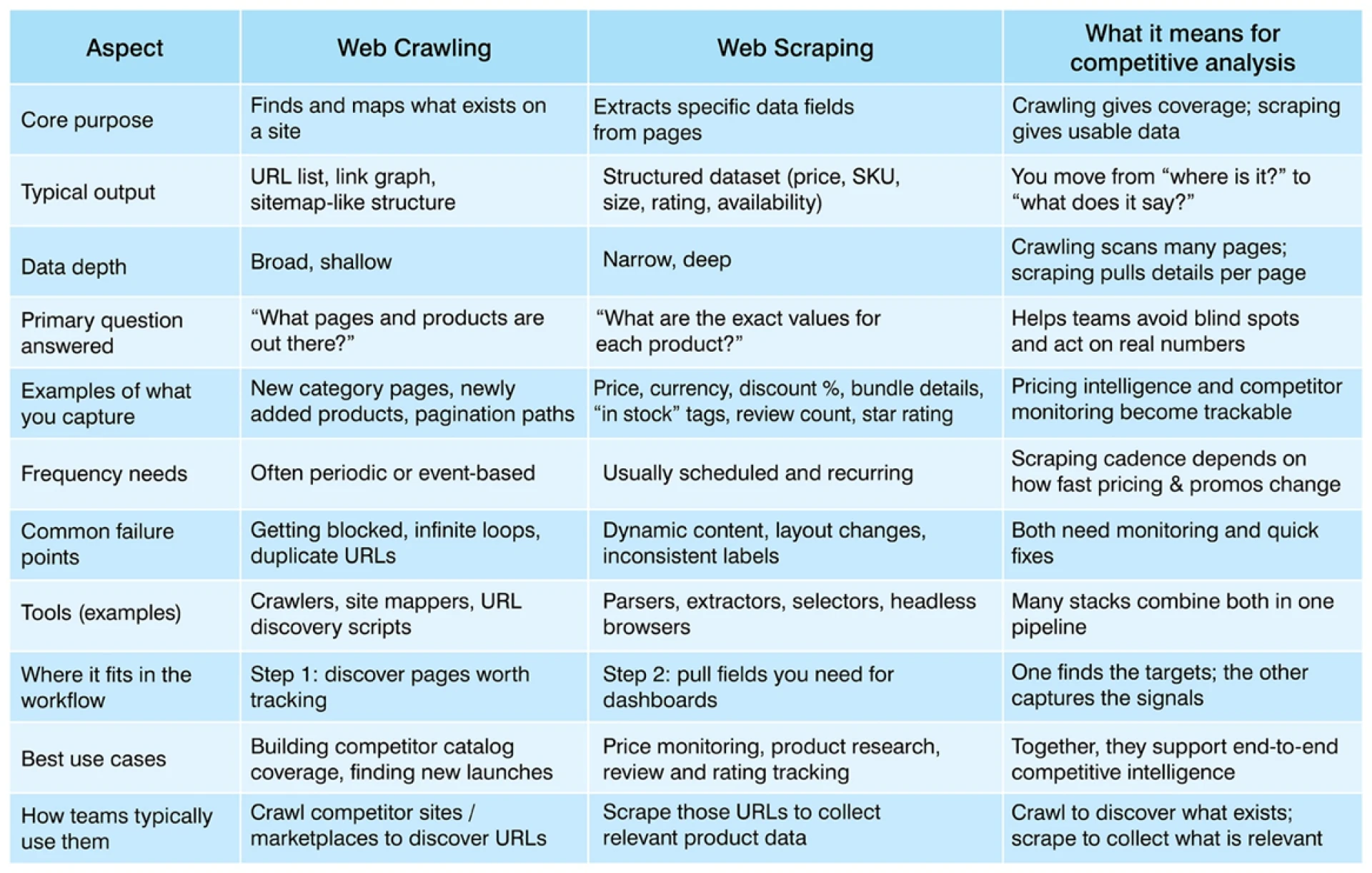
Web crawling maps competitor websites to discover pages, products, and coverage, while web scraping extracts precise data like prices, ratings, and availability. Together, crawling identifies what exists and scraping captures what matters, enabling complete competitive analysis, pricing intelligence, monitoring, and data-driven decision-making across dynamic markets and fast-changing digital ecosystems globally.
Let’s have a look at it in a tabular format for better understanding:
Top 7 Uses of Product Data Scraping for Competitive Analysis
So, how does product data scraping actually help in competitive analysis? The answer is that product data scraping helps spot competitor actions that can be converted into measurable indicators of their performance. You might be aiming for pricing intelligence, assortment changes, sentiment trends or gaps in content strategies, and product data will help you understand all of these.
Use Case 1: Competitive Pricing Intelligence & Dynamic Pricing
Pricing monitoring is of course the first priority when it comes to watching competitors. Companies can use product data scraping to gather competitor pricing on multiple platforms including marketplaces, direct-to-consumer (D2C) websites and regional storefronts, and measure discount frequency and promotional cadence. Research from the European Central Bank has shown that price changes occur frequently online, and as such, maintaining an out-of-date price list in fast-changing product categories can be a significant risk.
Technically, product data scraping for pricing intelligence often requires scheduling, normalizing pricing (by pack sizes, bundles) and converting currencies. This helps in building clean and actionable pricing decisions, enhance margin management and clarify "why we we set the price that way". While pricing is a prime goal for competitive analysis, it is difficult to do it without contextual understanding of competitor product positioning. This is where the knowledge gained from product data comes into play.
Use Case 2: Feature, Specification & Attribute Benchmarking
This is where product research gets granular. You can use product data scraping to extract product attributes (product specifications, product variants, bundles) and normalize them into a competitor database at a SKU level analytics granularity. This normalized dataset facilitates side-by-side comparison of product features, as well as roadmap discussions based on empirical evidence. The business benefit here is the enhanced clarity regarding competitor strengths and weaknesses, and tighter value proposition messaging due to ability to reference actual competitor specifications rather than conjecture. When you combine feature data with market intelligence, your analysis gains additional strength.
Use Case 3: Product Assortment & Catalog Gap Analysis
Product data scraping allows competitive intelligence teams to gather product catalog data from competitor websites to gain insight into SKU breadth, SKU depth and SKU lifecycle trends. With this type of data, teams can identify overlapping SKUs, gaps in their competitor's assortments, white space opportunities for the team to fill, and categories of products that may have been expanding or contracting in terms of offerings over time. Additionally, teams can identify when new SKUs were introduced or discontinued by their competitors before they appear in a quarterly sales report.
The primary business benefit here is Improved assortment planning and more intentional differentiation. While assortment strategy is key to understanding competitor offerings, it is equally essential to understand how customers perceive and interact with those offerings.
Use Case 4: Review, Rating & Customer Sentiment Insights
Reviews provide competitive intelligence teams with an opportunity to listen to their customers. Using product data scraping to collect reviews, ratings and FAQs from various marketplaces enables teams to perform simple text analytics and sentiment analysis to identify common themes of dissatisfaction among customers.
This is critical because review behavior is extremely active. For example, a recent survey showed that 91% of respondents read reviews at least monthly, and nearly one-third read them weekly or daily. Collecting reviews and ratings through product data scraping enables teams to:
· Identify customer pain points
· Identify gaps in product features
· Identify factors that drive customer satisfaction
The business benefit here is providing customer-centric competitive intelligence, and improving credibility in positioning efforts. Sentiment analysis indicates the outcome of competitor actions while positioning efforts seek to generate competitor action.
Use Case 5: Product Content & SEO Benchmarking
Product pages act as strategy documents and are invisible in plain sight. Extract title, description, meta-data and claims. Then compare the structural elements of content; the pattern of keywords used; and how competitors frame the benefit(s) of the product or compliance language. The business impact here is stronger search engine visibility planning and better product detail pages due to learning what the market "teaches" consumers to expect. Content must support larger-scale promotion planning.
Use Case 6: Promotion, Discount, and Campaign Tracking
Campaign tracking extends upon price tracking, but focuses on time and method: flash sales, bundle deals, seasonal promotions and channel specific tactics. Historical price tracking and snapshot of price tracking over time will be important to understanding the "before and after".
The impact of this case is better planning of campaigns, better match of promotional offers and less lost revenue by understanding competitor's aggressive promotion plans. Tactical insights must translate into strategy.
Use Case 7: Data-Driven SWOT and Competitor Intelligence Frameworks
At this point we're looking at the Executive Layer of competitive analysis. At this level, the combination of price tracking, assortment movement, sentiment signals and product content benchmarking, creates a factual basis for an organizations SWOT (Strengths, Weaknesses, Opportunities and Threats) analysis. The organization can take its clean data and put it into dashboards, business intelligence tools and forecasting models and turn data mining for retail into repeatable decision support. The value of the data is based on the quality and analysis of the data not the volume of data collected.
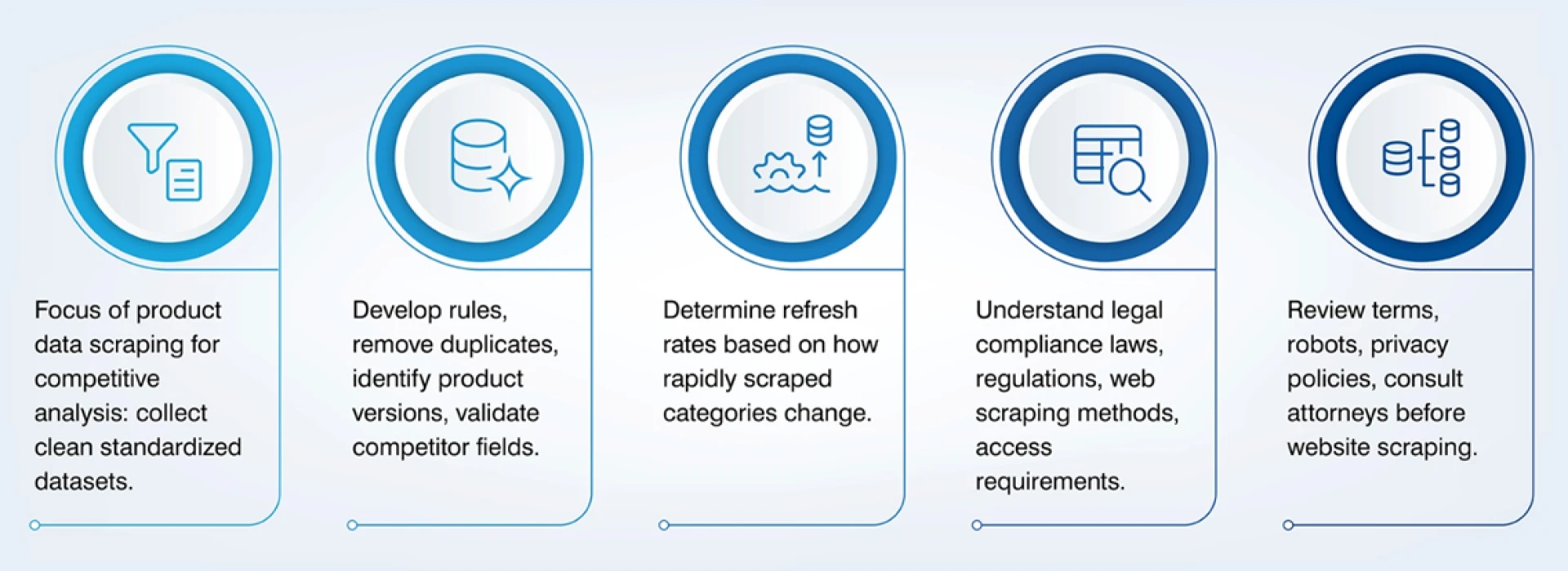
Note: In the United States, court cases such as hiQ v. LinkedIn and the Supreme Court's Van Buren case establish how courts interpret the concept of "authorized access" as defined under the Computer Fraud Abuse Act ("CFAA").
Build vs. Outsource: How to Implement Product Data Scraping
If an organization has sufficient internal resources and/or the ability to develop and maintain the technical requirements for web scraping, including anti-bot measures, etc., they may be able to internally perform web scraping.
Common tools for performing web scraping include Scrapy, Beautiful Soup and Selenium. Organizations without the necessary internal resources, or who require rapid coverage of new websites, stable pipelines of data and reliable collection of data from multiple websites, may find outsourcing to be a more beneficial option.
Conclusion: From Scraped Data to Strategic Advantage
Web scraping of product data is a strategic input to competitive analysis: Pricing Intelligence, Assortment Planning, Customer Sentiment, and Content Benchmarking, all integrated into one system. Those organizations that achieve success view web scraping as the beginning of the process, and then invest in the validation of the data collected, standardizing the data collected, and analyzing the data collected. Hitech BPO can support organizations through the entire loop of collecting data, monitoring their competitors, and producing reports ready to be used by leadership in actual planning.