
Digital resources can make lessons more engaging, but they can also create an unexpected problem: students need to know where to find everything.
A teacher may have prepared an excellent video, worksheet, quiz, or presentation, yet students can still lose time searching for the correct link. They may open the wrong folder, mistype a web address, or struggle to locate a resource inside a learning platform.
QR codes offer a straightforward way to reduce those obstacles.
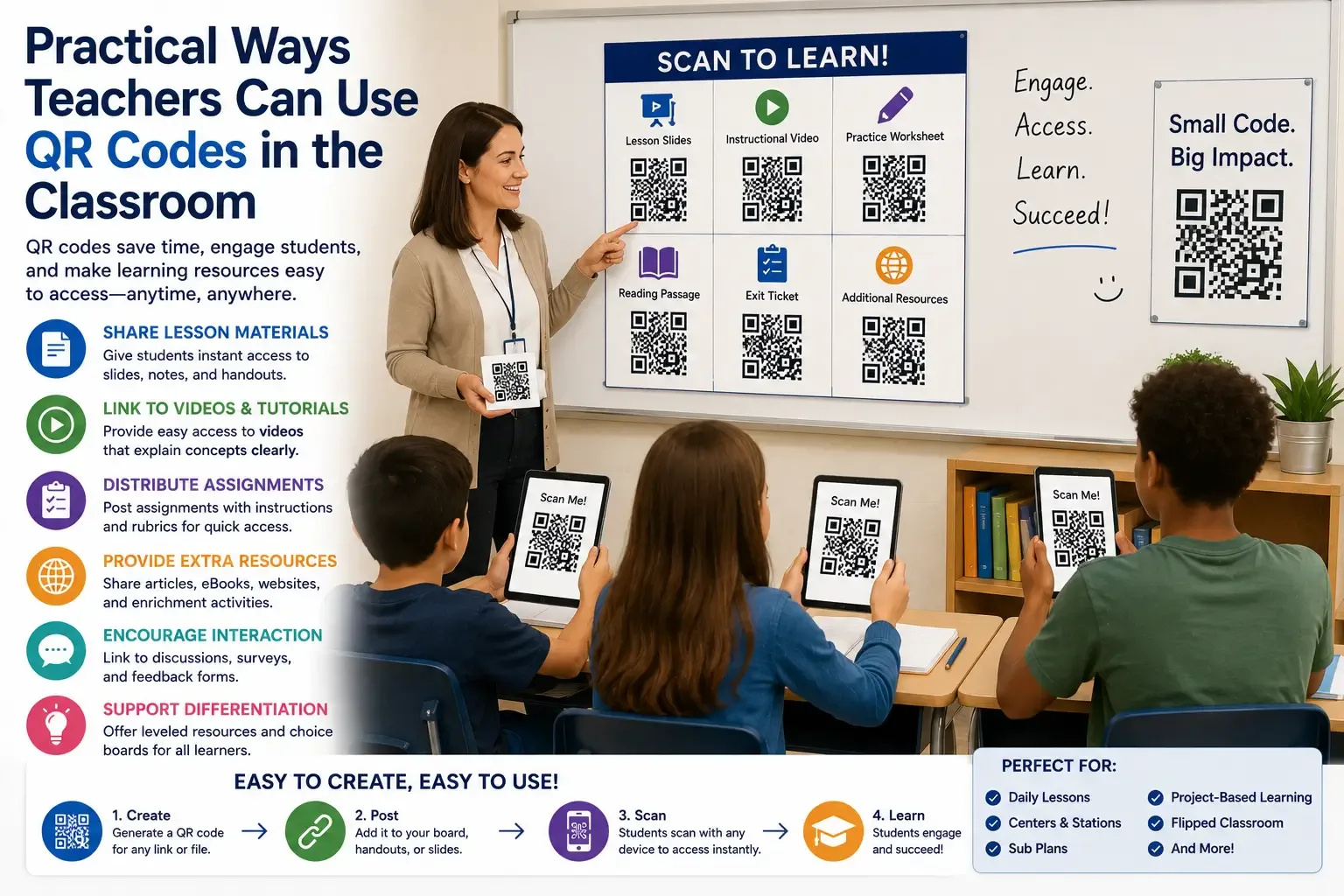
A teacher can place a QR code on a worksheet, classroom poster, presentation slide, homework sheet, or project guide. Students scan it with a compatible phone or tablet and go directly to the connected material.
This makes QR codes in education useful for more than simply opening websites. They can help educators distribute assignments, provide extra support, organize activities, and connect printed lessons with online content.
Turning Printed Pages Into Digital Starting Points
Printed materials remain an important part of education.
Students can write on worksheets, highlight handouts, and keep printed instructions beside them while completing a task. However, paper cannot display a video, play an audio recording, or provide an interactive exercise.
A QR code can turn a printed page into a starting point for digital learning.
For example, an educator could connect:
- A science handout to an experiment demonstration
- A language worksheet to a pronunciation recording
- A mathematics exercise to a step-by-step solution
- A history lesson to an interactive archive
- A geography activity to an online map
- A reading assignment to an author interview
The main page can remain simple while additional material is available through the code.
Students who need the resource can scan it immediately. Those who do not need extra support can continue working without interruption.
Giving Students Direct Access to Assignments
Sharing assignments can become complicated when several files are involved.
A project may require written instructions, background reading, a template, an example, and a submission form. When each item is stored in a different location, students may overlook an important part of the task.
One QR code can direct them to a central page containing all the required information.
Teachers can add assignment QR codes to:
- Homework sheets
- Printed schedules
- Project briefs
- Classroom boards
- Course outlines
- Presentation slides
- Revision booklets
The code should always include a clear instruction.
For example:
- Scan to view the assignment
- Scan to download the project template
- Scan to read the full instructions
- Scan to submit your completed work
A short description removes uncertainty and helps students understand where the code will take them.
Sharing Worksheets, PDFs, and Study Guides
QR codes provide a convenient way to distribute digital documents.
Educators can use them to share:
- PDF worksheets
- Lesson notes
- Revision guides
- Reading lists
- Presentations
- Project templates
- Classroom schedules
- Additional exercises
The teacher first uploads the document to an online location that students can access. The document link can then be converted into a QR code and added to the relevant printed material.
A service such as QRColor can help create a QR code that points students to an online assignment, document, video, or learning page.
The destination should be tested before the code is distributed.
Teachers should confirm that students can open the file without requesting permission, using a special account, or navigating through an unexpected login screen.
Helping Students Work More Independently
Students frequently need reminders or additional explanations while completing classroom tasks.
A QR code can make that information available without requiring the teacher to repeat the same instructions for every student.
For example, a code could open:
- A worked example
- A recorded explanation
- A list of project steps
- A troubleshooting guide
- A safety demonstration
- A translated instruction page
- A revision exercise
- A simplified explanation
This can be particularly useful in classrooms where students work at different speeds.
A student who needs extra support can scan the code and review the material independently. Meanwhile, the teacher can continue helping other students.
QR codes do not remove the need for teacher guidance. They simply provide another route to information that students may need more than once.
Using QR Codes for Classroom Stations
QR codes can also support lessons that involve movement and exploration.
An educator can create several learning stations around the room. Each station contains a QR code connected to a question, video, image, clue, or set of instructions.
Students move from one station to another and complete the linked activities.
This format can be useful for:
- Revision sessions
- Classroom scavenger hunts
- Vocabulary challenges
- Research activities
- Science investigations
- Group projects
- Interactive stories
- School orientation exercises
Each code can reveal the next stage of the activity or provide information needed to solve a problem.
The QR codes should support the learning objective rather than become the main attraction. Their purpose is to make the activity easier to organize and follow.
Providing Video and Audio Explanations
Some information is easier to understand when it can be watched or heard.
A written explanation of a physical movement, musical example, pronunciation pattern, or scientific process may not be enough for every learner.
QR codes can connect printed materials directly to:
- Tutorial videos
- Recorded lessons
- Audio exercises
- Interviews
- Demonstrations
- Music recordings
- Spoken instructions
- Captioned explanations
A student can scan the code during the lesson and return to the same resource later while studying at home.
This creates a useful connection between classroom materials and independent revision.
Offering Different Types of Learning Support
Students have different needs and preferences.
Some learn effectively from written instructions. Others benefit from diagrams, videos, audio, examples, or repeated explanations.
QR codes can provide different versions of the same learning material without making the printed page too crowded.
A code might lead to:
- An audio version of a reading
- A visual explanation
- A translated document
- A captioned lesson
- Extra practice questions
- A shorter summary
- A step-by-step tutorial
- A more advanced extension activity
Students can select the support that is most useful to them.
This approach can make classroom materials more flexible while allowing the main lesson to remain consistent for everyone.
Launching Quizzes and Short Assessments
QR codes can also make it easier to begin online quizzes and feedback activities.
A teacher can display a code at the beginning of a lesson for an entry question or at the end for a short review.
Students scan the code to open:
- A knowledge check
- An exit ticket
- A lesson reflection
- A homework quiz
- A student survey
- A peer-review form
- A course evaluation
- A classroom poll
This removes the need to dictate a link or explain how to locate the form.
The responses can help the teacher identify which parts of the lesson were understood and which areas may need further attention.
Making Repeated Instructions Easier to Find
Some classroom instructions are used repeatedly throughout a course.
Instead of printing lengthy directions every time, a teacher can place a QR code near the relevant activity or equipment.
A code might provide:
- Laboratory safety instructions
- Equipment setup steps
- Art material guidelines
- Computer login directions
- Project requirements
- Troubleshooting advice
- Cleaning procedures
- A demonstration video
Students can scan the code whenever they need a reminder.
This can reduce interruptions and encourage them to solve simple problems independently before asking for help.
Improving Communication With Parents and Guardians
QR codes can also make school information easier for families to access.
Printed letters often include web addresses for forms, calendars, event pages, and additional details. Long links can be inconvenient to type, particularly on a phone.
A QR code can connect parents directly to:
- Permission forms
- School calendars
- Event registration pages
- Newsletters
- Parent guides
- Contact forms
- Translated announcements
- Lists of required materials
The printed notice should still explain the essential information. The QR code can provide access to forms, updates, or further details.
An alternative web address should also be included when possible for people who cannot scan the code.
Expanding Library Resources and Student Displays
School libraries, exhibitions, and classroom displays often have limited space.
QR codes can add digital information without covering the display with large blocks of text.
A code placed near a library book could lead to:
- An author interview
- A reading guide
- A student review
- A related book list
- An audio sample
A code attached to a student project could open:
- A recorded presentation
- Research references
- Extra photographs
- A digital portfolio
- A project diary
- A detailed explanation
Visitors can choose whether to explore the additional material while the physical display remains organized.
Choosing Between Static and Dynamic QR Codes
Not every QR code works in exactly the same way.
Educators may need to choose between a static and a dynamic code.
Static QR codes
A static QR code permanently contains the original destination.
It can be suitable for:
- A one-time worksheet
- A permanent school page
- A fixed reference document
- A resource that is unlikely to move
If the destination changes, a new code usually needs to be created and printed.
Dynamic QR codes
A dynamic QR code generally allows the destination to be updated while the visible code remains the same.
This may be helpful for:
- Reused classroom posters
- Weekly homework pages
- Rotating learning resources
- Noticeboards
- Reading lists
- Materials used during multiple terms
A dynamic code can reduce reprinting when the linked material changes regularly.
Keeping QR Codes Easy to Scan
A QR code must be readable before it can be useful.
Several simple design choices can improve reliability.
Maintain strong contrast
The QR pattern should be clearly different from the background.
Dark elements on a light background are generally the most dependable. Custom colors may also work when there is enough contrast.
Leave an empty margin
The clear space around a QR code helps scanning devices identify it.
Avoid placing text, borders, photographs, or decorative elements directly against the code.
Use an appropriate size
A code on a worksheet can be smaller because students will hold the page nearby.
A code placed on a wall or projector screen must be larger because it will be scanned from farther away.
Avoid poor printing conditions
Faded printing, reflective surfaces, folds, and curved materials can interfere with scanning.
The code should be printed clearly and positioned on a flat, visible surface whenever possible.
Label Every Code Clearly
Students should understand the purpose of a QR code before they scan it.
An unexplained code may be ignored or treated with suspicion.
Useful labels include:
- Scan to watch the demonstration
- Scan to open the lesson notes
- Scan to begin the quiz
- Scan to hear the audio example
- Scan to download the study guide
A descriptive label also helps students distinguish between several codes on the same page.
Test More Than the Code
Testing should include the complete user experience, not only whether the camera recognizes the QR pattern.
Educators should confirm that:
- The correct destination opens
- The resource works on a phone or tablet
- Students have access permission
- The text is readable on a small screen
- The page loads without errors
- No unnecessary registration is required
- The content has not been moved or deleted
The printed version should also be tested because resizing or poor print quality can affect scanning.
When possible, test the code using several devices.
Do Not Make Scanning the Only Option
Not every student has access to a suitable personal device.
Some schools do not allow phones during lessons. Devices may run out of power, and internet connections may fail.
Essential learning materials should therefore be available through another method.
Alternatives can include:
- A short web address
- A link inside the school platform
- A classroom computer
- A school-owned tablet
- A printed copy
- Written instructions
QR codes should improve accessibility rather than create a new barrier.
Protecting Student Privacy
A QR code displayed in a classroom, hallway, library, or public event may be scanned by unintended visitors.
Publicly visible codes should not link directly to:
- Confidential student records
- Private folders
- Personal contact information
- Restricted documents
- Files containing sensitive information
Teachers should review the privacy settings of linked platforms and follow their school’s policies.
Students should also understand that scanning a QR code is similar to clicking an ordinary link. They should scan only codes provided by a trusted source.
Mistakes That Can Make QR Codes Less Useful
Common problems include:
- Linking to a document that students cannot access
- Printing the code too small
- Using colors with insufficient contrast
- Sending users to a page that is difficult to use on mobile
- Failing to explain the code’s purpose
- Moving or deleting the linked file
- Requiring students to create unnecessary accounts
- Placing the code on a glossy or curved surface
- Depending on QR codes as the only access method
- Forgetting to test the printed version
Most of these issues can be avoided by scanning the code and following the entire process from a student’s perspective.
Using QR Codes Only When They Add Value
A QR code does not automatically make a lesson more modern, interesting, or effective.
It should be used when it solves a real access problem.
A code may be helpful when it:
- Saves time
- Prevents typing mistakes
- Connects a printed page with multimedia
- Sends students to a specific resource
- Supports independent work
- Provides optional assistance
- Simplifies an interactive activity
When a short printed instruction would work better, adding a QR code may be unnecessary.
The technology should make the learning process smoother, not more complicated.
Conclusion
QR codes can give educators a practical way to connect classroom materials with online resources.
They can help students open assignments, watch demonstrations, access worksheets, complete quizzes, review instructions, and find extra learning support.
They can also improve communication with families and add digital depth to libraries, exhibitions, and student projects.
Their value comes from reducing the distance between a learner and the information they need.
When QR codes are clearly labeled, carefully tested, readable, privacy-conscious, and supported by another access method, they can become a useful everyday classroom tool.
A small code cannot improve a lesson by itself, but it can make the right learning resource much easier to reach.