
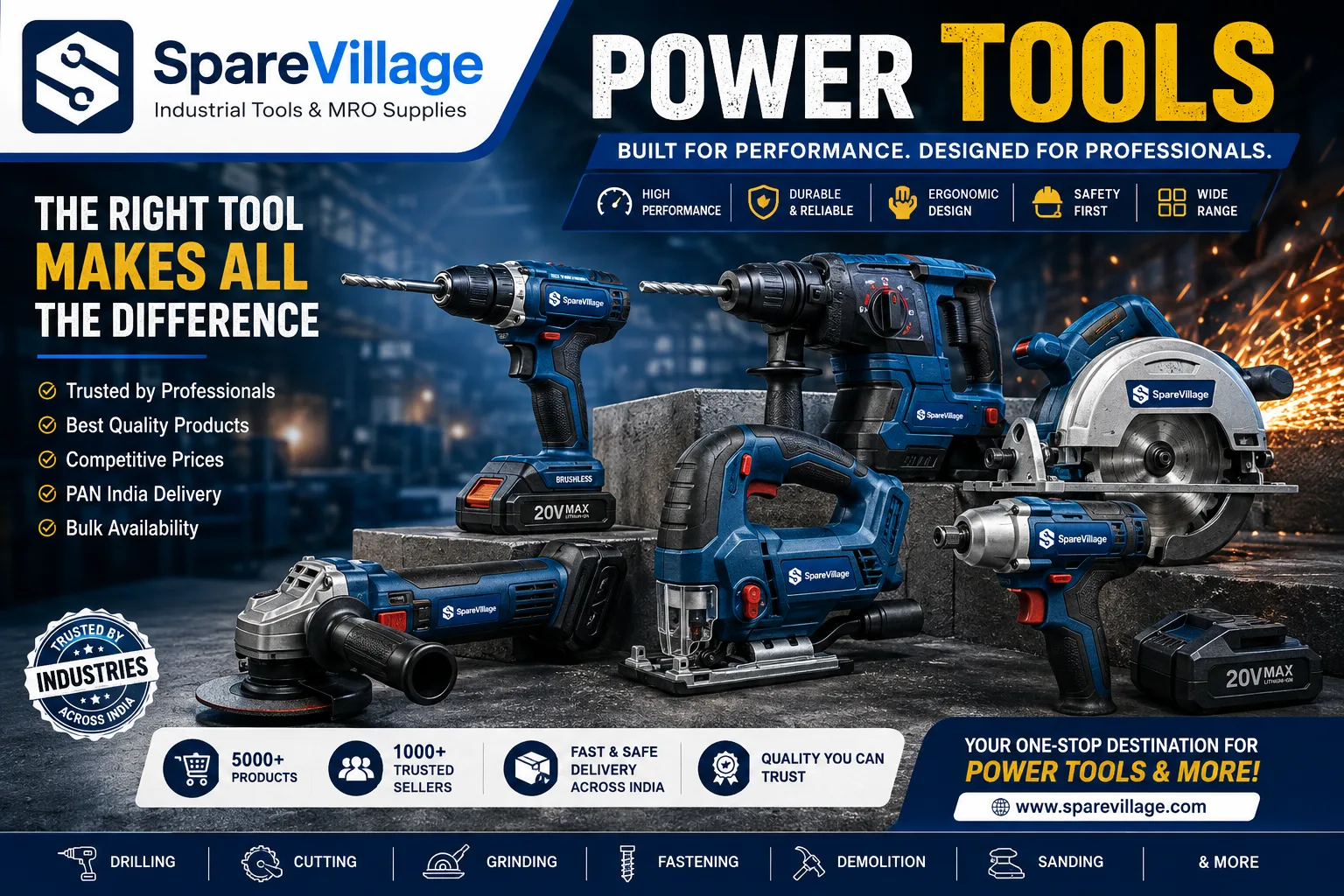
Power tools are essential equipment for construction, manufacturing, workshops, maintenance, repair, and many other professional applications. Compared with traditional hand tools, power tools use electricity, batteries, or other power sources to perform tasks faster and with less manual effort.
From drilling and grinding to cutting, polishing, fastening, and sanding, different power tools are designed for specific applications. Selecting the right tool can improve work efficiency, accuracy, and productivity.
SpareVillage is a B2B marketplace that connects businesses with suppliers and manufacturers across multiple product categories. Businesses can explore power tools and related products on SpareVillage according to their professional and industrial requirements.
What Are Power Tools?
Power tools are tools operated using an external power source rather than manual force alone. They can be powered by electricity, rechargeable batteries, compressed air, or other energy sources.
Power tools are commonly used in:
- Construction
- Manufacturing
- Automotive workshops
- Engineering
- Woodworking
- Metalworking
- Industrial maintenance
- Home improvement
- Repair and fabrication
The appropriate power tool depends on the material, application, working environment, and required level of performance.
Why Are Power Tools Important?
Power tools can make many demanding tasks quicker and more efficient. They are particularly useful when repetitive or high-effort work needs to be performed regularly.
1. Save Time
Power tools can complete many tasks faster than manual tools, helping workers improve productivity.
2. Reduce Manual Effort
Electric and battery-powered tools can reduce the physical effort required for drilling, cutting, grinding, sanding, and fastening.
3. Improve Work Efficiency
Using the correct tool for a specific application can make work more consistent and organized.
4. Support Professional Applications
Power tools are widely used by contractors, technicians, mechanics, manufacturers, fabricators, and maintenance professionals.
5. Handle Different Materials
Different power tools and accessories can be used for materials such as wood, metal, concrete, plastic, and other materials, depending on the tool specifications.
Common Types of Power Tools
There are many types of power tools available for different applications. Some of the most commonly used tools include:
1. Drilling Machines
Drills are used to create holes in different materials. Depending on the model and application, drilling machines can be used for wood, metal, masonry, and other materials.
Common types include:
- Corded drills
- Cordless drills
- Hammer drills
- Impact drills
- Rotary drills
The right drill should be selected according to the material, required hole size, speed, torque, and application.
2. Angle Grinders
Angle grinders are versatile tools used for grinding, cutting, polishing, and surface preparation. They are commonly used in metalworking, fabrication, construction, and maintenance.
The appropriate disc or accessory should always be selected according to the material and intended application.
3. Circular Saws
Circular saws use a rotating blade to cut materials. They are commonly used for woodworking, construction, and other cutting applications.
Different blades are designed for different materials, so users should select blades according to the tool and material requirements.
4. Jigsaws
Jigsaws are useful for making curved, straight, and detailed cuts. They are commonly used in woodworking and certain construction applications.
5. Reciprocating Saws
Reciprocating saws use a back-and-forth blade movement and can be useful for demolition, construction, maintenance, and cutting applications.
6. Sanders
Sanders are used to smooth and prepare surfaces. They are widely used in woodworking, furniture manufacturing, painting preparation, and finishing work.
Common types include orbital sanders, random orbital sanders, and belt sanders.
7. Impact Wrenches
Impact wrenches are designed for tightening and loosening fasteners. They are commonly used in automotive workshops, construction, machinery maintenance, and industrial applications.
8. Heat Guns
Heat guns produce a stream of hot air and can be used for applications such as paint removal, shrinking, softening certain materials, and other professional tasks.
9. Rotary Tools
Rotary tools are compact and versatile tools that can support applications such as grinding, polishing, cutting, engraving, and finishing when the appropriate accessory is used.
Corded vs Cordless Power Tools
One important decision when selecting power tools is choosing between corded and cordless models.
Corded Power Tools
Corded tools receive continuous power through an electrical connection.
Advantages:
- Continuous operation
- No battery charging required
- Suitable for extended use
- Consistent power supply
They can be useful in workshops and fixed work environments where electrical power is easily available.
Cordless Power Tools
Cordless tools operate using rechargeable batteries.
Advantages:
- Easy to carry
- Greater mobility
- No power cable
- Useful in remote or difficult-to-reach locations
Battery capacity, voltage, charging time, tool compatibility, and expected runtime should be considered before selecting cordless tools.
How to Choose the Right Power Tools
Choosing the right power tool depends on the specific job and working environment.
Consider the Application
First identify what the tool will be used for. A drill, grinder, saw, or sander is designed for a different primary application.
Check Power and Performance
Review specifications such as motor power, speed, torque, voltage, operating capacity, and other relevant specifications.
Select the Right Size
The size and weight of the tool should match the application and expected duration of use. A compact tool may be easier to handle for certain jobs, while heavier equipment may be suitable for demanding applications.
Consider Accessories
Many power tools require specific accessories such as drill bits, cutting discs, sanding pads, blades, or grinding wheels. Make sure compatible accessories are available.
Evaluate Durability
For professional and industrial applications, consider the tool's construction, expected workload, maintenance requirements, and operating environment.
Compare Suppliers
For B2B procurement, businesses should compare product specifications, supplier information, availability, pricing, warranty terms where applicable, and after-sales support.
Power Tools for Different Industries
Power tools are used across many industries and professional environments.
Construction
Construction professionals use drills, grinders, saws, sanders, and other tools for installation, fabrication, cutting, and finishing.
Manufacturing
Manufacturing facilities may use power tools for assembly, maintenance, fabrication, and production-related activities.
Automotive
Automotive workshops commonly use drills, impact wrenches, grinders, polishers, and other tools for vehicle repair and maintenance.
Woodworking
Woodworkers use drills, circular saws, jigsaws, sanders, routers, and other tools for cutting, shaping, drilling, and finishing wood.
Metalworking
Metalworking applications can involve angle grinders, drills, cutting tools, polishers, and other equipment designed for metal fabrication and finishing.
Maintenance and Repair
Maintenance teams use power tools for equipment servicing, installation, repair, and routine workplace maintenance.
Safety Tips for Using Power Tools
Power tools can be highly effective, but they should be used responsibly and according to the manufacturer's instructions.
Important safety practices include:
- Read the manufacturer's instructions before use.
- Select the correct tool and accessory for the application.
- Inspect tools and power cables before operation.
- Wear appropriate personal protective equipment.
- Keep hands away from moving parts.
- Secure the workpiece where necessary.
- Maintain a clean and organized work area.
- Disconnect power before changing accessories when required.
- Do not use damaged tools.
- Store tools safely after use.
The required PPE depends on the tool, material, workplace hazards, and applicable safety procedures.
Benefits of Buying Power Tools Through B2B Procurement
Businesses often need multiple tools for different teams and applications. B2B procurement can make sourcing more organized.
Potential benefits include:
- Easier supplier discovery
- Access to multiple product categories
- Product comparison
- Bulk procurement opportunities
- Better purchasing planning
- Convenient supplier communication
- Easier management of recurring requirements
A structured procurement process can help businesses select tools based on actual operational requirements.
Why Choose SpareVillage for Power Tools?
SpareVillage is a B2B marketplace that connects businesses with suppliers and manufacturers across a wide range of product categories.
Businesses can explore power tools and related industrial products on SpareVillage according to their procurement requirements. The platform can help businesses discover relevant suppliers and products in one place.
Whether you need drilling machines, angle grinders, saws, sanders, impact tools, or other professional power tools, SpareVillage provides a convenient platform for B2B product discovery and sourcing.
How to Maintain Power Tools
Proper maintenance can help keep power tools in suitable working condition.
Clean Tools Regularly
Remove dust, dirt, and material residue after use according to the manufacturer's recommendations.
Inspect Components
Check cables, switches, batteries, accessories, guards, and other components for visible damage.
Store Tools Properly
Keep tools in a dry and organized location and protect them from conditions that could damage the equipment.
Maintain Batteries
For cordless tools, follow the manufacturer's recommendations for charging, storage, and battery care.
Replace Worn Accessories
Drill bits, blades, discs, sanding pads, and other accessories can wear over time. Replace them when required.
Frequently Asked Questions
What are power tools?
Power tools are tools operated using an external power source such as electricity, rechargeable batteries, or compressed air. They are used for drilling, cutting, grinding, sanding, fastening, and other tasks.
What are the most common power tools?
Common power tools include drills, angle grinders, circular saws, jigsaws, sanders, impact wrenches, reciprocating saws, and rotary tools.
What is the difference between corded and cordless power tools?
Corded tools use a continuous electrical connection, while cordless tools operate using rechargeable batteries. The right option depends on mobility, runtime, workload, and work environment.
How do I choose the right power tool?
Consider the application, material, power requirements, tool size, performance specifications, accessories, durability, safety requirements, and supplier reliability.
Are power tools used in industrial applications?
Yes. Power tools are widely used in construction, manufacturing, automotive, metalworking, woodworking, maintenance, repair, and other professional industries.
Conclusion
Power tools have become essential for many professional and industrial applications. They can help reduce manual effort, save time, and improve efficiency when the correct tool is selected for the job.
From drilling machines and angle grinders to saws, sanders, impact wrenches, and rotary tools, each power tool serves a specific purpose. Businesses should consider application, specifications, durability, accessories, safety requirements, and supplier reliability before procurement.
SpareVillage helps businesses explore power tools and connect with suppliers through a B2B marketplace. With a wide range of industrial and professional product categories, SpareVillage can support businesses in making their product sourcing and procurement process more convenient.
For businesses looking for reliable power tools, choosing the right equipment and supplier can be an important step toward efficient and productive operations.