
Navigating Higher Education: Your Guide to Elite American Colleges
Choosing where to spend your undergraduate or graduate years is one of the most defining decisions of your life. Stepping onto an American campus introduces you to an unmatched atmosphere of ambition—from late-night debates in historic residence halls to cutting-edge research facilities where tomorrow's technology is born. Whether you are aiming for a corporate leadership position or seeking a path in specialized healthcare, the search for the 10 best universities in us requires careful consideration of what truly matters to your academic journey.
What Defines an Elite American Institution?
Every student values different aspects of higher education. While some prioritize global prestige and powerful alumni networks, others look closely at research funding, classroom sizes, or overall affordability. Despite these varied priorities, the most successful institutions consistently share a few core characteristics:
- World-Class Faculty: Leading experts and active researchers who guide students directly.
- Advanced Research Spaces: Laboratories and libraries equipped with state-of-the-art tools.
- Diverse Student Bodies: Vibrant communities bringing together international perspectives.
- Robust Career Support: Strong graduation outcomes and high placement rates with top employers.
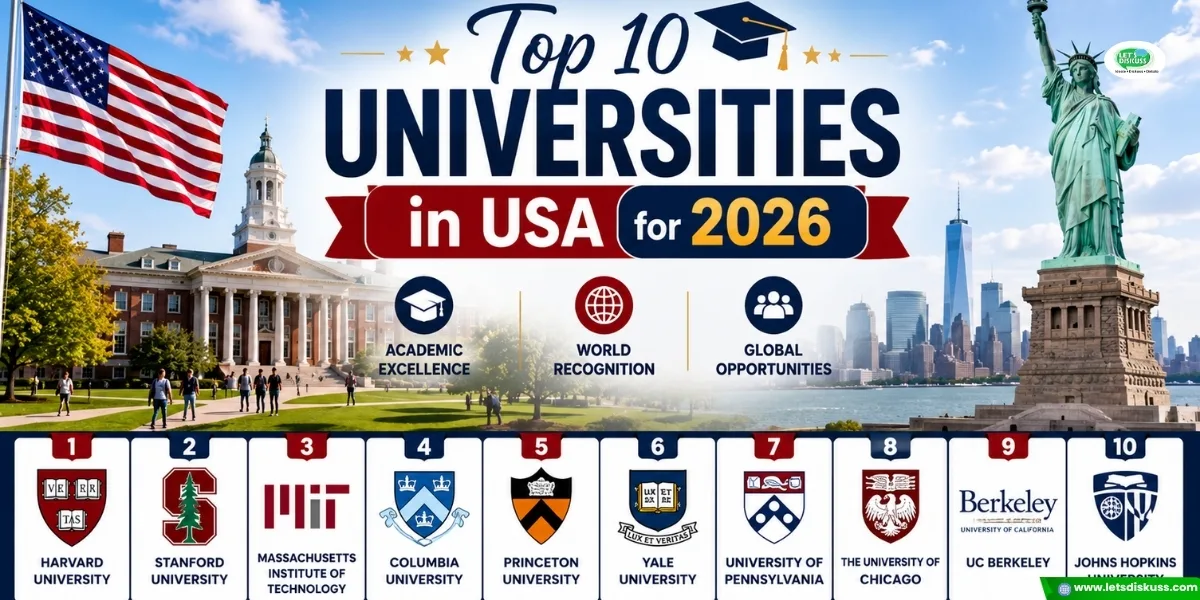
The 2026 Elite: Examining the US Top 10 University List
While rankings shift slightly year over year based on performance trends, certain institutions remain perennial leaders in education, innovation, and global impact.
1. Harvard University
As the oldest institution of higher learning in the United States, Harvard carries a legacy that needs little introduction. Beyond its historical prestige in Cambridge, Massachusetts, it boasts powerhouse law, medical, and business programs that attract ambitious minds from every corner of the globe.
2. Stanford University
Located right in the heart of California's Silicon Valley, Stanford thrives on an entrepreneurial spirit. Its campus blends rigorous academics with a culture of startup creation, making it a premier destination for technology and engineering enthusiasts.
3. Massachusetts Institute of Technology (MIT)
For students eager to turn theoretical concepts into tangible inventions, MIT stands alone. Known globally for analytical accuracy paired with real-world application, the campus radiates collaborative energy and relentless curiosity.
4. University of California, Berkeley
Proving that public education can match the prestige of any Ivy League institution, UC Berkeley has long been a birthplace of scientific breakthroughs, economic innovation, and influential social movements.
5. Princeton University
Princeton offers a quiet, focused academic environment centered heavily on undergraduate teaching. With strict attention to the humanities, mathematics, and economics, professors here form genuine mentorship connections with their students.
6. University of Chicago
Known for intellectual rigor and intense philosophical exploration, the University of Chicago serves as an ideal playground for students drawn to behavioral science, economics, and sociology.
7. University of Pennsylvania (Wharton School)
Home to the world-renowned Wharton School, Penn blends an Ivy League atmosphere with the vibrant energy of Philadelphia. Its interdisciplinary approach allows business students to collaborate seamlessly with healthcare and design peers.
8. Columbia University
Situated in New York City, Columbia grants students an active front-row seat to global arts, journalism, and commerce, integrating urban experiences directly into daily coursework.
9. Yale University
Yale combines striking Gothic architecture with a tight-knit community feel. Celebrated for its drama and law programs, the university proves that intense academic competition can coexist with strong collaborative teamwork.
10. California Institute of Technology (Caltech)
Though relatively small in size, Caltech maintains a massive footprint in physics, space science, and engineering. Its high faculty-to-student ratio and close ties to NASA's Jet Propulsion Laboratory foster exceptional hands-on problem solvers.
Exploring Public Versus Private Options
When evaluating your choices, understanding the structural differences between public and private universities is essential.
- Public Universities: Generally offer lower tuition rates, particularly for state residents. These campuses are typically larger, highly energetic, and feature diverse student populations with massive alumni networks.
- Private Universities: Often feature smaller class sizes, highly selective admissions processes, and more specialized individual attention, frequently balanced by robust institutional financial aid.
Funding Your Education: Scholarships and Aid
Financing an international or domestic move for college can feel overwhelming, but financial support is widely available. Most leading institutions provide a mix of options:
- Merit-Based Awards: Granted for exceptional academic, athletic, or creative achievements.
- Need-Based Assistance: Determined by evaluating your family's overall financial standing.
- External Grants: Provided by private foundations, cultural organizations, and specific academic department endowments.
Final Thoughts on Finding Your Fit
Ultimately, searching for the top 10 universities in usa serves as a helpful baseline, but your final choice should align closely with your personal ambitions, learning style, and long-term career goals. Rankings provide direction, but genuine passion and a supportive campus environment will ultimately drive your success.
Check Full Article of Best Universities in USA on Letdiskuss!