Driveways are among the most frequently used outdoor areas of any home or commercial property, yet they are often overlooked in lighting design. A well-lit driveway plays a critical role in safety, navigation, and overall property security. Thoughtfully planned outdoor lighting ensures clear visibility for vehicles and pedestrians, reduces accident risk, and enhances the space's architectural presence after dark.
With advances in lighting technology, driveway illumination is no longer limited to a single floodlight or wall lamp. Today, a combination of functional and decorative fixtures, such as garden lights, bollards, and integrated landscape lighting systems, allows homeowners and designers to achieve both performance and aesthetics.
Why Driveway Lighting Needs Special Planning
Unlike indoor spaces, driveways are exposed to environmental conditions such as rain, dust, temperature variations, and vehicular movement. This makes lighting selection far more technical.
The primary purpose of driveway lighting is to provide uniform illumination that supports safe movement of vehicles and people. Poorly lit driveways can lead to misjudged turns, vehicle damage, tripping hazards, and reduced visibility at entry points. At the same time, excessive brightness or poorly directed light can cause glare, discomfort, and light spill into neighbouring properties.
This is why outdoor lighting for driveways must balance functional illumination, visual comfort, and controlled light distribution.
Key Objectives of Driveway Lighting
Before selecting fixtures, it is important to define what driveway lighting needs to achieve:
- Clear visibility for vehicle movement and parking
- Safe pedestrian navigation
- Highlighting driveway edges and boundaries
- Visual continuity with garden and facade lighting
- Improved security around entry zones
A good lighting plan addresses all these points without over-lighting the space.
Types of Outdoor Lights Best Suited for Driveways
The following types of outdoor lighting fixtures are best suited for driveway applications.
Bollards
Bollards are widely considered one of the most effective outdoor lighting solutions for driveways. These are low-height luminaires installed along the edges of pathways and driveways to provide guided illumination.
Bollards create a clear visual boundary, helping drivers stay aligned within the driveway space. They distribute light at ground level, which reduces glare and ensures visual comfort. Their height and beam design make them ideal for marking curves, turns, and entry points.
They also contribute to landscape lighting by adding rhythm and structure to outdoor layouts.
Garden Lights
A garden light fixture is often used alongside driveway illumination to maintain visual consistency across Landscape Lighting designs. These lights illuminate softscape areas such as lawns, shrubs, and planters near the driveway.
When placed strategically, garden lights prevent dark patches around the driveway and enhance peripheral visibility. This creates a seamless transition between functional driveway lighting and decorative landscape zones.
They are particularly useful in residential properties where driveways run through garden areas.
Pole and Post Lights
For larger driveways or private roads, pole-mounted lights provide wider coverage. These are taller fixtures designed to illuminate broader areas from a higher mounting point.
Pole lights work well for long driveways, utilising robust outdoor lighting standards to ensure coverage.
Their optical design ensures even light distribution without harsh shadows.
Wall-Mounted Outdoor Lights
Wall-mounted fixtures are commonly installed near garage doors, gates, and building facades. These lights support task illumination for parking and entry.
They are ideal for compact driveways where space for floor-mounted fixtures is limited. Combined with bollards or garden lights, they form a layered outdoor lighting approach.
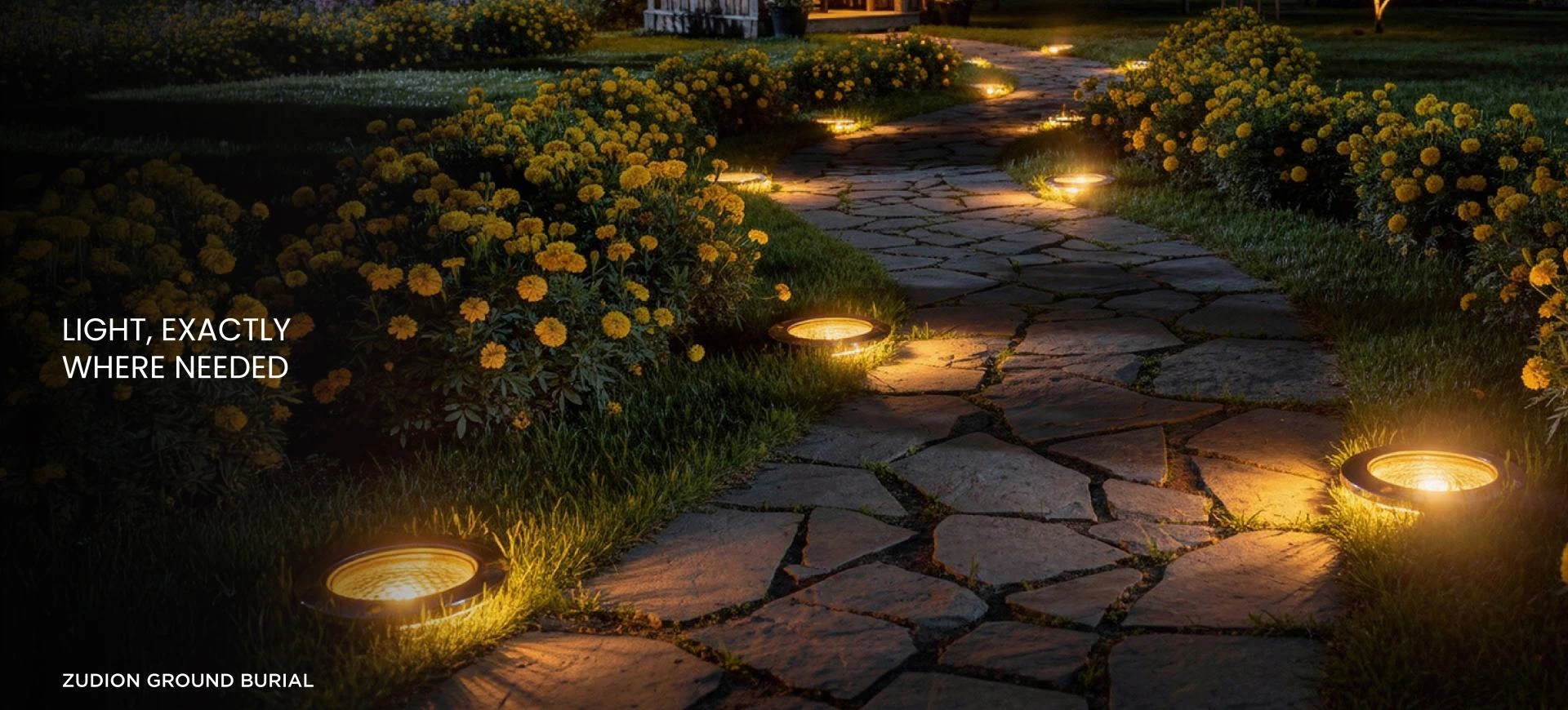
Recessed Ground Lights
Recessed lights are embedded into the driveway surface or edges. These provide subtle guidance lighting without visible fixtures.
They are especially effective for modern architectural designs that favour minimalism and clean lines. However, they must have high load-bearing capacity and proper ingress protection.
How to Find the Best Kind of Outdoor Light for Your Driveway?
Choosing the right outdoor lighting for a driveway requires evaluating technical specifications that directly affect performance, safety, and long-term reliability.
IP Rating
Select fixtures, including ground lights and bollards, with a minimum IP65 rating to ensure protection against dust ingress and water jets. For exposed or ground-recessed areas, IP67-IP68 is recommended for resistance to heavy rainfall and surface water.
Light Distribution and Beam Angle
Opt for luminaires, such as a wide-beam garden light, with angles of 90°-120° for uniform illumination. Asymmetric optics are ideal for driveways as they distribute light along movement paths rather than vertically, reducing light loss.
Colour Temperature
Use lighting in the range of 3000K-4000K. Warm white (3000K) offers visual comfort for residential driveways, while neutral white (4000K) provides better visibility for larger or commercial spaces.
Glare Control and Optics
Choose fixtures with UGR<19 or diffused lenses to minimise glare. Poor glare control can reduce driver visibility and create visual discomfort at entry points.
Lumen Output and Efficiency
Driveway lighting should deliver around 1500 lumens in total for safe visibility. Low-level fixtures like bollards deliver 100-200 lumens each, while a single floodlight may need 1200-2000 lumens. Choose LED lights with 100 lm/W or higher for efficient performance.
Material and Structural Durability
Fixtures, particularly exposed bollards, should use die-cast aluminium or stainless steel housings with powder-coated or anodised finishes for corrosion resistance and UV stability in outdoor conditions.
How Landscape Lighting Complements Driveway Lighting
Landscape lighting plays a supporting role in driveway illumination. While driveway lights focus on functional visibility, landscape lighting enhances the visual depth of the surrounding environment.
Together, they create a cohesive outdoor lighting scheme where the driveway does not appear isolated but integrated into the overall design of the property.
For example:
- Bollards define driveway movement
- Garden light fixtures illuminate greenery
- Facade lights highlight building structure
- Recessed lights add subtle guidance
This layered approach improves safety, aesthetics, and spatial perception.
Conclusion
Driveway lighting extends beyond simple fixture installation; it requires creating a safe, efficient, and visually balanced outdoor environment. The right combination of bollards, garden light fixtures, and well-planned landscape lighting ensures smooth navigation, enhanced security, and strong architectural impact.
Jaquar designs outdoor lighting solutions that combine durability, high-performance LED technology, weather-resistant construction, and precise optical control. Their range of outdoor lighting products is engineered to meet the functional demands of driveways while seamlessly blending with modern landscape design.
With Jaquar, you get lighting systems that deliver long-term reliability, optimal illumination, and a refined outdoor experience, making every driveway safer, smarter, and visually complete.