
Market Overview
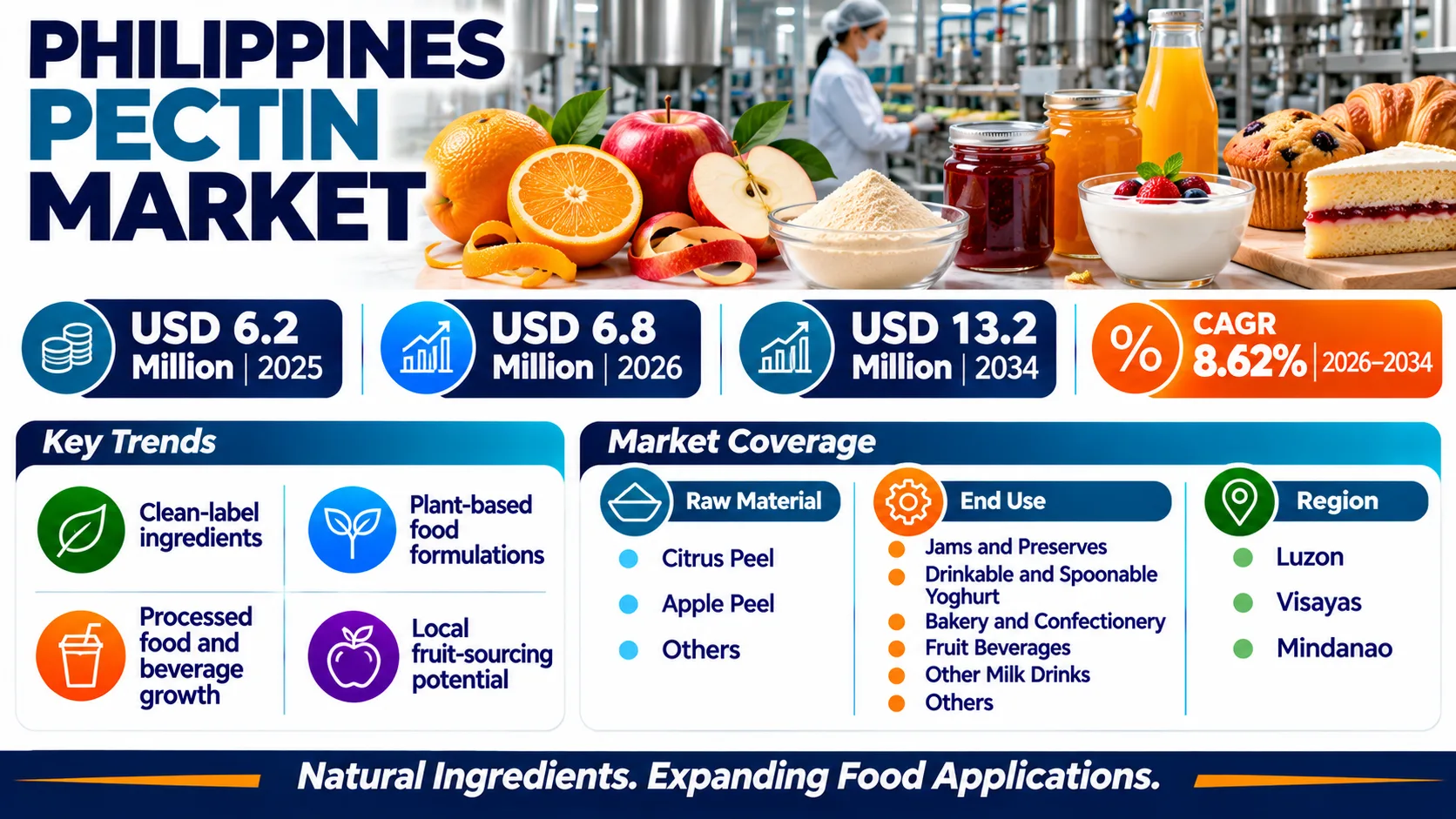
The Philippines pectin market is growing as demand rises for natural, plant-based ingredients in food and beverages (F&B), especially jams, jellies, confectionery, and dairy products. The market size increased from USD 6.2 Million in 2025 to USD 6.8 Million in 2026. It is projected to reach USD 13.2 Million by 2034, registering a compound annual growth rate (CAGR) of 8.62% during 2026-2034. Growing health consciousness is fuelling a preference for clean-label and low-fat formulations, where pectin serves as a stabiliser and gelling agent. Expanding processed food and beverage industries, supported by urbanisation and changing lifestyles, are further boosting usage. The country’s strong fruit production, particularly mangoes and citrus, supports raw material availability, local manufacturing potential, and lower import dependency, which strengthens the Philippines pectin market share.
Request a Sample Report for In-Depth Market Insights: https://www.imarcgroup.com/philippines-pectin-market/requestsample
Market Summary
- The market grew from USD 6.2 Million in 2025 to USD 6.8 Million in 2026 and is forecast to reach USD 13.2 Million by 2034.
- Pectin, derived from fruits such as citrus and apples, is valued as a plant-based, non-GMO, chemical-free additive that suits clean-label formulations.
- Pectin is used as a gelling, stabilising, and thickening agent in jams, jellies, dairy beverages, and fruit-based products.
- The Philippines is one of Asia’s top producers of tropical fruits such as mangoes, bananas, pineapples, and citrus, creating opportunities for local pectin production.
- Urbanisation, higher disposable incomes, and the growth of supermarkets, convenience stores, and online grocery platforms are expanding the processed F&B sector.
- The market is segmented by raw material (citrus peel, apple peel, others), end use (jams and preserves, drinkable and spoonable yoghurt, bakery and confectionery, fruit beverages, other milk drinks, others), and region (Luzon, Visayas, Mindanao), with forecasts for 2026-2034.
Market Trends
Rising Demand for Clean-Label and Natural Ingredients
Filipino consumers are increasingly looking for healthier and more natural alternatives in food and beverages. Pectin is plant-based, non-GMO, and chemical-free, which makes it highly suitable for clean-label products. This matches the global health-conscious movement, where consumers prefer minimally processed products with recognisable ingredients. The trend is particularly evident in jams, jellies, dairy beverages, and fruit-based products. The growing middle class, exposure to global health trends, and awareness of diet-related diseases further support demand. With greater emphasis on transparency and natural sourcing, pectin is becoming an essential additive across multiple food categories.
Abundant Fruit Production Supporting Local Supply Potential
The Philippines is one of Asia’s top tropical fruit producers, and many of its fruits are potential pectin sources or complement pectin-based applications. According to FMC Philippines, annual mango production reaches about 1 million metric tons, with 95% consumed locally and 5% exported, generating around USD 35 million in revenue. This agricultural base creates opportunities for local pectin production, lower import dependence, and cost advantages for domestic manufacturers. Mangoes and calamansi, central to Philippine food culture, are widely processed into juices, jams, and preserves that rely on pectin for stability and consistency. Stronger local supply chains can add value, reduce post-harvest losses, and support sustainability. Government initiatives in agricultural innovation and food processing can reinforce long-term growth.
Growth of the Processed Food and Beverage Industry
Rapid urbanisation, higher disposable incomes, and evolving preferences are driving demand for processed food and beverages. Busy lifestyles have raised demand for ready-to-eat meals, packaged snacks, fruit-based beverages, and dairy alternatives, all of which rely on pectin for texture, stability, and shelf life. The expansion of supermarkets, convenience stores, and online grocery platforms has widened access to processed foods. Local manufacturers favour pectin because it improves quality without artificial additives, in line with consumer expectations for convenience and health. As global F&B brands expand in the Philippines, demand for standardised, high-quality stabilisers is expected to rise.
Market Segmentation
Raw Material Insights- Citrus Peel
- Apple Peel
- Others
- Jams and Preserves
- Drinkable and Spoonable Yoghurt
- Bakery and Confectionery
- Fruit Beverages
- Other Milk Drinks
- Others
- Luzon
- Visayas
- Mindanao
Competitive Landscape
The Philippines pactin maket report provides a comprehensive analysis of the competitive landscape, covering market structure, key player positioning, top winning strategies, a competitive dashboard, and a company evaluation quadrant. It also includes detailed profiles of all major companies.
Recent News & Developments
September 2026: Iloilo-based startup CirPro Innovations developed a liquid pectin product from discarded calamansi peels, turning fruit-processing waste into a value-added food ingredient. The company sources peels from local farmers and juice processors and uses approximately 20 kilograms of calamansi peels per month to produce 15–18 litres of liquid pectin. Its Limontene Liquid Pectin can be used as a stabiliser, texturiser, and gelling agent in products such as jams, sauces, jellies, concentrated teas, and ice cream. Founded in 2024, the startup aims to increase annual production from approximately 200 litres to at least 600 litres by the end of 2026 while seeking additional investment and raw-material suppliers.
2026: DOST research project advances calamansi-waste pectin production. The Department of Science and Technology's Industrial Technology Development Institute (DOST-ITDI), in collaboration with Good Sense Foods and Juices Corporation, has been working on an initiative to extract pectin from discarded calamansi peels. The project aims to convert fruit-processing waste into a locally produced ingredient that can replace part of the company's imported pectin requirements. The programme is designed to address waste-disposal challenges while supporting local ingredient production and resource efficiency. The project is scheduled to run through November 2026.
Key Aspects Required for the Philippines Pectin Market
- Market Performance: The market increased from USD 6.2 Million in 2025 to USD 6.8 Million in 2026 and is projected to reach USD 13.2 Million by 2034.
- Market Outlook: An 8.62% CAGR during 2026-2034 reflects rapid expansion supported by clean-label demand, domestic fruit supply, and a growing processed food sector.
- Industry Trends: Rising demand for clean-label and natural ingredients, abundant fruit production supporting local supply, and growth of the processed F&B industry.
- Key Questions Covered: The report examines market performance, breakups by raw material, end use, and region, value chain stages, key drivers and challenges, market structure and key players, and the degree of competition.
- Strategic Recommendations: Develop local pectin production from domestic fruit sources, offer clean-label stabiliser solutions to jam, dairy, and beverage manufacturers, and align supply with expanding processed food and online grocery channels.
Note: If you need any specific information that is not covered currently within the scope of the report, we will provide the same as a part of customization.
Speak to an analyst: https://www.imarcgroup.com/request?type=report&id=42059&flag=C
Frequently Asked Questions
1. What is the size of the Philippines pectin market?
The market increased from USD 6.2 Million in 2025 to USD 6.8 Million in 2026.
2. What is the expected growth rate of the Philippines pectin market?
The market is projected to grow at a CAGR of 8.62% during 2026-2034, reaching USD 13.2 Million by 2034.
3. What is driving the growth of the Philippines pectin market?
Growth is driven by demand for natural, plant-based ingredients in jams, jellies, confectionery, and dairy products, growing health consciousness and clean-label preferences, a growing processed food and beverage sector, and strong domestic fruit production.
4. What are the key trends in the market?
Key trends include rising demand for clean-label and natural ingredients, abundant fruit production supporting local supply potential, and growth of the processed food and beverage industry.