Many small businesses do not struggle because their ideas are weak. They struggle because their finances are not managed well. Sales may increase, but cash flow often stays tight. This usually happens because accounting requires time, attention, and expertise. For business owners with limited resources, managing books becomes overwhelming.
When accounting is not handled properly, businesses face late payments, missing financial reports, tax issues, and poor cash control. To solve this problem, many owners choose to outsource accounting for small business operations instead of managing everything internally.
By outsourcing accounting work to experts, small businesses regain valuable time and gain financial clarity. An online accountant delivers accurate records, timely reports, and better cash flow control. Outsourcing does not reduce control—it improves visibility and decision-making. In this blog, we explain how outsourcing works, why it benefits small businesses, and how the right online accountant can help you grow faster.
What Does It Mean to Outsource Accounting for Small Business?
To outsource accounting for small business means assigning your accounting tasks to an external professional or firm. These tasks may include bookkeeping, payroll, tax filing, compliance, and financial reporting.
Instead of hiring a full-time employee, businesses work with remote accounting experts known as online accountants. They use cloud-based accounting software so you can access your financial data anytime. Outsourcing allows you to reduce costs while still receiving high-quality financial support.
Example:
A small café owner spends several hours every week managing payroll, bills, and taxes. By outsourcing accounting, an online accountant handles these tasks, freeing the owner to focus on customer service, menu planning, and marketing.
Another example is an online store that struggles with tax filings. Outsourcing helps avoid errors, penalties, and operational disruptions.
Key Reasons to Outsource Accounting for Small Business
1. Save Cash
Hiring an in-house accountant involves salary, benefits, training, tools, and office space. Outsourcing eliminates most of these costs. You only pay for the services you need.
For small businesses with limited budgets, outsourcing provides access to expert accounting without long-term financial commitments.
Tip: Use the money saved through outsourcing for marketing, inventory, or business expansion.
2. Focus on Your Firm
Accounting takes time away from revenue-generating activities. When you outsource accounting for small business needs, you can focus on sales, customers, and growth while professionals manage your finances.
Example:
A retail owner spends hours processing invoices. After outsourcing, that time is used to improve customer experience and increase sales.
Tip: List tasks that consume your time but do not directly grow your business—those are ideal to outsource.
3. Get Expert Help
Professional accountants understand tax laws, financial rules, and best practices. They reduce errors and help identify savings opportunities. An online accountant provides expertise that most small businesses cannot afford in-house.
Example:
A business owner may miss allowable tax deductions. An expert accountant ensures these savings are not overlooked.
Tip: Ask your accountant to review past returns for missed deductions.
4. Scale Your Firm Easily
As your business grows, accounting needs become more complex. Outsourcing is flexible and scalable. You can start with bookkeeping and later add payroll, tax support, or financial reporting.
Example:
A business grows from 5 to 20 employees. An outsourced accountant can manage the expanded payroll without additional hiring.
Tip: Choose an accounting partner who can scale services as your business grows.
5. Correct and Timely Reports
Accurate and on-time reports are essential for smart decision-making. When you outsource accounting for small business, professionals ensure your financial statements are reliable and delivered on schedule.
Example:
Up-to-date reports help business owners plan hiring, expansion, and investments with confidence.
Tip: Request automated reminders for tax deadlines, payroll, and bill payments.
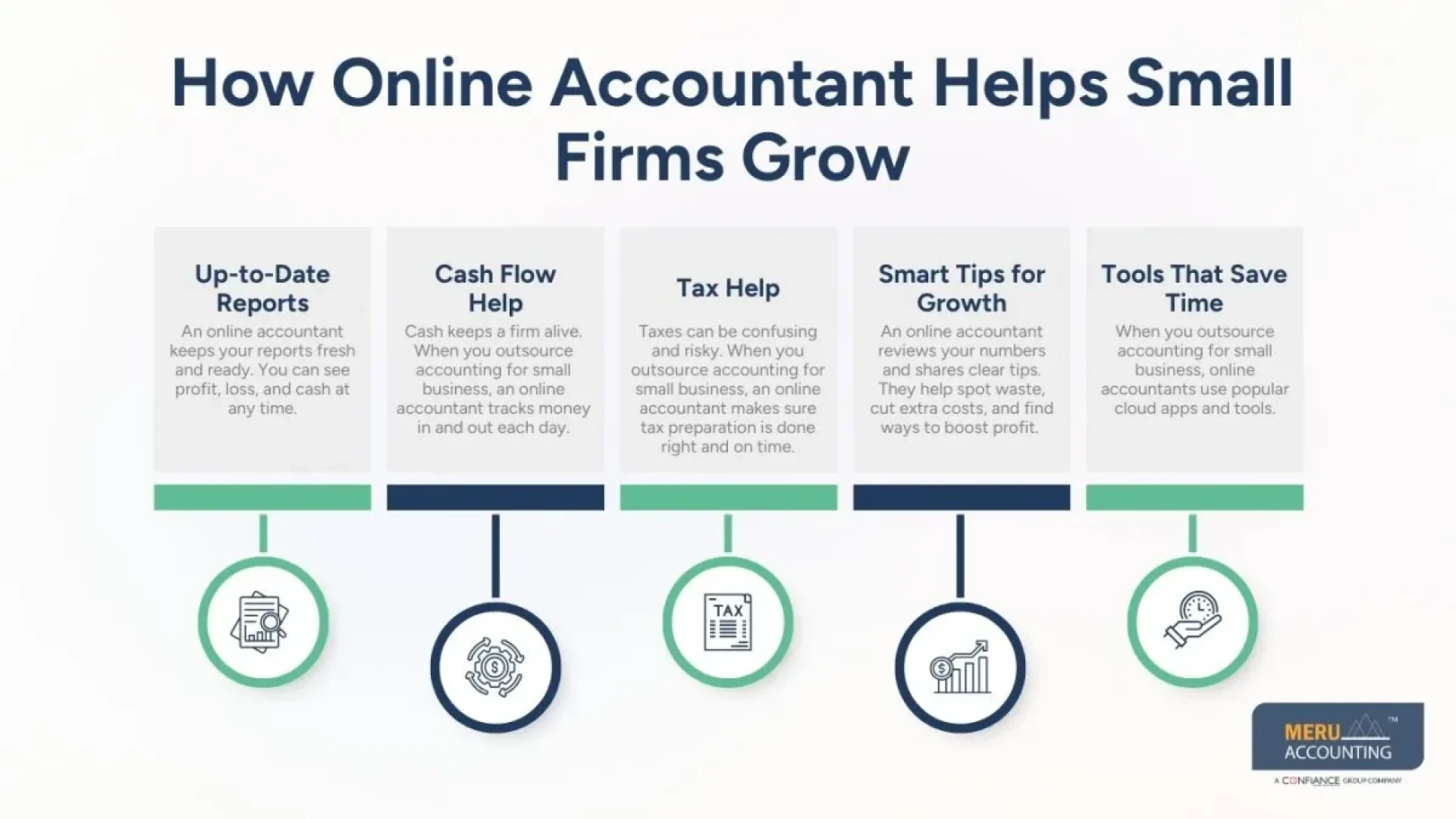
How an Online Accountant Helps Small Firms Grow
When you outsource accounting for small business, an online accountant becomes more than a bookkeeper. They help you understand your numbers and use them strategically.
Up-to-Date Reports
Online accountants provide real-time access to profit, loss, and cash flow reports. This helps you see your financial position clearly at any moment.
Cash Flow Management
Cash flow is critical for survival. An online accountant tracks money coming in and going out, helping you plan payments and maintain sufficient cash reserves.
Tax Support
Tax rules are complex and constantly changing. Outsourcing accounting ensures taxes are prepared accurately, filed on time, and optimized where possible. This reduces risks and penalties.
Smart Growth Insights
Online accountants analyze financial data and provide practical advice to reduce costs, increase margins, and improve efficiency—all based on real numbers.
Time-Saving Tools
Cloud-based accounting tools automate invoices, payroll, and reporting. This reduces manual work, minimizes errors, and saves time.
Example:
A bakery planning a second location uses cash-flow analysis from an online accountant to expand safely without financial strain.
Outsource Accounting for Small Business: Cost Comparison
Cost Type
In-House Employee
Outsourced Accounting
Salary
Full salary + benefits
Save 40–60%
Benefits
20–30% extra
Included
Software
Separate purchase
Included
Training
Extra cost
Included
Office Space
Required
Not needed
Outsourcing accounting can reduce total accounting costs by 40–60% for small businesses.
How to Pick the Right Online Accountant
When choosing an online accountant, consider:
- Experience: Industry-specific knowledge
- Services: Bookkeeping, payroll, tax, reporting
- Technology: Cloud accounting tools
- Compliance: Knowledge of tax laws and regulations
- Pricing: Clear and transparent costs
- Communication: Fast responses and timely updates
Meru Accounting’s Outsourced Accounting Services
Meru Accounting helps small businesses save time, reduce costs, and grow confidently.
Our services include:
- Bookkeeping: Accurate recording of all transactions
- Accounts Payable & Receivable: Timely bill payments and faster collections
- Payroll Management: Error-free payroll and compliance
- Tax Services: Federal, state, and local tax preparation
- Financial Reports: Profit, loss, and cash flow insights
- Cloud Access: Real-time access to your financial data anytime
With Meru Accounting, you can confidently outsource accounting for small business and focus on growth.
Key Takeaways
- Outsourcing accounting saves time and money
- Online accountants provide accurate reports and expert guidance
- Outsourcing is flexible and scalable
- It costs less than hiring a full-time employee
- The right accountant supports long-term business growth