Introduction
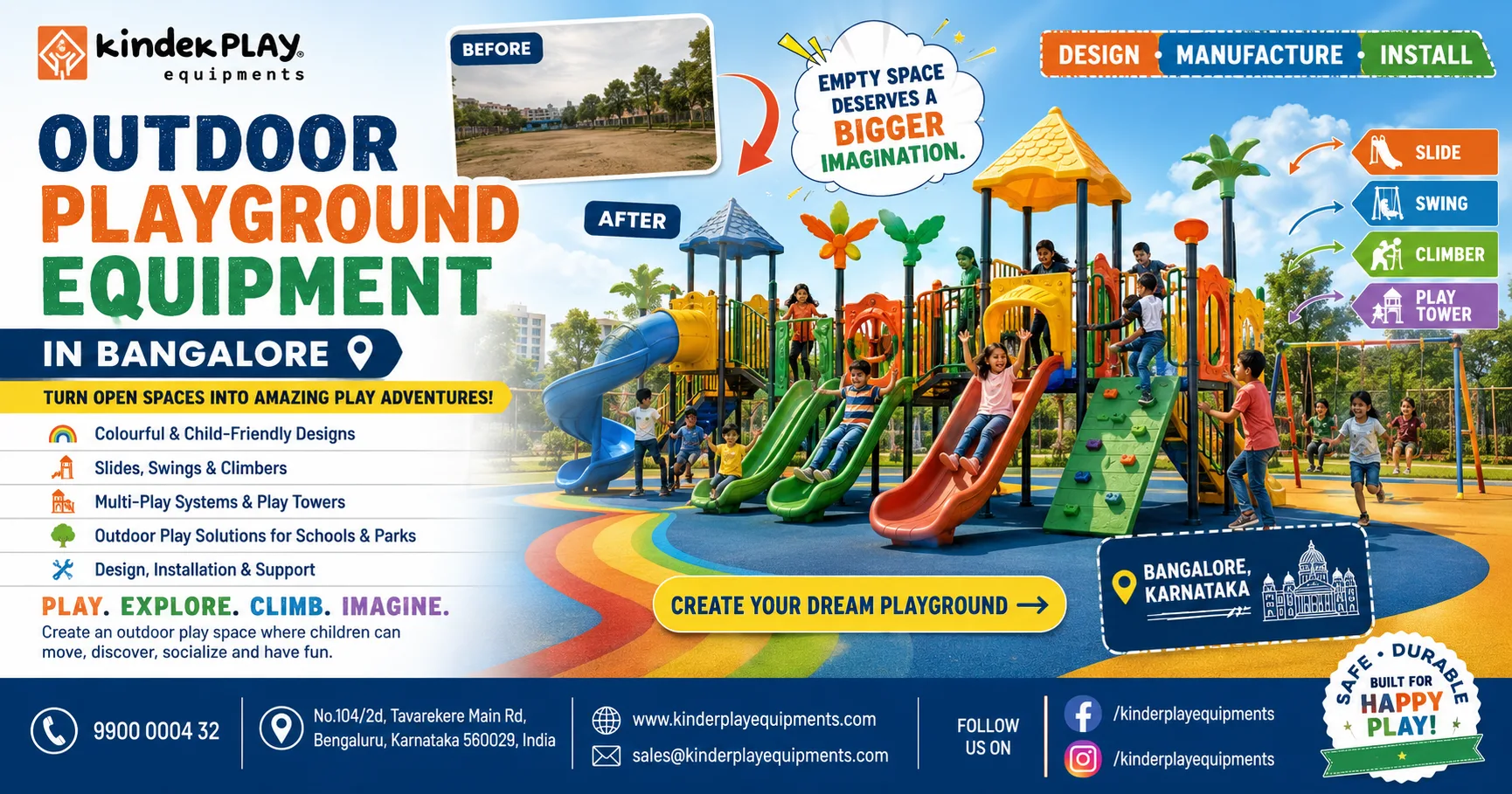
A well-developed outdoor playground can transform an ordinary open area into a place where children can be active, socialise, explore, and enjoy independent play. Schools, preschools, parks, residential communities, and recreational spaces may all have different requirements depending on the children using the area and the available site. When exploring Outdoor Play Equipment in Bangalore, the focus should not be limited to selecting attractive structures. Equipment variety, age suitability, available space, durability, layout, safety, and maintenance all influence the quality and long-term usefulness of an outdoor play environment.
What Makes an Outdoor Playground Stand Out?
A memorable playground usually gives children several reasons to explore it. Different structures can create different experiences, from climbing and balancing to sliding, swinging, and imaginative play.
When evaluating an Outdoor Playground Equipment Manufacturer in Bangalore, organisations can look at the range of activities available and consider whether the equipment can create a balanced play environment rather than simply filling the site with structures.
Equipment Variety Creates More Opportunities
A playground with different activities can appeal to children with different interests and abilities.
Popular outdoor play elements can include:
- Slides
- Swings
- Climbing structures
- Seesaws
- Balancing activities
- Multi-play systems
- Interactive play panels
The appropriate combination depends on the age group, site dimensions, intended usage, and equipment specifications.
Age-Appropriate Play Matters
Young children and older children may require different levels of physical challenge. Equipment should therefore be selected with the intended users in mind.
When planning Outdoor Playground Equipment in Bangalore, schools and other organisations can consider recommended age ranges, equipment dimensions, access points, activity difficulty, and the number of children expected to use the space.
Smart Use of Available Outdoor Space
Not every playground has the same amount of space. A school may have a dedicated play area, while an apartment community may need to work with a smaller shared outdoor space.
A practical layout can help make the available area more functional.
The site plan can consider:
- Equipment footprint
- Movement areas
- Access routes
- Activity zones
- Supervision visibility
- Existing structures
Good planning can help prevent the playground from feeling overcrowded.
Outdoor Play Encourages Movement
One of the major advantages of outdoor playgrounds is the opportunity for children to participate in active movement. Climbing, balancing, swinging, jumping, and sliding can involve coordination, body control, and physical effort.
Because these activities are presented as play, children can engage in movement naturally while having fun.
Playgrounds Also Create Social Spaces
Outdoor play is rarely limited to physical activity. Children often interact with one another while using playground equipment.
They may take turns on a slide, cooperate on a climbing structure, invent games around play equipment, or simply talk while exploring the space.
Multi-play structures can be particularly useful for shared environments because they provide several activities within a connected system.
Durability Is Important Outdoors
Outdoor equipment is exposed to environmental conditions throughout the year. Sunlight, rain, dust, humidity, and repeated use can affect materials and components over time.
When comparing Outdoor Play Equipment Suppliers in Bangalore, organisations can examine construction quality, materials, surface finishing, weather suitability, maintenance requirements, and product specifications.
Safety Is Part of Playground Planning
Safety should be considered from the beginning of the project rather than after equipment has been selected.
Equipment placement, installation, suitable surfacing, spacing, access, supervision, inspection, and maintenance all contribute to the overall environment.
Routine attention can include:
- Checking structural components
- Inspecting connections
- Monitoring moving parts
- Checking play surfaces
- Identifying visible damage
- Following maintenance recommendations
Specific safety requirements depend on the equipment, site, installation, applicable standards, and manufacturer's instructions.
Outdoor Play Area Ideas for Different Locations
The same equipment configuration may not be suitable for every location. A preschool may need a simpler arrangement, while a public park may require equipment designed for heavier and more frequent use.
Schools, residential communities, resorts, parks, and commercial facilities can develop play areas according to their users and site characteristics.
The purpose of the playground should guide the equipment selection rather than following a one-size-fits-all approach.
Choosing Equipment for Long-Term Use
An outdoor play area represents a long-term investment for many organisations. Equipment quality, maintenance requirements, expected usage, and future needs can influence the overall value of the installation.
When researching suppliers and manufacturers, organisations can request information about product specifications, recommended applications, maintenance, available configurations, and suitability for the intended age group.
A well-matched playground can remain useful and engaging when properly maintained.
Contact Details
- Phone: 9900 0004 32
- Email: [email protected]
- Address: No.104/2D, Tavarekere Main Rd, Bengaluru, Karnataka 560029, India
- Location: Bengaluru
- Pincode: 560029
- Website: https://kinderplayequipments.com/index.php
- Facebook: https://www.facebook.com/profile.php?id=61591400145882
- Instagram: https://www.instagram.com/kinderplayequipments/
- GMB: https://share.google/yoAXT3dSDmZmbLhyi
Frequently Asked Questions
What equipment is commonly found in outdoor playgrounds?
Slides, swings, climbing structures, seesaws, balancing equipment, interactive panels, and multi-play systems are commonly used depending on the space and age group.
What should schools consider before developing an outdoor play area?
Schools can consider available space, children's age groups, equipment variety, movement areas, durability, surfacing, supervision, maintenance, and equipment specifications.
Why is outdoor equipment durability important?
Outdoor playground equipment is exposed to weather conditions and repeated use. Appropriate materials, construction, maintenance, and regular inspection can support long-term usability.
Can outdoor playground equipment be used in residential communities?
Yes. Equipment can be selected according to the available space, age groups, expected usage, and requirements of the residential community.
How can an outdoor playground remain interesting?
Providing different activities such as climbing, sliding, swinging, balancing, and interactive play can give children more opportunities to explore and remain engaged.
Conclusion
A standout outdoor playground is not simply the result of installing more equipment. It comes from creating a balanced environment where children can move, explore, interact, and enjoy different forms of play. Equipment variety, age suitability, thoughtful space planning, durability, appropriate safety measures, and regular maintenance all contribute to the success of the play area. Schools, preschools, parks, and residential communities can develop more useful outdoor spaces by matching equipment to their actual requirements. With careful planning and suitable equipment, an open area can become an active and enjoyable destination for children.